


CHAPTER 155
House Bill No. 2029
(Amends Chapters 5, 8, 12, 24, 33, 35, 36, 39, 48, 51, 54, 62, 72, 73, 74, 75, 88, 90, 95, 101, 114, 117, 121, 124, 125, 126, 127, 128, 129, 138, 140 and 150)
An Act reconciling multiple amendments to certain statutes; amending K.S.A. 25-2020, as amended by section 3 of 2026 Senate Bill No. 260, 31-133, as amended by section 6 of 2026 House Bill No. 2534, 38-2232, as amended by section 1 of 2025 House Bill No. 2329, 38-2242, as amended by section 2 of 2025 House Bill No. 2329, 40-3402, as amended by section 2 of 2025 House Bill No. 2068, 65-1119, as amended by section 4 of 2026 House Bill No. 2528, and 71-1414, as amended by section 10 of 2026 Senate Bill No. 260, and K.S.A. 2025 Supp. 8-2110, as amended by section 1 of 2026 House Bill No. 2467, 21-5601, as amended by section 7 of 2026 House Bill No. 2479, 21-6804, as amended by section 4 of 2026 House Bill No. 2413, 22-2802, as amended by section 4 of 2026 House Bill No. 2444, 22-4714, as amended by section 16 of 2026 House Bill No. 2466, 22-4714, as amended by section 5 of this act, 38-2243, as amended by section 3 of 2025 House Bill No. 2329, 65-516, as amended by section 5 of 2026 House Bill No. 2601, 72-3123, as amended by section 3 of 2025 House Bill No. 2320, 72-3262, as amended by section 4 of 2026 House Bill No. 2485, 72-3574, as amended by section 7 of 2026 House Bill No. 2534, 72-5170, as amended by section 7 of 2026 House Bill No. 2299, 72-5178, as amended by section 1 of 2026 House Bill No. 2482, 72-5179, as amended by section 2 of 2026 House Bill No. 2482, 77-421, as amended by section 12 of 2026 Senate Bill No. 459, 79-32,110, 79-32,121 and 82a-955, as amended by section 194 of 2026 House Bill No. 2513, and repealing the existing sections; also repealing K.S.A. 25-2020, as amended by section 4 of 2026 House Bill No. 2733, 31-133, as amended by section 1 of 2026 House Bill No. 2739, 38-2232, as amended by section 9 of 2026 Senate Bill No. 408, 38-2242, as amended by section 10 of 2026 Senate Bill No. 408, 40-3402, as amended by section 1 of 2025 House Bill No. 2223, 40-3402, as amended by section 3 of 2026 House Bill No. 2509, 65-1119, as amended by section 1 of 2026 Senate Bill No. 334, and 71-1414, as amended by section 6 of 2026 House Bill No. 2733, and K.S.A. 2025 Supp. 8-2110, as amended by section 2 of 2025 House Bill No. 2393, 21-5601, as amended by section 2 of 2026 Senate Bill No. 408, 21-6804, as amended by section 2 of 2026 House Bill No. 2444, 21-6804, as amended by section 4 of 2026 House Bill No. 2501, 22-2802, as amended by section 9 of 2026 House Bill No. 2479, 22-4714, as amended by section 1 of 2026 Senate Bill No. 427, 22-4714, as amended by section 2 of 2026 House Bill No. 2702, 38-2243, as amended by section 11 of 2026 Senate Bill No. 408, 65-180a, 65-516, as amended by section 1 of 2026 House Bill No. 2524, 72-3123, as amended by section 4 of 2026 House Bill No. 2618, 72-3123, as amended by section 2 of 2026 Senate Bill No. 382, 72-3262, as amended by section 5 of 2026 House Bill No. 2618, 72-3574, as amended by section 7 of 2026 House Bill No. 2618, 72-5170, as amended by section 9 of 2026 House Bill No. 2618, 72-5178, as amended by section 10 of 2026 House Bill No. 2618, 72-5179, as amended by section 11 of 2026 House Bill No. 2618, 72-5179, as amended by section 3 of 2026 House Bill No. 2485, 77-421, as amended by section 8 of 2026 House Bill No. 2719, 79-32,110b, 79-32,121b and 82a-955, as amended by section 3 of 2026 House Bill No. 2462.
Be it enacted by the Legislature of the State of Kansas:
Section 1. K.S.A. 2025 Supp. 8-2110, as amended by section 1 of 2026 House Bill No. 2467, is hereby amended to read as follows: 8-2110. (a) Failure to comply with a traffic citation means failure either to: (1) Appear before any district or municipal court in response to a traffic citation and pay any fine and court costs imposed as ordered by the court; or (2) otherwise comply with a traffic citation as provided in K.S.A. 8-2118, and amendments thereto. Failure to comply with a traffic citation is a misdemeanor, regardless of the disposition of the charge for which such citation was originally issued.
(b) (1) (A) In addition to penalties of law applicable under subsection (a), when a person fails to comply with a traffic citation, except for any violations provided in subparagraph (C), the district or municipal court in which the person should have complied with the citation shall mail notice to the person that if the person does not appear in district or municipal court or pay fines, court costs and any penalties as ordered by the court within 30 days from the date of mailing notice, the division of vehicles will be notified to suspend the person’s driving privileges unless such person is eligible for restricted driving privileges pursuant to subparagraph (B). If the person is eligible for restricted driving privileges, the division of vehicles shall restrict such person’s driving privileges pursuant to the terms set forth in subparagraph (B). The district or municipal court may charge an additional fee of $5 for mailing such notice. Upon the person’s failure to comply within such 30 days of mailing notice, the district or municipal court shall electronically notify the division of vehicles unless the district or municipal court has determined pursuant to a written order that the person shall fulfill any requirements set forth by the court prior to the suspension. Failure to abide by the terms of the order shall result in the court notifying the division of vehicles that the person’s license shall be suspended for the failure to comply with a traffic citation. Upon receipt of a report of a failure to comply with a traffic citation under this subsection, pursuant to K.S.A. 8-255, and amendments thereto, the division of vehicles shall notify the violator and suspend the license of the violator until satisfactory evidence of substantial compliance with the terms of the traffic citation has been furnished to the informing court unless such person is eligible for restricted driving privileges pursuant to subparagraph (B). If the person is eligible for restricted driving privileges, the division of vehicles shall notify the violator that the person’s driving privileges are restricted pursuant to the terms set forth in subparagraph (B). When the court determines the person is in substantial compliance with the terms of the traffic citation, the court shall immediately electronically notify the division of vehicles of such compliance. Upon receipt of notification of such compliance from the informing court, the division of vehicles shall terminate the restriction, suspension or suspension action.
(B) (i) When restricted driving privileges are approved pursuant to this subsection, the person’s driving privileges shall be restricted to driving only under the following circumstances:
(a) In going to or returning from the person’s place of employment or schooling;
(b) in the course of the person’s employment;
(c) in going to or returning from an appointment with a healthcare provider or during a medical emergency;
(d) in going to and returning from probation or parole meetings, drug or alcohol counseling or any place the person is required to go by a court;
(e) in going to or returning from dropping off or picking up one or more children from school or child care;
(f) in going to or returning from purchasing groceries or fuel for their vehicle; and
(g) in going to or returning from any religious worship service held by a religious organization.
(ii) A person shall not qualify for restricted driving privileges pursuant to this subparagraph if such person has been convicted for driving with a canceled, suspended or revoked license more than three times or if such person is suspended for reasons other than a failure to comply with a traffic citation at the time of application. Restricted driving privileges approved pursuant to this subparagraph shall remain in effect for the lesser of time of either:
(a) 60 days from the date that the division of vehicles mails notice to the person of the restricted driving privileges;
(b) the person enters into an agreement with the court regarding the person’s failure to comply; or
(c) the rescission of the restricted driving privileges by the division of vehicles.
(iii) The division shall rescind restricted driving privileges for any person authorized pursuant to this subparagraph if the person is found guilty of:
(a) A violation resulting in a license suspension, revocation or cancellation for reasons other than failure to comply with a traffic citation; or
(b) operating a motor vehicle in violation of restrictions provided in clause (i) two or more times.
(iv) A person operating a motor vehicle in violation of restrictions provided in clause (i) shall be guilty of operating a vehicle in violation of restrictions as provided in K.S.A. 8-291, and amendments thereto.
(C) (i) Violations of the following sections or violations of substantially similar offenses under a city ordinance shall not provide the basis for a violation of this section: K.S.A. 8-1513, 8-1532, 8-1534, 8-1536, 8-1537, 8-1538, 8-1543, 8-1569, 8-1571, 8-1572, 8-1573, 8-1578, 8-1578a, 8-1583, 8-1585, 8-1586, 8-1588, 8-1589, 8-1590, 8-1591, 8-1592, 8-15,102, 8-15,108, 8-15,113, 8-1744, 21-5607, 21-5810, 21-5815, 21-5816, 21-5817, 21-6203, 41-715, 41-727, 66-1330, 68-2106, 75-4510a and 79-34,112, and amendments thereto.
(ii) The provisions of this subparagraph shall be construed and applied retroactively. A person may petition the district or municipal court in which the person should have complied with the citation that led to a prior violation of this section. If the court determines that the person committed an offense that does not provide the basis for a violation of this section, as amended by this act, the court shall immediately electronically notify the division of vehicles. Upon receipt of such notification from the informing court, the division of vehicles shall terminate any restriction, suspension or suspension action that resulted from the prior violation of this section.
(2) (A) In lieu of suspension under paragraph (1), the driver may submit to the division of vehicles a written request for restricted driving privileges. The driver may apply and be eligible for restricted driving privileges pursuant to this paragraph if such driver has previously been approved for restricted driving privileges pursuant to paragraph (1).
(B) (i) A person whose driving privileges have been revoked solely for driving a motor vehicle on any highway as defined in K.S.A. 8-1424, and amendments thereto, of this state at a time when such person’s privilege to do so was canceled, suspended or revoked for failure to comply with a traffic citation pursuant to this section may submit to the division of vehicles a written request for restricted driving privileges. A person shall not qualify for restricted driving privileges pursuant to this section if such person has been convicted for driving with a canceled, suspended or revoked license more than three times or if such person is suspended for reasons other than a failure to comply with a traffic citation at the time of application. Restricted driving privileges approved pursuant to this subparagraph shall remain in effect unless otherwise rescinded for the lesser of time of either:
(a) The remainder of the period of time that such person’s driving privileges are revoked; or
(b) three years from the date when the restricted driving privileges were approved.
(ii) The division shall rescind restricted driving privileges for any person authorized pursuant to this subparagraph if the person is found guilty of a violation resulting in a license suspension, revocation or cancellation for reasons other than failure to comply with a traffic citation.
(iii) A person operating a motor vehicle in violation of restrictions provided in subparagraph (D) shall be guilty of operating a vehicle in violation of restrictions as provided in K.S.A. 8-291, and amendments thereto.
(C) A person whose driver’s license has expired during the period when such person’s driver’s license has been suspended for failure to pay fines for traffic citations, the driver may submit to the division of vehicles a written request for restricted driving privileges. A person shall not qualify for restricted driving privileges pursuant to this section unless the following conditions are met:
(i) The suspended license that expired was issued by the division of vehicles;
(ii) the suspended license resulted from the individual’s failure to comply with a traffic citation pursuant to subsection (b)(1); and
(iii) the traffic citation that resulted in the failure to comply pursuant to subsection (b)(1) was issued in this state.
(D) Upon review and approval of the driver’s eligibility, the driving privileges will be restricted by the division of vehicles until the terms of the traffic citation have been substantially complied with and the court shall immediately electronically notify the division of vehicles of such compliance. If the driver fails to substantially comply with the traffic citation, the driving privileges will be suspended by the division of vehicles until the court determines the person has substantially complied with the terms of the traffic citation and the court shall immediately electronically notify the division of vehicles of such substantial compliance. Upon receipt of notification of such compliance from the informing court, the division of vehicles shall terminate the suspension action. When restricted driving privileges are approved pursuant to this section, the person’s driving privileges shall be restricted to driving only under the following circumstances:
(i) In going to or returning from the person’s place of employment or schooling;
(ii) in the course of the person’s employment;
(iii) in going to or returning from an appointment with a health care provider or during a medical emergency;
(iv) in going to and returning from probation or parole meetings, drug or alcohol counseling or any place the person is required to go by a court;
(v) in going to or returning from dropping off or picking up one or more children from school or child care;
(vi) in going to or returning from purchasing groceries or fuel for their vehicle; and
(vii) in going to or returning from any religious worship service held by a religious organization.
(c) Except as provided in subsection (d), when the district or municipal court notifies the division of vehicles of a failure to comply with a traffic citation pursuant to subsection (b), the court shall assess a reinstatement fee of $100. Such reinstatement fee shall be in addition to any fine, restricted driving privilege application fee, district or municipal court costs and other penalties. The court shall remit all reinstatement fees to the state treasurer in accordance with the provisions of K.S.A. 75-4215, and amendments thereto. Upon receipt of each such remittance, the state treasurer shall deposit the entire amount in the state treasury and shall credit the first $15 of such reinstatement fee to the state general fund and of the remaining amount, 29.41% of such moneys to the division of vehicles operating fund, 22.06% to the community alcoholism and intoxication programs fund created by K.S.A. 41-1126, and amendments thereto, 7.36% to the juvenile alternatives to detention fund created by K.S.A. 79-4803, and amendments thereto, and 41.17% to the state general fund.
(d) The district court or municipal court shall waive the reinstatement fee provided for in subsection (c), if the failure to comply with a traffic citation was the result of such person enlisting in or being drafted into the armed services of the United States, being called into service as a member of a reserve component of the military service of the United States, or volunteering for such active duty, or being called into service as a member of the state of Kansas national guard, or volunteering for such active duty, and being absent from Kansas because of such military service.
(e) (1) A person who is assessed a reinstatement fee pursuant to subsection (c) may petition the court that assessed the fee at any time to waive payment of the fee, any additional charge imposed pursuant to subsection (f), or any portion thereof. If it appears to the satisfaction of the court that payment of the amount due will impose manifest hardship on the person or the person’s immediate family, the court may waive payment of all or part of the amount due or modify the method of payment.
(2) A person who is assessed a fine or court costs for a traffic citation may petition the court that assessed the fine or costs at any time to waive payment of the fine or costs, or any portion thereof. If it appears to the satisfaction of the court that payment of the amount due will impose manifest hardship on the person or the person’s immediate family, the court may waive payment of all or part of the amount due or modify the method of payment.
(3) The clerk of the district court and the clerk of the municipal court shall make forms available to any person seeking to petition the court to waive or reduce traffic fines, court costs or reinstatement fees.
(f) Except as provided further, the reinstatement fee established in this section shall be the only fee collected or moneys in the nature of a fee collected for such reinstatement. Such fee shall only be established by an act of the legislature and no other authority is established by law or otherwise to collect a fee. On and after July 1, 2019 2026, through June 30, 2025 2030, the supreme court may impose an additional charge, not to exceed $22 per reinstatement fee, to fund the costs of non-judicial personnel.
(g) (1) Prior to issuing an order pursuant to this section that notifies the division of vehicles to restrict or suspend a person’s driving privileges, the court shall consider:
(A) Waiver or reduction of fees, fines and court costs and allowing for payment plans for any fees, fines and court costs; and
(B) alternative requirements in lieu of restriction or suspension of driving privileges, including, but not limited to, alcohol or drug treatment or community service.
(2) Nothing in this subsection shall be construed to require the court to make written findings or written payment plan orders.
(h) (1) Any conviction or sanction for a failure to comply pursuant to this section shall not be considered by the district or municipal court or the division of vehicles in determining suspended or restricted driving privileges if such conviction or sanction is more than five years old.
(2) The provisions of this subsection and the amendments made to this subsection by this act shall be construed and applied retroactively.
(i) As used in this section, “substantial compliance” or “substantially complied” means the person has followed the orders of the court involving payments of fines, court costs and any penalties and has not failed substantially in making payments or satisfying the terms of the court order.
Sec. 2. K.S.A. 2025 Supp. 21-5601, as amended by section 7 of 2026 House Bill No. 2479, is hereby amended to read as follows: 21-5601. (a) Endangering a child is knowingly and unreasonably causing or permitting a child under 18 years of age to be placed in a situation in which the child’s life, body or health may be endangered.
(b) Aggravated endangering a child is:
(1) Recklessly causing or permitting a child under 18 years of age to be placed in a situation in which the child’s life, body or health is endangered;
(2) causing or permitting such child to be in an environment where the person knows or reasonably should know that any person is distributing, possessing with intent to distribute, manufacturing or attempting to manufacture any methamphetamine or any fentanyl-related controlled substance; or
(3) causing or permitting such child to be in an environment where the person knows or reasonably should know that:
(A) Drug paraphernalia or volatile, toxic or flammable chemicals are stored or used for the purpose of manufacturing or attempting to manufacture any methamphetamine; or
(B) drug paraphernalia or toxic materials, compounds or mixtures are stored or used for the purpose of manufacturing or attempting to manufacture any fentanyl-related controlled substance.
(c) (1) Endangering a child is a:
(A) Class A person misdemeanor if the child is at least six years of age but less than 18 years of age; and
(B) severity level 9, person felony if the child is less than six years of age.
(2) Except as provided in subsection (c)(3), aggravated endangering a child is a:
(A) Severity level 9, person felony if the child is at least six years of age but less than 18 years of age; and
(B) severity level 8, person felony if the child is less than six years of age.
(3) Aggravated endangering a child when bodily harm is inflicted upon the child is a:
(A) Severity level 6, person felony if the child is at least six years of age but less than 18 years of age; and
(B) severity level 5, person felony if the child is less than six years of age.
(4) The sentence for a violation of aggravated endangering a child shall be served consecutively to any other term or terms of imprisonment imposed. Such sentence shall not be considered a departure and shall not be subject to appeal.
(d) Nothing in subsection (a) shall be construed to mean a child is endangered for the sole reason that the child’s parent or guardian,:
(1) In good faith, selects and depends upon spiritual means alone through prayer, in accordance with the tenets and practice of a recognized church or religious denomination, for the treatment or cure of disease or remedial care of such child; or
(2) permits or fails to prohibit a child from engaging in independent activity as described in K.S.A. 38-2202, and amendments thereto, unless such parent or guardian has knowingly or recklessly disregarded an obvious danger to the child given the child’s age, maturity and physical or mental abilities.
(e) As used in this section:
(1) “Drug paraphernalia,” “fentanyl-related controlled substance” and “manufacture” mean the same as defined in K.S.A. 21-5701, and amendments thereto; and
(2) “methamphetamine” means any substance designated in K.S.A. 65-4107(d)(3) or (f)(1), and amendments thereto, or any analog thereof.
Sec. 3. K.S.A. 2025 Supp. 21-6804, as amended by section 4 of 2026 House Bill No. 2413, is hereby amended to read as follows: 21-6804. (a) The provisions of this section shall be applicable to the sentencing guidelines grid for nondrug crimes. The following sentencing guidelines grid shall be applicable to nondrug felony crimes:
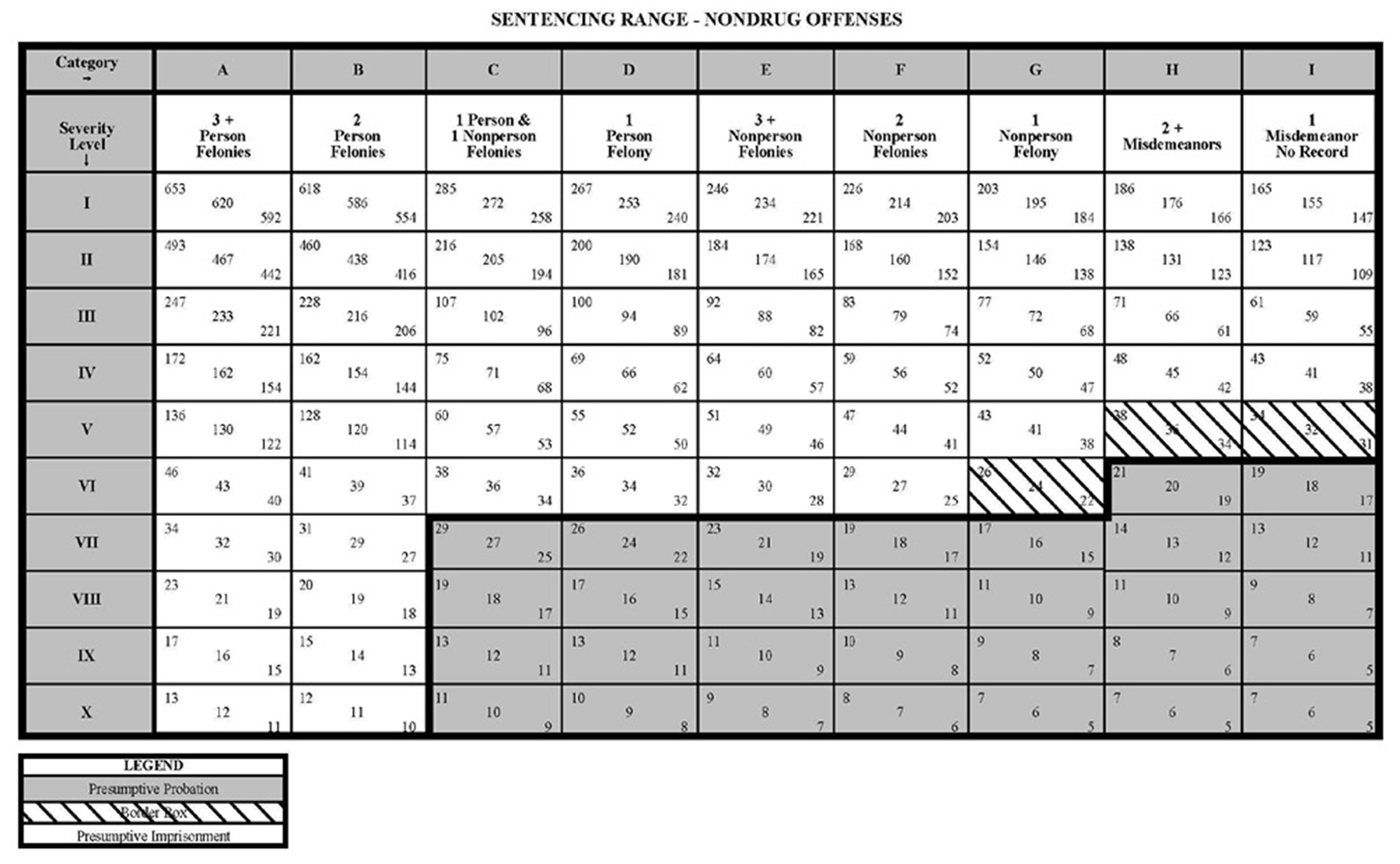
(b) Sentences expressed in the sentencing guidelines grid for nondrug crimes represent months of imprisonment.
(c) The sentencing guidelines grid is a two-dimensional crime severity and criminal history classification tool. The grid’s vertical axis is the crime severity scale which classifies current crimes of conviction. The grid’s horizontal axis is the criminal history scale which classifies criminal histories.
(d) The sentencing guidelines grid for nondrug crimes as provided in this section defines presumptive punishments for felony convictions, subject to the sentencing court’s discretion to enter a departure sentence. The appropriate punishment for a felony conviction should depend on the severity of the crime of conviction when compared to all other crimes and the offender’s criminal history.
(e) (1) The sentencing court has discretion to sentence at any place within the sentencing range. In the usual case it is recommended that the sentencing judge select the center of the range and reserve the upper and lower limits for aggravating and mitigating factors insufficient to warrant a departure.
(2) In presumptive imprisonment cases, the sentencing court shall pronounce the complete sentence which shall include the:
(A) Prison sentence;
(B) maximum potential reduction to such sentence as a result of good time; and
(C) period of postrelease supervision at the sentencing hearing. Failure to pronounce the period of postrelease supervision shall not negate the existence of such period of postrelease supervision.
(3) In presumptive nonprison cases, the sentencing court shall pronounce the:
(A) Prison sentence; and
(B) duration of the nonprison sanction at the sentencing hearing.
(f) Each grid block states the presumptive sentencing range for an offender whose crime of conviction and criminal history place such offender in that grid block. If an offense is classified in a grid block below the dispositional line, the presumptive disposition shall be nonimprisonment. If an offense is classified in a grid block above the dispositional line, the presumptive disposition shall be imprisonment. If an offense is classified in grid blocks 5-H, 5-I or 6-G, the court may impose an optional nonprison sentence as provided in subsection (q).
(g) The sentence for a violation of K.S.A. 21-3415, prior to its repeal, aggravated battery against a law enforcement officer committed prior to July 1, 2006, or a violation of K.S.A. 21-5412(d), and amendments thereto, aggravated assault against a law enforcement officer, which places the defendant’s sentence in grid block 6-H or 6-I shall be presumed imprisonment. The court may impose an optional nonprison sentence as provided in subsection (q).
(h) (1) When a firearm is used to commit any person felony, the offender’s sentence shall be presumed imprisonment. The court may impose an optional nonprison sentence as provided in subsection (q).
(2) When a firearm is used to commit any nonperson felony, the offender’s sentence shall be one severity level above the appropriate level for such offense if the trier of fact makes a finding beyond a reasonable doubt that such firearm was:
(A) Equipped with a device designed to suppress the report of the firearm; or
(B) a shotgun equipped with a forend and having a barrel less than 18 inches in length.
(3) The sentence imposed pursuant to this subsection shall not be considered a departure and shall not be subject to appeal.
(i) (1) The sentence for the violation of the felony provision of K.S.A. 21-5414(c)(1)(C), 21-5823(b)(3) and (b)(4), 21-6412 and 21-6416, and amendments thereto, shall be as provided by the specific mandatory sentencing requirements of that section and shall not be subject to the provisions of this section or K.S.A. 21-6807, and amendments thereto.
(2) If because of the offender’s criminal history classification the offender is subject to presumptive imprisonment or if the judge departs from a presumptive probation sentence and the offender is subject to imprisonment, the provisions of this section and K.S.A. 21-6807, and amendments thereto, shall apply and the offender shall not be subject to the mandatory sentence as provided in K.S.A. 21-5823, and amendments thereto.
(3) Notwithstanding the provisions of any other section, the term of imprisonment imposed for the violation of the felony provision of K.S.A. 21-5414(c)(1)(C), 21-5823(b)(3) and (b)(4), 21-6412 and 21-6416, and amendments thereto, shall not be served in a state facility in the custody of the secretary of corrections. Prior to imposing any sentence pursuant to this subsection, the court may consider assigning the defendant to a house arrest program pursuant to K.S.A. 21-6609, and amendments thereto.
(j) (1) The sentence for any persistent sex offender whose current convicted crime carries a presumptive term of imprisonment shall be double the maximum duration of the presumptive imprisonment term. The sentence for any persistent sex offender whose current conviction carries a presumptive nonprison term shall be presumed imprisonment and shall be double the maximum duration of the presumptive imprisonment term.
(2) Except as otherwise provided in this subsection, as used in this subsection, “persistent sex offender” means a person who:
(A) (i) Has been convicted in this state of a sexually violent crime, as defined in K.S.A. 22-3717, and amendments thereto; and
(ii) at the time of the conviction under clause (i) has at least one conviction for a sexually violent crime, as defined in K.S.A. 22-3717, and amendments thereto, in this state or comparable felony under the laws of another state, the federal government or a foreign government; or
(B) (i) has been convicted of rape, as defined in K.S.A. 21-3502, prior to its repeal, or K.S.A. 21-5503, and amendments thereto; and
(ii) at the time of the conviction under clause (i) has at least one conviction for rape in this state or comparable felony under the laws of another state, the federal government or a foreign government.
(3) Except as provided in subsection (j)(2)(B), the provisions of this subsection shall not apply to any person whose current convicted crime is a severity level 1 or 2 felony.
(k) (1) If it is shown at sentencing that the offender committed any felony violation for the benefit of, at the direction of, or in association with any criminal street gang, with the specific intent to promote, further or assist in any criminal conduct by gang members, the offender’s sentence shall be presumed imprisonment. The court may impose an optional nonprison sentence as provided in subsection (q).
(2) As used in this subsection, “criminal street gang” means any organization, association or group of three or more persons, whether formal or informal, having as one of its primary activities:
(A) The commission of one or more person felonies; or
(B) the commission of felony violations of article 57 of chapter 21 of the Kansas Statutes Annotated, and amendments thereto, K.S.A. 2010 Supp. 21-36a01 through 21-36a17, prior to their transfer, or any felony violation of any provision of the uniform controlled substances act prior to July 1, 2009; and
(C) its members have a common name or common identifying sign or symbol; and
(D) its members, individually or collectively, engage in or have engaged in the commission, attempted commission, conspiracy to commit or solicitation of two or more person felonies or felony violations of article 57 of chapter 21 of the Kansas Statutes Annotated, and amendments thereto, K.S.A. 2010 Supp. 21-36a01 through 21-36a17, prior to their transfer, any felony violation of any provision of the uniform controlled substances act prior to July 1, 2009, or any substantially similar offense from another jurisdiction.
(l) Except as provided in subsection (o), the sentence for a violation of K.S.A. 21-5807(a)(1), and amendments thereto, or any attempt or conspiracy, as defined in K.S.A. 21-5301 and 21-5302, and amendments thereto, to commit such offense, when such person being sentenced has a prior conviction for a violation of K.S.A. 21-3715(a) or (b), prior to its repeal, 21-3716, prior to its repeal, K.S.A. 21-5807(a)(1) or (a)(2) or 21-5807(b), and amendments thereto, or any attempt or conspiracy to commit such offense, shall be presumptive imprisonment.
(m) The sentence for a violation of K.S.A. 22-4903 or K.S.A. 21-5913(a)(2), and amendments thereto, shall be presumptive imprisonment. If an offense under such sections is classified in grid blocks 5-E, 5-F, 5-G, 5-H or 5-I, the court may impose an optional nonprison sentence as provided in subsection (q).
(n) The sentence for a violation of criminal deprivation of property, as defined in K.S.A. 21-5803, and amendments thereto, when such property is a motor vehicle, and when such person being sentenced has any combination of two or more prior convictions of K.S.A. 21-3705(b), prior to its repeal, or of criminal deprivation of property, as defined in K.S.A. 21-5803, and amendments thereto, when such property is a motor vehicle, shall be presumptive imprisonment. Such sentence shall not be considered a departure and shall not be subject to appeal.
(o) (1) The sentence for a felony violation of theft of property as defined in K.S.A. 21-5801, and amendments thereto, or burglary as defined in K.S.A. 21-5807(a), and amendments thereto, when such person being sentenced has no prior convictions for a violation of K.S.A. 21-3701 or 21-3715, prior to their repeal, or theft of property as defined in K.S.A. 21-5801, and amendments thereto, or burglary as defined in K.S.A. 21-5807(a), and amendments thereto; or the sentence for a felony violation of theft of property as defined in K.S.A. 21-5801, and amendments thereto, when such person being sentenced has one or two prior felony convictions for a violation of K.S.A. 21-3701, 21-3715 or 21-3716, prior to their repeal, or theft of property as defined in K.S.A. 21-5801, and amendments thereto, or burglary or aggravated burglary as defined in K.S.A. 21-5807, and amendments thereto; or the sentence for a felony violation of burglary as defined in K.S.A. 21-5807(a), and amendments thereto, when such person being sentenced has one prior felony conviction for a violation of K.S.A. 21-3701, 21-3715 or 21-3716, prior to their repeal, or theft of property as defined in K.S.A. 21-5801, and amendments thereto, or burglary or aggravated burglary as defined in K.S.A. 21-5807, and amendments thereto, shall be the sentence as provided by this section, except that the court may order an optional nonprison sentence for a defendant to participate in a drug treatment program, including, but not limited to, an approved aftercare plan, if the court makes the following findings on the record:
(A) Substance abuse was an underlying factor in the commission of the crime;
(B) substance abuse treatment in the community is likely to be more effective than a prison term in reducing the risk of offender recidivism; and
(C) participation in an intensive substance abuse treatment program will serve community safety interests.
(2) A defendant sentenced to an optional nonprison sentence under this subsection shall be supervised by community correctional services. The provisions of K.S.A. 21-6824(f)(1), and amendments thereto, shall apply to a defendant sentenced under this subsection. The sentence under this subsection shall not be considered a departure and shall not be subject to appeal.
(p) (1) The sentence for a felony violation of theft of property as defined in K.S.A. 21-5801, and amendments thereto, when such person being sentenced has any combination of three or more prior felony convictions for violations of K.S.A. 21-3701, 21-3715 or 21-3716, prior to their repeal, or theft of property as defined in K.S.A. 21-5801, and amendments thereto, or burglary or aggravated burglary as defined in K.S.A. 21-5807, and amendments thereto; or the sentence for a violation of burglary as defined in K.S.A. 21-5807(a), and amendments thereto, when such person being sentenced has any combination of two or more prior convictions for violations of K.S.A. 21-3701, 21-3715 and 21-3716, prior to their repeal, or theft of property as defined in K.S.A. 21-5801, and amendments thereto, or burglary or aggravated burglary as defined in K.S.A. 21-5807, and amendments thereto, shall be presumed imprisonment and the defendant shall be sentenced to prison as provided by this section, except that the court may recommend that an offender be placed in the custody of the secretary of corrections, in a facility designated by the secretary to participate in an intensive substance abuse treatment program, upon making the following findings on the record:
(A) Substance abuse was an underlying factor in the commission of the crime;
(B) substance abuse treatment with a possibility of an early release from imprisonment is likely to be more effective than a prison term in reducing the risk of offender recidivism; and
(C) participation in an intensive substance abuse treatment program with the possibility of an early release from imprisonment will serve community safety interests by promoting offender reformation.
(2) The intensive substance abuse treatment program shall be determined by the secretary of corrections, but shall be for a period of at least four months. Upon the successful completion of such intensive treatment program, the offender shall be returned to the court and the court may modify the sentence by directing that a less severe penalty be imposed in lieu of that originally adjudged within statutory limits. If the offender’s term of imprisonment expires, the offender shall be placed under the applicable period of postrelease supervision. The sentence under this subsection shall not be considered a departure and shall not be subject to appeal.
(q) (1) As used in this section, an “optional nonprison sentence” is a sentence which the court may impose, in lieu of the presumptive sentence, upon making the following findings on the record:
(A) An appropriate treatment program exists which is likely to be more effective than the presumptive prison term in reducing the risk of offender recidivism; and
(B) the recommended treatment program is available and the offender can be admitted to such program within a reasonable period of time; or
(C) the nonprison sanction will serve community safety interests by promoting offender reformation.
(2) Any decision made by the court regarding the imposition of an optional nonprison sentence shall not be considered a departure and shall not be subject to appeal.
(r) The sentence for a violation of K.S.A. 21-5413(c)(2), and amendments thereto, shall be presumptive imprisonment and shall be served consecutively to any other term or terms of imprisonment imposed. Such sentence shall not be considered a departure and shall not be subject to appeal.
(s) The sentence for a violation of K.S.A. 21-5512, and amendments thereto, shall be presumptive imprisonment. Such sentence shall not be considered a departure and shall not be subject to appeal.
(t) (1) If the trier of fact makes a finding beyond a reasonable doubt that an offender wore or used ballistic resistant material in the commission of, or attempt to commit, or flight from any felony, in addition to the sentence imposed pursuant to the Kansas sentencing guidelines act, the offender shall be sentenced to an additional 30 months’ imprisonment.
(2) The sentence imposed pursuant to paragraph (1) shall be presumptive imprisonment and shall be served consecutively to any other term or terms of imprisonment imposed. Such sentence shall not be considered a departure and shall not be subject to appeal.
(3) As used in this subsection, “ballistic resistant material” means any:
(A) Commercially produced material designed with the purpose of providing ballistic and trauma protection, including, but not limited to, bulletproof vests and kevlar vests; and
(B) homemade or fabricated substance or item designed with the purpose of providing ballistic and trauma protection.
(u) The sentence for a violation of K.S.A. 21-6107, and amendments thereto, or any attempt or conspiracy, as defined in K.S.A. 21-5301 and 21-5302, and amendments thereto, to commit such offense, when such person being sentenced has a prior conviction for a violation of K.S.A. 21-4018, prior to its repeal, or K.S.A. 21-6107, and amendments thereto, or any attempt or conspiracy to commit such offense, shall be presumptive imprisonment. Such sentence shall not be considered a departure and shall not be subject to appeal.
(v) The sentence for a third or subsequent violation of K.S.A. 8-1568, and amendments thereto, shall be presumptive imprisonment and shall be served consecutively to any other term or terms of imprisonment imposed. Such sentence shall not be considered a departure and shall not be subject to appeal.
(w) The sentence for aggravated criminal damage to property as defined in K.S.A. 21-5813(b), and amendments thereto, when such person being sentenced has a prior conviction for any nonperson felony shall be presumptive imprisonment. Such sentence shall not be considered a departure and shall not be subject to appeal.
(x) The sentence for a violation of K.S.A. 21-5807(a)(1), and amendments thereto, shall be presumptive imprisonment if the offense under such paragraph is classified in grid blocks 7-C, 7-D or 7-E. Such sentence shall not be considered a departure and shall not be subject to appeal.
(y) (1) Except as provided in paragraph (3), if the trier of fact makes a finding beyond a reasonable doubt that an offender committed a nondrug felony offense, or any attempt or conspiracy, as defined in K.S.A. 21-5301 and 21-5302, and amendments thereto, to commit a nondrug felony offense, against a law enforcement officer, as defined in K.S.A. 21-5111(p)(1) and (3), and amendments thereto, while such officer was engaged in the performance of such officer’s duty, or in whole or in any part because of such officer’s status as a law enforcement officer, the sentence for such offense shall be:
(A) If such offense is classified in severity level 2 through 10, one severity level above the appropriate level for such offense; and
(B) (i) if such offense is classified in severity level 1, except as otherwise provided in clause (ii), imprisonment for life, and such offender shall not be eligible for probation or suspension, modification or reduction of sentence. In addition, such offender shall not be eligible for parole prior to serving 25 years’ imprisonment, and such 25 years’ imprisonment shall not be reduced by the application of good time credits. No other sentence shall be permitted.
(ii) The provisions of clause (i) requiring the court to impose a mandatory minimum term of imprisonment of 25 years shall not apply if the court finds the offender, because of the offender’s criminal history classification, is subject to presumptive imprisonment and the sentencing range exceeds 300 months. In such case, the offender is required to serve a mandatory minimum term equal to the sentence established pursuant to the sentencing range.
(2) The sentence imposed pursuant to paragraph (1) shall not be considered a departure and shall not be subject to appeal.
(3) The provisions of this subsection shall not apply to an offense described in paragraph (1) if the factual aspect concerning a law enforcement officer is a statutory element of such offense.
(z) (1) Notwithstanding K.S.A. 21-5109(b)(2), and amendments thereto, or any other provision of law to the contrary, the sentence for a violation of criminal possession of a weapon by a convicted felon as defined in K.S.A. 21-6304, and amendments thereto, shall be presumptive imprisonment and shall be served consecutively to any other term or terms of imprisonment imposed if the trier of fact makes a finding beyond a reasonable doubt that:
(A) The weapon the offender possessed during such violation was a firearm; and
(B) such firearm was used by the offender during the commission of any violent felony.
(2) The sentence imposed pursuant to paragraph (1) shall not be considered a departure and shall not be subject to appeal. No other sentence shall be permitted.
(3) The provisions of this subsection shall not apply to an offender who is prohibited from possessing a weapon pursuant to K.S.A. 21-6304, and amendments thereto, as a result of a juvenile adjudication.
(4) As used in this subsection, “violent felony” means any of the following:
(A) Capital murder, as defined in K.S.A. 21-5401, and amendments thereto;
(B) murder in the first degree, as defined in K.S.A. 21-5402, and amendments thereto;
(C) murder in the second degree, as defined in K.S.A. 21-5403, and amendments thereto;
(D) voluntary manslaughter, as defined in K.S.A. 21-5404, and amendments thereto;
(E) kidnapping, as defined in K.S.A. 21-5408(a)(1), and amendments thereto, or aggravated kidnapping, as defined in K.S.A. 21-5408(b), and amendments thereto;
(F) aggravated assault, as defined in K.S.A. 21-5412(b)(1), and amendments thereto, and aggravated assault of a law enforcement officer, as defined in K.S.A. 21-5412(d)(1), and amendments thereto;
(G) aggravated battery, as defined in K.S.A. 21-5413(b)(1)(A) or (b)(1)(B), and amendments thereto, and aggravated battery against a law enforcement officer, as defined in K.S.A. 21-5413(d)(1) or (d)(2), and amendments thereto;
(H) mistreatment of a dependent adult or mistreatment of an elder person, as defined in K.S.A. 21-5417(a)(1), and amendments thereto;
(I) rape, as defined in K.S.A. 21-5503, and amendments thereto;
(J) aggravated criminal sodomy, as defined in K.S.A. 21-5504(b), and amendments thereto;
(K) abuse of a child, as defined in K.S.A. 21-5602(a)(1) or (a)(3), and amendments thereto;
(L) any felony offense described in K.S.A. 21-5703 or 21-5705, and amendments thereto;
(M) treason, as defined in K.S.A. 21-5901, and amendments thereto;
(N) criminal discharge of a firearm, as defined in K.S.A. 21-6308(a)(1), and amendments thereto;
(O) fleeing or attempting to elude a police officer, as defined in K.S.A. 8-1568(b), and amendments thereto;
(P) any felony that includes the domestic violence designation pursuant to K.S.A. 22-4616, and amendments thereto; or
(Q) any attempt, conspiracy or criminal solicitation, as defined in K.S.A. 21-5301, 21-5302 and 21-5303, and amendments thereto, of any felony offense defined in this subsection.
(aa) (1) The sentence for a violation of K.S.A. 21-6308(a)(1)(A) or (a)(1)(B), and amendments thereto, if the trier of fact makes a finding beyond a reasonable doubt that the offender discharged a firearm and that the offender knew or reasonably should have known that:
(A) A person was present in the dwelling, building, structure or motor vehicle at which the offender discharged a firearm, shall be presumptive imprisonment and, in addition to the sentence imposed pursuant to the Kansas sentencing guidelines act, the offender shall be sentenced to an additional 60 months of imprisonment; and
(B) a person less than 14 years of age was present in the dwelling, building, structure or motor vehicle at which the offender discharged a firearm, shall be presumptive imprisonment and, in addition to the sentence imposed pursuant to the Kansas sentencing guidelines act, the offender shall be sentenced to an additional 120 months of imprisonment.
(2) The sentence imposed pursuant to paragraph (1) shall be served consecutively to any other term or terms of imprisonment imposed. Such sentence shall not be considered a departure and shall not be subject to appeal.
(bb) (1) If the trier of fact makes a finding beyond a reasonable doubt that an offender committed any act described in K.S.A. 21-5408, 21-5409, 21-5411, 21-5412, 21-5413, 21-5414, 21-5415, 21-5426, 21-5427, 21-5428, 21-5429, 21-5503, 21-5504, 21-5505, 21-5506, 21-5507, 21-5508, 21-5509, 21-5510, 21-5515, 21-5601, 21-5602, 21-5604 or 21-5605, and amendments thereto, or any attempt or conspiracy as defined in K.S.A. 21-5301 and 21-5302, and amendments thereto, to commit any such act with knowledge that a woman is pregnant and with the intent that such act will compel such woman to obtain an abortion when such woman has expressed her desire to not obtain an abortion, the sentence for such offense shall be:
(A) If such offense is classified in severity level 2 through 10, one severity level above the appropriate level for such offense; and
(B) (i) if such offense is classified in severity level 1, except as otherwise provided in clause (ii), imprisonment for life, and such offender shall not be eligible for probation or suspension, modification or reduction of sentence. In addition, such offender shall not be eligible for parole prior to serving 25 years’ imprisonment, and such 25 years’ imprisonment shall not be reduced by the application of good time credits. No other sentence shall be permitted.
(ii) The provisions of clause (i) requiring the court to impose a mandatory minimum term of imprisonment of 25 years shall not apply if the court finds the offender, because of the offender’s criminal history classification, is subject to presumptive imprisonment and the sentencing range exceeds 300 months. In such case, the offender is required to serve a mandatory minimum term equal to the sentence established pursuant to the sentencing range.
(2) The sentence imposed pursuant to paragraph (1) shall not be considered a departure and shall not be subject to appeal.
(cc) (1) If the trier of fact makes a finding beyond a reasonable doubt that an offender committed any offense or any attempt or conspiracy as defined in K.S.A. 21-5301 and 21-5302, and amendments thereto, to commit any offense with the intent to commit transnational repression as described in section 1(d) of 2026 House Bill No. 2413, and amendments thereto, the sentence for such offense shall be:
(A) If such offense is classified in severity level 2 through 10, one severity level above the appropriate level for such offense; and
(B) (i) if such offense is classified in severity level 1, except as otherwise provided in clause (ii), imprisonment for life, and such offender shall not be eligible for probation or suspension, modification or reduction of sentence. In addition, such offender shall not be eligible for parole prior to serving 25 years’ imprisonment, and such 25 years’ imprisonment shall not be reduced by the application of good time credits. No other sentence shall be permitted.
(ii) The provisions of clause (i) requiring the court to impose a mandatory minimum term of imprisonment of 25 years shall not apply if the court finds the offender, because of the offender’s criminal history classification, is subject to presumptive imprisonment and the sentencing range exceeds 300 months. In such case, the offender is required to serve a mandatory minimum term equal to the sentence established pursuant to the sentencing range.
(2) The sentence imposed pursuant to paragraph (1) shall not be considered a departure and shall not be subject to appeal.
(dd) The sentence for a felony offense committed while an offender was in custody for a prior nondrug felony or on probation, assignment to a community correctional services program, under suspended sentence or on parole or postrelease supervision for a prior nondrug felony and when such offender’s criminal history score is A, B, C, D or E shall be presumptive imprisonment regardless of the grid block for such current felony. A sentence imposed pursuant to this subsection shall be served consecutively to any other term or terms of imprisonment imposed in the prior nondrug felony case in which the offender was on probation, assignment to a community correctional services program, under suspended sentence or on parole or postrelease supervision. Such sentence shall not be considered a departure and shall not be subject to appeal.
Sec. 4. K.S.A. 2025 Supp. 22-2802, as amended by section 4 of 2026 House Bill No. 2444, is hereby amended to read as follows: 22-2802. (a) Any person charged with a crime shall, at the person’s first appearance before a magistrate, be ordered released pending preliminary examination or trial upon the execution of an appearance bond in an amount specified by the magistrate and sufficient to assure the appearance of such person before the magistrate when ordered and to assure the public safety. If the person is being bound over for a felony, the bond shall also be conditioned on the person’s appearance in the district court or by way of a two-way electronic audio-video communication as provided in subsection (n) at the time required by the court to answer the charge against such person and at any time thereafter that the court requires. Unless the magistrate makes a specific finding otherwise, if the person is being bonded out for a person felony or a person misdemeanor, the bond shall be conditioned on the person being prohibited from having any contact with the alleged victim of such offense for a period of at least 72 hours. The magistrate may impose such of the following additional conditions of release as will reasonably assure the appearance of the person for preliminary examination or trial:
(1) Place the person in the custody of a designated person or organization agreeing to supervise such person;
(2) place restrictions on the travel, association or place of abode of the person during the period of release;
(3) impose any other condition deemed reasonably necessary to assure appearance as required, including a condition requiring that the person return to custody during specified hours;
(4) place the person under a house arrest program pursuant to K.S.A. 21-6609, and amendments thereto; or
(5) place the person under the supervision of a court services officer responsible for monitoring the person’s compliance with any conditions of release ordered by the magistrate. The magistrate may order the person to pay for any costs associated with the supervision provided by the court services department in an amount not to exceed $15 per week of such supervision. The magistrate may also order the person to pay for all other costs associated with the supervision and conditions for compliance in addition to the $15 per week.
(b) In addition to any conditions of release provided in subsection (a), for any person charged with:
(1) A felony, the magistrate may order such person to submit to a drug and alcohol abuse examination and evaluation in a public or private treatment facility or state institution and, if determined by the head of such facility or institution that such person is a drug or alcohol abuser or is incapacitated by drugs or alcohol, to submit to treatment for such drug or alcohol abuse, as a condition of release; and
(2) a domestic violence offense, as defined in K.S.A. 21-5111, and amendments thereto, domestic battery or aggravated domestic battery, as described in K.S.A. 21-5414, and amendments thereto, stalking, as described in K.S.A. 21-5427, and amendments thereto, or violation of a protective order as described in K.S.A. 21-5924, and amendments thereto, the magistrate shall consider ordering electronic monitoring of the person with victim notification pursuant to section 1 of 2026 House Bill No. 2479, and amendments thereto, as a condition of release.
(c) (1) If a person is charged with a misdemeanor, the appearance bond shall be executed with sufficient solvent sureties who are residents of the state of Kansas unless the magistrate determines, in the exercise of such magistrate’s discretion, that requiring sureties is not necessary to assure the appearance of the person at the time ordered or to assure public safety. If such person is not a citizen of the United States, such person’s immigration status shall be verified with the federal government pursuant to 8 U.S.C. § 1373(e). There shall be a rebuttable presumption that a person who has been determined to be an alien unlawfully present in the United States is a flight risk.
(2) (A) If a person is charged with a felony, the appearance bond shall be executed with sufficient solvent sureties who are residents of the state of Kansas unless the magistrate determines by clear and convincing evidence, after a hearing at which the person charged is present, that requiring sureties is not necessary to assure the appearance of the person at the time ordered or to assure public safety.
(B) Prior to releasing a person charged with a felony without a surety, the magistrate shall determine, after a hearing at which the person is present, whether the person meets the following qualifications:
(i) Is a citizen of the United States or is an alien who is lawfully present in the United States and whose status has been verified with the federal government pursuant to 8 U.S.C. § 1373(e);
(ii) is a resident of the state of Kansas;
(iii) has no prior felony conviction;
(iv) has no prior history of failure to appear for any court appearances;
(v) has no detainer or hold from any other jurisdiction;
(vi) has not been extradited from and is not awaiting extradition to another state;
(vii) has not been detained for an alleged violation of probation;
(viii) has not been charged with a felony violation of K.S.A. 8-1567, and amendments thereto; and
(ix) has not been charged with an off-grid felony, a person felony or a drug severity level 1, 2 or 3 felony.
(C) If the magistrate determines that the person does not meet one or more of the qualifications listed in subparagraph (B), there is a presumption that such person is either a flight risk or that such person’s release would endanger the public. Such presumption may only be overcome by clear and convincing evidence. Prior to ordering a release of such person without a surety, the magistrate shall make a written finding on the record that such person is not a public safety risk and not a flight risk and specify which of the qualifications listed in subparagraph (B) that such person meets.
(d) A deposit of cash in the amount of the bond may be made in lieu of the execution of the bond pursuant to subsection (c). Except as provided in subsection (e), such deposit shall be in the full amount of the bond and in no event shall a deposit of cash in less than the full amount of bond be permitted. Any person charged with a crime who is released on a cash bond shall be entitled to a refund of all moneys paid for the cash bond, after deduction of any outstanding restitution, costs, fines and fees, after the final disposition of the criminal case if the person complies with all requirements to appear in court. The court may not exclude the option of posting bond pursuant to subsection (c).
(e) Except as provided further, the amount of the appearance bond shall be the same whether executed as described in subsection (c) or posted with a deposit of cash as described in subsection (d). When the appearance bond has been set at $2,500 or less and the most serious charge against the person is a misdemeanor, a severity level 8, 9 or 10 nonperson felony, a drug severity level 4 felony committed prior to July 1, 2012, a drug severity level 5 felony committed on or after July 1, 2012, or a violation of K.S.A. 8-1567, and amendments thereto, the magistrate may allow the person to deposit cash with the clerk in the amount of 10% of the bond, provided the person meets at least the following qualifications:
(1) Is a citizen of the United States or is an alien who is lawfully present in the United States and whose status has been verified with the federal government pursuant to 8 U.S.C. § 1373(e);
(2) is a resident of the state of Kansas;
(3) has a criminal history score category of G, H or I;
(4) has no prior history of failure to appear for any court appearances;
(5) has no detainer or hold from any other jurisdiction;
(6) has not been extradited from, and is not awaiting extradition to, another state; and
(7) has not been detained for an alleged violation of probation.
(f) Except as provided in subsections (c) and (q), in the discretion of the court, a person charged with a crime may be released upon the person’s own recognizance by guaranteeing payment of the amount of the bond for the person’s failure to comply with all requirements to appear in court. The release of a person charged with a crime upon the person’s own recognizance shall not require the deposit of any cash by the person.
(g) The court shall not impose any administrative fee.
(h) In determining which conditions of release will reasonably assure appearance and the public safety, the magistrate shall, on the basis of available information, take into account:
(1) The nature and circumstances of the crime charged;
(2) the weight of the evidence against the defendant;
(3) whether the defendant is lawfully present in the United States;
(4) the defendant’s family ties, employment, financial resources, character, mental condition, length of residence in the community, record of convictions, record of appearance or failure to appear at court proceedings or of flight to avoid prosecution;
(5) the likelihood or propensity of the defendant to commit crimes while on release, including whether the defendant will be likely to threaten, harass or cause injury to the victim of the crime or any witnesses thereto; and
(6) whether the defendant is on probation, parole or postrelease supervision from a prior offense at the time of the alleged commission of the subsequent offense.
(i) The appearance bond shall set forth all of the conditions of release.
(j) A person for whom conditions of release are imposed and who continues to be detained as a result of the person’s inability to meet the conditions of release shall be entitled, upon application, to have the conditions reviewed without unnecessary delay by the magistrate who imposed them. If the magistrate who imposed conditions of release is not available, any other magistrate in the county may review such conditions.
(k) A magistrate ordering the release of a person on any conditions specified in this section may at any time amend the order to impose additional or different conditions of release. If the imposition of additional or different conditions results in the detention of the person, the provisions of subsection (j) shall apply.
(l) Statements or information offered in determining the conditions of release need not conform to the rules of evidence. No statement or admission of the defendant made at such a proceeding shall be received as evidence in any subsequent proceeding against the defendant.
(m) The appearance bond and any security required as a condition of the defendant’s release shall be deposited in the office of the magistrate or the clerk of the court where the release is ordered. If the defendant is bound to appear before a magistrate or court other than the one ordering the release, the order of release, together with the bond and security shall be transmitted to the magistrate or clerk of the court before whom the defendant is bound to appear.
(n) Proceedings before a magistrate as provided in this section to determine the release conditions of a person charged with a crime including release upon execution of an appearance bond may be conducted by two-way electronic audio-video communication between the defendant and the judge in lieu of personal presence of the defendant or defendant’s counsel in the courtroom in the discretion of the court. The defendant may be accompanied by the defendant’s counsel. The defendant shall be informed of the defendant’s right to be personally present in the courtroom during such proceeding if the defendant so requests. Exercising the right to be present shall in no way prejudice the defendant.
(o) The magistrate may order the person to pay for any costs associated with the supervision of the conditions of release of the appearance bond in an amount not to exceed $15 per week of such supervision, except as provided in section 1 of 2026 House Bill No. 2479, and amendments thereto. As a condition of sentencing under K.S.A. 21-6604, and amendments thereto, the court may impose the full amount of any such costs in addition to the $15 per week, including, but not limited to, costs for treatment and evaluation under subsection (b).
(p) (1) If a defendant is charged with rape, as described in K.S.A. 21-5503, and amendments thereto, criminal sodomy or aggravated criminal sodomy, as described in K.S.A. 21-5504, and amendments thereto, aggravated sexual battery, as described in K.S.A. 21-5505, and amendments thereto, or indecent liberties with a child or aggravated indecent liberties with a child, as described in K.S.A. 21-5506, and amendments thereto, the magistrate shall determine prior convictions of such offenses or comparable out-of-state convictions upon available evidence.
(2) If the magistrate determines that such defendant has a prior conviction of any crime that constitutes a sexually violent crime as defined in K.S.A. 22-4902, and amendments thereto, bond shall be at least $750,000 cash or surety and have at least minimum conditions of no contact with any victims or witnesses and the magistrate shall place the person under a house arrest program pursuant to subsection (a)(4). Such bond shall not be reduced or modified downward unless the magistrate determines by a preponderance of the evidence at an evidentiary hearing and makes a written finding on the record that the defendant is not a public safety risk and not a flight risk. At such evidentiary hearing, there shall be a presumption that the defendant is both a public safety risk and a flight risk.
(q) (1) If the affidavit establishes probable cause that the person was on probation, parole, postrelease supervision or bond for a prior felony offense at the time of the alleged commission of a charged felony offense and the person’s criminal history score under the Kansas sentencing guidelines act was previously established as A, B, C, D or E, except as provided in subsection (q)(2), the court shall set a secured appearance bond in an amount not less than:
(A) $50,000 if the most serious charge against the person is a severity level 7, 8, 9 or 10 felony or a drug severity level 4 or 5 felony;
(B) $100,000 if the most serious charge against the person is a severity level 4, 5 or 6 felony or a drug severity level 3 felony; and
(C) $250,000 if the most serious charge against the person is a severity level 1, 2 or 3 felony or a drug severity level 1 or 2 felony.
(2) (A) Except as provided in subparagraph (B), such bond shall not be reduced or modified downward unless the magistrate determines by a preponderance of the evidence at an evidentiary hearing and makes a written finding on the record that the defendant is not a public safety risk and not a flight risk. At such evidentiary hearing, there shall be a presumption that the defendant is both a public safety risk and a flight risk.
(B) The court may modify the bond or otherwise reduce the amount of bond without an evidentiary hearing and written finding required by subparagraph (A) if both parties have agreed to the proposed bond, except that such bond shall not be modified to allow release of the defendant on the defendant’s own recognizance.
Sec. 5. K.S.A. 2025 Supp. 22-4714, as amended by section 16 of 2026 House Bill No. 2466, is hereby amended to read as follows: 22-4714. (a) A governmental agency other than a criminal justice agency as defined in K.S.A. 22-4701, and amendments thereto, identified in subsection (b) may require a person to be fingerprinted and shall submit such fingerprints to the Kansas bureau of investigation and the federal bureau of investigation for a search of the state and federal database. Fingerprints provided pursuant to this section may be used to identify a person and to determine whether such person has a record of criminal history in this state or in another jurisdiction. An agency identified in subsection (b) may use the information obtained from the criminal history record check for the purposes of verifying the identification of a person and in the official determination of the qualifications and fitness of such person to be issued or maintain employment, licensure, registration, certification or a permit, act as an agent of a licensee, hold ownership of a licensee or serve as a director or officer of a licensee.
(b) (1) The Kansas bureau of investigation shall release criminal history record information related to adult convictions, adult non-convictions, adult diversions, adult expunged records, juvenile adjudications, juvenile non-adjudications, juvenile diversions and juvenile expunged records to:
(A) The Kansas department for children and families or the Kansas department for aging and disability services for initial or continuing employment or participation in any program administered for the placement, safety, protection or treatment of vulnerable children or adults as described in K.S.A. 75-53,105, and amendments thereto;
(B) the attorney general for applicants as defined in K.S.A. 75-7b01, and amendments thereto, in connection with such application as described in K.S.A. 75-7b04 and 75-7b17, and amendments thereto;
(C) the attorney general for applicants as defined in K.S.A. 75-7c02, and amendments thereto, in connection with such application as described in K.S.A. 75-7c05, and amendments thereto;
(D) the attorney general for applicants as defined in K.S.A. 75-7b01, and amendments thereto, in connection with such application for certification as described in K.S.A. 75-7b21, and amendments thereto; and
(E) the attorney general for applicants as defined in K.S.A. 75-7e01, and amendments thereto, in connection with such application as described in K.S.A. 75-7e03, and amendments thereto.
(2) The Kansas bureau of investigation shall release criminal history record information related to adult convictions, adult non-convictions, adult diversions, adult expunged records and juvenile expunged records to:
(A) The state lottery for candidates for employees as defined in K.S.A. 74-8702, and amendments thereto, in connection with such employment as described in K.S.A. 74-8704, and amendments thereto; and
(B) the Kansas racing and gaming commission for candidates for employees or licensees as defined in K.S.A. 74-8802, and amendments thereto, in connection with such employment or license as described in K.S.A. 74-8804, and amendments thereto, including an applicant for a simulcasting license.
(3) The Kansas bureau of investigation shall release criminal history record information related to adult convictions, adult non-convictions, adult diversions, adult expunged records, juvenile adjudications, juvenile non-adjudications and juvenile diversions to:
(A) The emergency medical services board for applicants as defined in K.S.A. 65-6129, and amendments thereto, in connection with such application as described in K.S.A. 65-6129, and amendments thereto;
(B) the department of administration for candidates for sensitive employees as defined in K.S.A. 75-3707e, and amendments thereto, in connection with such employment as described in K.S.A. 75-3707e, and amendments thereto; and
(C) the state gaming agency for candidates for employees and licensees as defined in K.S.A. 74-9802, and amendments thereto, in connection with such employment or license as described in K.S.A. 74-9805, and amendments thereto.
(4) The Kansas bureau of investigation shall release criminal history record information related to adult convictions, adult non-convictions, adult diversions and adult expunged records to:
(A) The supreme court and state board of law examiners for applicants as defined in K.S.A. 7-127, and amendments thereto, in connection with such application as described in K.S.A. 7-127, and amendments thereto; and
(B) the commission on peace officers’ standards and training for applicants for certification under the Kansas law enforcement training act as described in K.S.A. 74-5607, and amendments thereto.
(5) The Kansas bureau of investigation shall release criminal history record information related to adult convictions, adult non-convictions, adult diversions and juvenile adjudications to:
(A) The athletic commission within the Kansas department of commerce for a candidate for boxing commission as defined in K.S.A. 74-50,182, and amendments thereto, in connection with such appointment as described in K.S.A. 74-50,184, and amendments thereto;
(B) the secretary of health and environment for employees at a child care facility as defined in K.S.A. 65-503, and amendments thereto, in connection with such employment as described in K.S.A. 65-516, and amendments thereto;
(C) the secretary of commerce for final applicants for a sensitive position or employees in a sensitive position as defined in K.S.A. 2025 Supp. 74-5005a, and amendments thereto, in connection with such employment as described in K.S.A. 2025 Supp. 74-5005a, and amendments thereto;
(D) the secretary of labor for employees as defined in K.S.A. 75-5702, and amendments thereto, in connection with such employment as described in K.S.A. 75-5702, and amendments thereto; and
(E) the state bank commissioner for any officer, partner, member, owner, principal or director of an applicant or registrant in connection with such application or registration as described in K.S.A. 2025 Supp. 9-2411, and amendments thereto.
(6) The Kansas bureau of investigation shall release criminal history record information related to adult convictions and juvenile adjudications to:
(A) The secretary for aging and disability services for applicants as defined in K.S.A. 39-970, and amendments thereto, in connection with such application as described in K.S.A. 39-970, and amendments thereto;
(B) the Kansas department for aging and disability services for applicants as defined in K.S.A. 39-2009, and amendments thereto, in connection with such application as described in K.S.A. 39-2009, and amendments thereto; and
(C) the secretary for aging and disability services for applicants as defined in K.S.A. 65-5117, and amendments thereto, in connection with such application as described in K.S.A. 65-5117, and amendments thereto.
(7) The Kansas bureau of investigation shall release criminal history record information related to adult convictions and adult non-convictions to:
(A) The division of motor vehicles within the department of revenue for applicants for reinstatement of a license to drive a commercial motor vehicle as described in K.S.A. 8-2,142, and amendments thereto;
(B) the board of examiners in optometry for applicants or licensees as defined in K.S.A. 65-1501, and amendments thereto, in connection with such application or an investigation as described in K.S.A. 65-1505, and amendments thereto;
(C) the board of pharmacy for fingerprint candidates as defined in K.S.A. 65-1626, and amendments thereto, in connection with such application or license as described in K.S.A. 65-1696, and amendments thereto;
(D) the state board of healing arts for applicants or licensees as defined in K.S.A. 65-2802, and amendments thereto, in connection with such application or an investigation as described in K.S.A. 65-28,129, and amendments thereto;
(E) the state board of healing arts for applicants or licensees as defined in K.S.A. 65-2901, and amendments thereto, in connection with such application or an investigation as described in K.S.A. 65-2924, and amendments thereto;
(F) the board of nursing for applicants as defined in K.S.A. 74-1112, and amendments thereto, in connection with such application as described in K.S.A. 74-1112, and amendments thereto;
(G) the behavioral sciences regulatory board for licensees as defined in K.S.A. 74-7511, and amendments thereto, in connection with such application or license as described in K.S.A. 74-7511, and amendments thereto;
(H) the state lottery for a vendor to whom a major procurement contract is to be awarded in connection with an investigation as described in K.S.A. 74-8705, and amendments thereto;
(I) the attorney general for appointees of the governor to positions subject to confirmation by the senate and judicial appointees as described in K.S.A. 75-712, and amendments thereto;
(J) appointing authorities as defined in K.S.A. 75-4315d, and amendments thereto, for nongubernatorial appointees to positions subject to confirmation by the senate as described in K.S.A. 75-712, and amendments thereto, and as described in K.S.A. 75-4315d, and amendments thereto;
(K) the Kansas real estate commission for applicants as defined in K.S.A. 58-3035, and amendments thereto, or for licensees as defined in K.S.A. 58-3035, and amendments thereto, in connection with an investigation as described in K.S.A. 58-3039, and amendments thereto;
(L) the insurance commissioner for applicants for licensure as an insurance agent as defined in K.S.A. 40-4902, and amendments thereto, in connection with such application as described in K.S.A. 40-4905, and amendments thereto;
(M) the insurance commissioner for applicants as defined in K.S.A. 40-5501, and amendments thereto, in connection with such application as described in K.S.A. 40-5505, and amendments thereto;
(N) the state bank commissioner for applicants in control of a licensee, licensees or key individuals as defined in K.S.A. 2025 Supp. 9-555, and amendments thereto, in connection with such application as described in K.S.A. 2025 Supp. 9-565, and amendments thereto; and
(O) appointing authorities as defined in section 2 of 2026 House Bill No. 2466, and amendments thereto, for appointees as described in section 3 of 2026 House Bill No. 2466, and amendments thereto.
(8) The Kansas bureau of investigation shall release criminal history record information related to adult convictions to:
(A) The department of agriculture for hemp employees as defined in K.S.A. 2-3901, and amendments thereto, in connection with such employment as described in K.S.A. 2-3902, and amendments thereto;
(B) the department of agriculture for applicants for licensure as a hemp producer as defined in K.S.A. 2-3901, and amendments thereto, in connection with such application as described in K.S.A. 2-3906, and amendments thereto;
(C) the office of state fire marshal for applicants for registration as a hemp processor as defined in K.S.A. 2-3901, and amendments thereto, in connection with such application as described in K.S.A. 2-3907, and amendments thereto;
(D) the department of agriculture for hemp destruction employees as defined in K.S.A. 2-3901, and amendments thereto, in connection with such employment as described in K.S.A. 2-3911, and amendments thereto;
(E) the bank commissioner for any applicant as defined in K.S.A. 9-508, and amendments thereto, in connection with such application as described in K.S.A. 9-509, and amendments thereto;
(F) the bank commissioner for an applicant for employment as a new executive officer or director with a money transmitter company as described in K.S.A. 9-513e, and amendments thereto;
(G) the bank commissioner for any applicant as defined in K.S.A. 9-1719, and amendments thereto, in connection with such application as described in K.S.A. 9-1722, and amendments thereto;
(H) the bank commissioner for an applicant, registrant or licensee as defined in K.S.A. 9-2201, and amendments thereto, in connection with such application, registration or license as described in K.S.A. 9-2209, and amendments thereto;
(I) the state banking board for any officer, director or organizer of a proposed fiduciary financial institution as defined in K.S.A. 9-2301, and amendments thereto, in connection with such role as described in K.S.A. 9-2302, and amendments thereto;
(J) municipalities for applicants for merchant or security police as described in K.S.A. 12-1679, and amendments thereto;
(K) the bank commissioner for applicants as defined in K.S.A. 16a-6-104, and amendments thereto, in connection with such application as described in K.S.A. 16a-6-104, and amendments thereto;
(L) the state department of credit unions for every candidate as defined in K.S.A. 17-2234, and amendments thereto, in connection with such employment as described in K.S.A. 17-2234, and amendments thereto;
(M) the division of alcoholic beverage control within the department of revenue for applicants as defined in K.S.A. 41-102, and amendments thereto, in connection with such application as described in K.S.A. 41-311b, and amendments thereto;
(N) the division of post audit for employees as defined in K.S.A. 46-1103, and amendments thereto, in connection with such employment as described in K.S.A. 46-1103, and amendments thereto;
(O) the bank commissioner for licensees as defined in K.S.A. 50-1126, and amendments thereto, in connection with such license as described in K.S.A. 50-1128, and amendments thereto;
(P) the real estate appraisal board for licensees as defined in K.S.A. 58-4102, and amendments thereto, in connection with an application or investigation as described in K.S.A. 58-4127, and amendments thereto;
(Q) the real estate appraisal board for applicants as defined in K.S.A. 58-4703, and amendments thereto, in connection with such application as described in K.S.A. 58-4709, and amendments thereto;
(R) the department of health and environment for an employee as defined in K.S.A. 65-2401, and amendments thereto, in connection with such employment as described in K.S.A. 65-2402, and amendments thereto;
(S) the Kansas office of veterans services for candidates as defined in K.S.A. 73-1210a, and amendments thereto, in connection with an application as described in K.S.A. 73-1210a, and amendments thereto;
(T) a senate standing committee for a member named, appointed or elected to the public employee retirement systems board of trustee membership as described in K.S.A. 74-4905, and amendments thereto;
(U) the department of revenue for employees as defined in K.S.A. 75-5133c, and amendments thereto, in connection with such employment as described in K.S.A. 75-5133c, and amendments thereto;
(V) the division of motor vehicles within the department of revenue for employees as defined in K.S.A. 75-5156, and amendments thereto, in connection with such employment as described in K.S.A. 75-5156, and amendments thereto;
(W) the Kansas commission for the deaf and hard of hearing for applicants as defined in K.S.A. 75-5397f, and amendments thereto, in connection with such application as described in K.S.A. 75-5393a, and amendments thereto;
(X) the Kansas commission for the deaf and hard of hearing for employees as defined in K.S.A. 75-5397f, and amendments thereto, in connection with such employment as described in K.S.A. 75-5393c, and amendments thereto;
(Y) the department of health and environment for employees as defined in K.S.A. 75-5609a, and amendments thereto, in connection with such employment as described in K.S.A. 75-5609a, and amendments thereto; and
(Z) an executive branch agency head for employees as defined in K.S.A. 75-7241, and amendments thereto, in connection with such employment as described in K.S.A. 75-7241, and amendments thereto.
(c) State and local law enforcement agencies shall assist with taking fingerprints of individuals as authorized by this section.
(d) Any board, commission, committee or other public body shall recess into a closed executive session pursuant to K.S.A. 75-4319, and amendments thereto, to receive and discuss criminal history record information obtained pursuant to this section.
(e) The Kansas bureau of investigation may charge a reasonable fee for conducting a criminal history record check.
(f) (1) Fingerprints and criminal history record information received pursuant to this section shall be confidential and shall not be subject to the provisions of the Kansas open records act, K.S.A. 45-215 et seq., and amendments thereto. The provisions of this paragraph shall expire on July 1, 2029, unless the legislature reviews and reenacts this provision pursuant to K.S.A. 45-229, and amendments thereto, prior to July 1, 2029.
(2) Disclosure or use of any information received pursuant to this section for any purpose other than the purpose described in this section shall be a class A nonperson misdemeanor and shall constitute grounds for removal from office.
Sec. 6. On and after January 1, 2027, K.S.A. 2025 Supp. 22-4714, as amended by section 5 of this act, is hereby amended to read as follows: 22-4714. (a) A governmental agency other than a criminal justice agency as defined in K.S.A. 22-4701, and amendments thereto, identified in subsection (b) may require a person to be fingerprinted and shall submit such fingerprints to the Kansas bureau of investigation and the federal bureau of investigation for a search of the state and federal database. Fingerprints provided pursuant to this section may be used to identify a person and to determine whether such person has a record of criminal history in this state or in another jurisdiction. An agency identified in subsection (b) may use the information obtained from the criminal history record check for the purposes of verifying the identification of a person and in the official determination of the qualifications and fitness of such person to be issued or maintain employment, licensure, registration, certification or a permit, act as an agent of a licensee, hold ownership of a licensee or serve as a director or officer of a licensee.
(b) (1) The Kansas bureau of investigation shall release criminal history record information related to adult convictions, adult non-convictions, adult diversions, adult expunged records, juvenile adjudications, juvenile non-adjudications, juvenile diversions and juvenile expunged records to:
(A) The Kansas department for children and families or the Kansas department for aging and disability services for initial or continuing employment or participation in any program administered for the placement, safety, protection or treatment of vulnerable children or adults as described in K.S.A. 75-53,105, and amendments thereto;
(B) the attorney general for applicants as defined in K.S.A. 75-7b01, and amendments thereto, in connection with such application as described in K.S.A. 75-7b04 and 75-7b17, and amendments thereto;
(C) the attorney general for applicants as defined in K.S.A. 75-7c02, and amendments thereto, in connection with such application as described in K.S.A. 75-7c05, and amendments thereto;
(D) the attorney general for applicants as defined in K.S.A. 75-7b01, and amendments thereto, in connection with such application for certification as described in K.S.A. 75-7b21, and amendments thereto; and
(E) the attorney general for applicants as defined in K.S.A. 75-7e01, and amendments thereto, in connection with such application as described in K.S.A. 75-7e03, and amendments thereto.
(2) The Kansas bureau of investigation shall release criminal history record information related to adult convictions, adult non-convictions, adult diversions, adult expunged records and juvenile expunged records to:
(A) The state lottery for candidates for employees as defined in K.S.A. 74-8702, and amendments thereto, in connection with such employment as described in K.S.A. 74-8704, and amendments thereto; and
(B) the Kansas racing and gaming commission for candidates for employees or licensees as defined in K.S.A. 74-8802, and amendments thereto, in connection with such employment or license as described in K.S.A. 74-8804, and amendments thereto, including an applicant for a simulcasting license.
(3) The Kansas bureau of investigation shall release criminal history record information related to adult convictions, adult non-convictions, adult diversions, adult expunged records, juvenile adjudications, juvenile non-adjudications and juvenile diversions to:
(A) The emergency medical services board for applicants as defined in K.S.A. 65-6129, and amendments thereto, in connection with such application as described in K.S.A. 65-6129, and amendments thereto;
(B) the department of administration for candidates for sensitive employees as defined in K.S.A. 75-3707e, and amendments thereto, in connection with such employment as described in K.S.A. 75-3707e, and amendments thereto; and
(C) the state gaming agency for candidates for employees and licensees as defined in K.S.A. 74-9802, and amendments thereto, in connection with such employment or license as described in K.S.A. 74-9805, and amendments thereto.
(4) The Kansas bureau of investigation shall release criminal history record information related to adult convictions, adult non-convictions, adult diversions and adult expunged records to:
(A) The supreme court and state board of law examiners for applicants as defined in K.S.A. 7-127, and amendments thereto, in connection with such application as described in K.S.A. 7-127, and amendments thereto; and
(B) the commission on peace officers’ standards and training for applicants for certification under the Kansas law enforcement training act as described in K.S.A. 74-5607, and amendments thereto.
(5) The Kansas bureau of investigation shall release criminal history record information related to adult convictions, adult non-convictions, adult diversions and juvenile adjudications to:
(A) The athletic commission within the Kansas department of commerce for a candidate for boxing commission as defined in K.S.A. 74-50,182, and amendments thereto, in connection with such appointment as described in K.S.A. 74-50,184, and amendments thereto;
(B) the secretary of health and environment for employees at a child care facility as defined in K.S.A. 65-503, and amendments thereto, in connection with such employment as described in K.S.A. 65-516, and amendments thereto;
(C) the secretary of commerce for final applicants for a sensitive position or employees in a sensitive position as defined in K.S.A. 2025 Supp. 74-5005a, and amendments thereto, in connection with such employment as described in K.S.A. 2025 Supp. 74-5005a, and amendments thereto;
(D) the secretary of labor for employees as defined in K.S.A. 75-5702, and amendments thereto, in connection with such employment as described in K.S.A. 75-5702, and amendments thereto; and
(E) the state bank commissioner for any officer, partner, member, owner, principal or director of an applicant or registrant in connection with such application or registration as described in K.S.A. 2025 Supp. 9-2411, and amendments thereto.
(6) The Kansas bureau of investigation shall release criminal history record information related to adult convictions and juvenile adjudications to:
(A) The secretary for aging and disability services for applicants as defined in K.S.A. 39-970, and amendments thereto, in connection with such application as described in K.S.A. 39-970, and amendments thereto;
(B) the Kansas department for aging and disability services for applicants as defined in K.S.A. 39-2009, and amendments thereto, in connection with such application as described in K.S.A. 39-2009, and amendments thereto; and
(C) the secretary for aging and disability services for applicants as defined in K.S.A. 65-5117, and amendments thereto, in connection with such application as described in K.S.A. 65-5117, and amendments thereto.
(7) The Kansas bureau of investigation shall release criminal history record information related to adult convictions and adult non-convictions to:
(A) The division of motor vehicles within the department of revenue for applicants for reinstatement of a license to drive a commercial motor vehicle as described in K.S.A. 8-2,142, and amendments thereto;
(B) the board of examiners in optometry for applicants or licensees as defined in K.S.A. 65-1501, and amendments thereto, in connection with such application or an investigation as described in K.S.A. 65-1505, and amendments thereto;
(C) the board of pharmacy for fingerprint candidates as defined in K.S.A. 65-1626, and amendments thereto, in connection with such application or license as described in K.S.A. 65-1696, and amendments thereto;
(D) the state board of healing arts for applicants or licensees as defined in K.S.A. 65-2802, and amendments thereto, in connection with such application or an investigation as described in K.S.A. 65-28,129, and amendments thereto;
(E) the state board of healing arts for applicants or licensees as defined in K.S.A. 65-2901, and amendments thereto, in connection with such application or an investigation as described in K.S.A. 65-2924, and amendments thereto;
(F) the board of nursing for applicants as defined in K.S.A. 74-1112, and amendments thereto, in connection with such application as described in K.S.A. 74-1112, and amendments thereto;
(G) the behavioral sciences regulatory board for licensees as defined in K.S.A. 74-7511, and amendments thereto, in connection with such application or license as described in K.S.A. 74-7511, and amendments thereto;
(H) the state lottery for a vendor to whom a major procurement contract is to be awarded in connection with an investigation as described in K.S.A. 74-8705, and amendments thereto;
(I) the attorney general for appointees of the governor to positions subject to confirmation by the senate and judicial appointees as described in K.S.A. 75-712, and amendments thereto;
(J) appointing authorities as defined in K.S.A. 75-4315d, and amendments thereto, for nongubernatorial appointees to positions subject to confirmation by the senate as described in K.S.A. 75-712, and amendments thereto, and as described in K.S.A. 75-4315d, and amendments thereto;
(K) the Kansas real estate commission for applicants as defined in K.S.A. 58-3035, and amendments thereto, or for licensees as defined in K.S.A. 58-3035, and amendments thereto, in connection with an investigation as described in K.S.A. 58-3039, and amendments thereto;
(L) the insurance commissioner for applicants for licensure as an insurance agent as defined in K.S.A. 40-4902, and amendments thereto, in connection with such application as described in K.S.A. 40-4905, and amendments thereto;
(M) the insurance commissioner for applicants as defined in K.S.A. 40-5501, and amendments thereto, in connection with such application as described in K.S.A. 40-5505, and amendments thereto;
(N) the state bank commissioner for applicants in control of a licensee, licensees or key individuals as defined in K.S.A. 2025 Supp. 9-555, and amendments thereto, in connection with such application as described in K.S.A. 2025 Supp. 9-565, and amendments thereto; and
(O) appointing authorities as defined in section 2 of 2026 House Bill No. 2466, and amendments thereto, for appointees as described in section 3 of 2026 House Bill No. 2466, and amendments thereto; and
(P) the state board of healing arts for applicants or licensees as defined in K.S.A. 65-28a01, and amendments thereto, in connection with such application or investigation pursuant to section 1 of 2026 House Bill No. 2702, and amendments thereto.
(8) The Kansas bureau of investigation shall release criminal history record information related to adult convictions to:
(A) The department of agriculture for hemp employees as defined in K.S.A. 2-3901, and amendments thereto, in connection with such employment as described in K.S.A. 2-3902, and amendments thereto;
(B) the department of agriculture for applicants for licensure as a hemp producer as defined in K.S.A. 2-3901, and amendments thereto, in connection with such application as described in K.S.A. 2-3906, and amendments thereto;
(C) the office of state fire marshal for applicants for registration as a hemp processor as defined in K.S.A. 2-3901, and amendments thereto, in connection with such application as described in K.S.A. 2-3907, and amendments thereto;
(D) the department of agriculture for hemp destruction employees as defined in K.S.A. 2-3901, and amendments thereto, in connection with such employment as described in K.S.A. 2-3911, and amendments thereto;
(E) the bank commissioner for any applicant as defined in K.S.A. 9-508, and amendments thereto, in connection with such application as described in K.S.A. 9-509, and amendments thereto;
(F) the bank commissioner for an applicant for employment as a new executive officer or director with a money transmitter company as described in K.S.A. 9-513e, and amendments thereto;
(G) the bank commissioner for any applicant as defined in K.S.A. 9-1719, and amendments thereto, in connection with such application as described in K.S.A. 9-1722, and amendments thereto;
(H) the bank commissioner for an applicant, registrant or licensee as defined in K.S.A. 9-2201, and amendments thereto, in connection with such application, registration or license as described in K.S.A. 9-2209, and amendments thereto;
(I) the state banking board for any officer, director or organizer of a proposed fiduciary financial institution as defined in K.S.A. 9-2301, and amendments thereto, in connection with such role as described in K.S.A. 9-2302, and amendments thereto;
(J) municipalities for applicants for merchant or security police as described in K.S.A. 12-1679, and amendments thereto;
(K) the bank commissioner for applicants as defined in K.S.A. 16a-6-104, and amendments thereto, in connection with such application as described in K.S.A. 16a-6-104, and amendments thereto;
(L) the state department of credit unions for every candidate as defined in K.S.A. 17-2234, and amendments thereto, in connection with such employment as described in K.S.A. 17-2234, and amendments thereto;
(M) the division of alcoholic beverage control within the department of revenue for applicants as defined in K.S.A. 41-102, and amendments thereto, in connection with such application as described in K.S.A. 41-311b, and amendments thereto;
(N) the division of post audit for employees as defined in K.S.A. 46-1103, and amendments thereto, in connection with such employment as described in K.S.A. 46-1103, and amendments thereto;
(O) the bank commissioner for licensees as defined in K.S.A. 50-1126, and amendments thereto, in connection with such license as described in K.S.A. 50-1128, and amendments thereto;
(P) the real estate appraisal board for licensees as defined in K.S.A. 58-4102, and amendments thereto, in connection with an application or investigation as described in K.S.A. 58-4127, and amendments thereto;
(Q) the real estate appraisal board for applicants as defined in K.S.A. 58-4703, and amendments thereto, in connection with such application as described in K.S.A. 58-4709, and amendments thereto;
(R) the department of health and environment for an employee as defined in K.S.A. 65-2401, and amendments thereto, in connection with such employment as described in K.S.A. 65-2402, and amendments thereto;
(S) the Kansas office of veterans services for candidates as defined in K.S.A. 73-1210a, and amendments thereto, in connection with an application as described in K.S.A. 73-1210a, and amendments thereto;
(T) a senate standing committee for a member named, appointed or elected to the public employee retirement systems board of trustee membership as described in K.S.A. 74-4905, and amendments thereto;
(U) the department of revenue for employees as defined in K.S.A. 75-5133c, and amendments thereto, in connection with such employment as described in K.S.A. 75-5133c, and amendments thereto;
(V) the division of motor vehicles within the department of revenue for employees as defined in K.S.A. 75-5156, and amendments thereto, in connection with such employment as described in K.S.A. 75-5156, and amendments thereto;
(W) the Kansas commission for the deaf and hard of hearing for applicants as defined in K.S.A. 75-5397f, and amendments thereto, in connection with such application as described in K.S.A. 75-5393a, and amendments thereto;
(X) the Kansas commission for the deaf and hard of hearing for employees as defined in K.S.A. 75-5397f, and amendments thereto, in connection with such employment as described in K.S.A. 75-5393c, and amendments thereto;
(Y) the department of health and environment for employees as defined in K.S.A. 75-5609a, and amendments thereto, in connection with such employment as described in K.S.A. 75-5609a, and amendments thereto; and
(Z) an executive branch agency head for employees as defined in K.S.A. 75-7241, and amendments thereto, in connection with such employment as described in K.S.A. 75-7241, and amendments thereto.
(c) State and local law enforcement agencies shall assist with taking fingerprints of individuals as authorized by this section.
(d) Any board, commission, committee or other public body shall recess into a closed executive session pursuant to K.S.A. 75-4319, and amendments thereto, to receive and discuss criminal history record information obtained pursuant to this section.
(e) The Kansas bureau of investigation may charge a reasonable fee for conducting a criminal history record check.
(f) (1) Fingerprints and criminal history record information received pursuant to this section shall be confidential and shall not be subject to the provisions of the Kansas open records act, K.S.A. 45-215 et seq., and amendments thereto. The provisions of this paragraph shall expire on July 1, 2029, unless the legislature reviews and reenacts this provision pursuant to K.S.A. 45-229, and amendments thereto, prior to July 1, 2029.
(2) Disclosure or use of any information received pursuant to this section for any purpose other than the purpose described in this section shall be a class A nonperson misdemeanor and shall constitute grounds for removal from office.
Sec. 7. K.S.A. 25-2020, as amended by section 3 of 2026 Senate Bill No. 260, is hereby amended to read as follows: 25-2020. (a) (1) When a district method of election is in effect in any school district, a person may become a candidate for election to board member by any one of the following methods:
(A) Any person who is an elector in any member district may petition to be a candidate for board member from the member district in which such person resides. Any such person shall file with the county election officer, a petition for such candidacy signed by not less fewer than 50 electors residing in such member district or by a number of such electors equal to not less than 10% of the electors residing in such member district, whichever is less.
(B) Any person who is an elector in any school district may petition to be a candidate for board member at-large from the school district in which such person resides. Any such person shall file with the county election officer, a petition for such candidacy signed by not less fewer than 50 electors residing in such school district.
(C) Any person who is an elector in any member district may become a candidate for board member from the member district in which such person resides by filing with the county election officer a declaration of intention to become such a candidate, and payment therewith of a filing fee in the amount of $20. Such declaration shall be prescribed by the secretary of state.
(D) Any person who is an elector in any school district may become a candidate for board member at-large from the school district in which such person resides by filing with the county election officer a declaration of intention to become such a candidate, and payment therewith of a filing fee in the amount of $20. Such declaration shall be prescribed by the secretary of state.
(2) Any such petition or declaration shall specify the member position for which the person is a candidate.
(b) (1) When the election at large method is in effect in any school district, a person may become a candidate for election to board member by either one of the following methods:
(A) Any person who is an elector of the school district may petition to be a candidate for board member. Any such person shall file with the county election officer a petition for such candidacy signed by not less fewer than 50 electors residing in the school district.
(B) Any person who is an elector in the unified school district may become a candidate for board member by filing with the county election officer a declaration of intention to become such a candidate, and payment therewith of a filing fee in the amount of $20. Such declaration shall be prescribed by the secretary of state.
(2) Any such petition or declaration that is for an unexpired term of a member shall so specify.
(c) (1) Any such petition or declaration of intent shall be filed before the filing deadline as prescribed in K.S.A. 25-205, and amendments thereto. No candidate shall be permitted to withdraw from candidacy after the filing deadline, except that a candidate shall be withdrawn from an election if:
(A) The candidate certifies to the county election officer that such candidate is withdrawing because of severe medical hardship on the candidate or the candidate’s immediate family. Such candidate shall send the county election officer a certification of the severe medical hardship signed by a physician; or
(B) the candidate certifies to the county election officer that such candidate no longer resides in the district for which the candidate filed for office.
(2) If the county election officer receives a certification as described in subparagraph (1) on or before September 1 of the year of the election, such candidate’s name shall be withdrawn and shall not be printed on the ballots.
(3) If a candidate dies on or before September 1 of the year of the election, such candidate’s name shall be withdrawn and shall not be printed on the ballots.
(d) Within three days from the date of the filing of a nomination petition or a declaration of intention to become a candidate for board member, the county election officer shall determine the validity of such petition or declaration.
(e) If a nomination petition or declaration is found to be invalid, the county election officer shall notify the candidate on whose behalf the petition or declaration was filed that such nomination petition or declaration has been found to be invalid and the reason for the finding. Such candidate may make objection to the finding of invalidity by the county election officer in accordance with K.S.A. 25-308, and amendments thereto.
(f) Any person who is a candidate for nomination or election to the office of school board member, at the time of election or appointment, and during the term of office, shall be and must remain a qualified elector who resides in the member or at-large district. Failure to remain a qualified elector residing in the member or at-large district shall constitute an immediate vacancy in the candidacy or office.
Sec. 8. K.S.A. 31-133, as amended by section 6 of 2026 House Bill No. 2534, is hereby amended to read as follows: 31-133. (a) The state fire marshal shall adopt reasonable rules and regulations, consistent with the provisions of this act, for the safeguarding of life and property from fire, explosion and hazardous materials. Such rules and regulations shall include, but not be limited to, the following:
(1) The keeping, storage, use, sale, handling, transportation or other disposition of highly flammable materials, including crude petroleum or any of its products, natural gas for use in motor vehicles, and of explosives, including gunpowder, dynamite, fireworks and firecrackers. Any such rules and regulations may prescribe the materials and construction of receptacles and buildings to be used for any of such purposes;
(2) the transportation of liquid fuel over public highways in order to provide for the public safety in connection therewith;
(3) the construction, maintenance and regulation of exits and fire escapes from buildings and all other places in which people work, live or congregate from time to time for any purpose, including apartment houses, as defined by K.S.A. 31-132a, and amendments thereto. Such rules and regulations shall not apply to buildings used wholly as dwelling houses containing no more than two families;
(4) the installation and maintenance of equipment intended for fire control, detection and extinguishment in all buildings and other places in which persons work, live or congregate from time to time for any purpose, including apartment houses as defined by K.S.A. 31-132a, and amendments thereto. Such rules and regulations shall not apply to buildings used wholly as dwelling houses containing no more than two families;
(5) requiring administrators of public and private schools and educational institutions, except community colleges, colleges and universities, to conduct at least four fire drills each school year at some time during school hours, aside from the regular dismissal at the close of the day’s session, and prescribing the manner in which such fire drills are to be conducted;
(6) procedures for the reporting of fires and explosions occurring within the state and for the investigation thereof;
(7) procedures for reporting by healthcare providers of treatment of second and third degree burn wounds involving 20% or more of the victim’s body and requiring hospitalization of the victim. Such reporting is hereby authorized notwithstanding any provision of K.S.A. 60-427, and amendments thereto, to the contrary;
(8) requiring administrators of public and private schools and educational institutions, except community colleges, colleges and universities, to establish tornado procedures. Such procedures shall:
(A) Provide for at least two tornado drills to be conducted each school year, of which one shall be conducted in September and one shall be conducted in March, at some time during school hours, aside from the regular dismissal at the close of the day’s session;
(B) describe the manner in which such tornado drills are to be conducted; and
(C) shall be subject to approval by the state fire marshal;
(9) requiring administrators of community colleges, colleges and universities to establish tornado procedures. Such procedures shall be subject to approval by the director of the disaster agency of the county;
(10) the development and implementation of a statewide system of hazardous materials assessment and response;
(11) the use of pyrotechnics, pyrotechnic devices and pyrotechnic materials;
(12) requiring administrators of public and private schools and educational institutions, except community colleges, colleges and universities, to conduct at least three crisis drills each school year at some time during school hours, aside from the regular dismissal at the close of the day’s session. The manner in which such crisis drills are conducted may be subject to approval by the safe and secure schools unit of the Kansas department of education; and
(13) other safeguards, protective measures or means adapted to render inherently safe from the hazards of fire or the loss of life by fire any building or other place in which people work, live or congregate from time to time for any purpose, except buildings used wholly as dwelling houses containing no more than two families.
(b) Any rules and regulations of the state fire marshal adopted pursuant to this section may incorporate by reference specific editions, or portions thereof, of nationally recognized fire prevention codes.
(c) The rules and regulations adopted pursuant to this section shall allow facilities in service prior to the effective date of such rules and regulations, and not in strict conformity therewith, to continue in service, so long as such facilities are not determined by the state fire marshal to constitute a distinct hazard to life or property. Any such determination shall be subject to the appeal provisions contained in K.S.A. 31-140, and amendments thereto.
(d) The state fire marshal may grant an exemption pursuant to K.S.A. 31-136, and amendments thereto, that authorizes a variance for the number or manner of drills conducted pursuant to subsection (a)(5), (8) or (12) for students receiving special education or related services.
(e) (1) As used in this section, “crisis drills” includes intruder response drills, lockdown drills and active shooter drills, as defined in section 3 of 2026 House Bill No. 2534, and amendments thereto.
(2) Any public or private school that conducts an active shooter drill shall conduct such drill in accordance with section 3 of 2026 House Bill No. 2534 et seq., and amendments thereto.
(3) No crisis drill conducted by any public or private school shall include an active shooter simulation as defined in section 3 of 2026 House Bill No. 2534, and amendments thereto, or any element of an active shooter simulation.
Sec. 9. K.S.A. 38-2232, as amended by section 1 of 2025 House Bill No. 2329, is hereby amended to read as follows: 38-2232. (a) (1) To the extent possible, when any law enforcement officer takes into custody a child under the age of 18 years without a court order, the child shall promptly be delivered to the custody of the child’s parent or other custodian unless there are reasonable grounds to believe that such action would not be in the best interests of the child.
(2) Except as provided in subsection (b), if the child is not delivered to the custody of the child’s parent or other custodian, the child shall promptly be delivered to a:
(A) (i) Shelter facility designated by the court;
(ii) court services officer;
(iii) juvenile intake and assessment worker;
(iv) licensed attendant care center;
(v) juvenile stabilization center; or
(vi) other person;
(B) if the child is 15 years of age or younger, to a facility or person designated by the secretary; or
(C) if the child is 16 or 17 years of age and the child has no identifiable parental or family resources or shows signs of physical, mental, emotional or sexual abuse, to a facility or person designated by the secretary.
(3) If, after delivery of the child to a shelter facility, the person in charge of the shelter facility at that time and the law enforcement officer determine that the child will not remain in the shelter facility and if the child is presently alleged, but not yet adjudicated, to be a child in need of care solely pursuant to K.S.A. 38-2202(d)(9)(1)(I) or (d)(10)(1)(J), and amendments thereto, the law enforcement officer shall deliver the child to a secure facility, designated by the court, where the child shall be detained for not more than 24 hours, excluding Saturdays, Sundays, legal holidays, and days on which when the office of the clerk of the court is not accessible.
(4) No child taken into custody pursuant to this code shall be placed in a secure facility, except as authorized by this section and by K.S.A. 38-2242, 38-2243 and 38-2260, and amendments thereto.
(5) It shall be the duty of the law enforcement officer to furnish to the county or district attorney, without unnecessary delay, all the information in the possession of the officer pertaining to the child, the child’s parents or other persons interested in or likely to be interested in the child and all other facts and circumstances which that caused the child to be taken into custody.
(b) (1) When any law enforcement officer takes into custody any child as provided in K.S.A. 38-2231(b)(2), and amendments thereto, proceedings shall be initiated in accordance with the provisions of the interstate compact on juveniles, K.S.A. 38-1001 et seq., and amendments thereto, or K.S.A. 38-1008, and amendments thereto, when effective. Any child taken into custody pursuant to the interstate compact on juveniles may be detained in a juvenile detention facility or other secure facility.
(2) When any law enforcement officer takes into custody any child as provided in K.S.A. 38-2231(b)(3), and amendments thereto, the law enforcement officer shall place the child in protective custody and may deliver the child to a staff secure facility. The law enforcement officer shall contact the department for children and families to begin an assessment to determine safety, placement and treatment needs for the child. Such child shall not be placed in a secure facility, except as authorized by this section and by K.S.A. 38-2242, 38-2243 and 38-2260, and amendments thereto.
(3) When any law enforcement officer takes into custody any child as provided in K.S.A. 38-2231(b)(4), and amendments thereto, the law enforcement officer shall place the child in protective custody and may deliver the child to a juvenile stabilization center. Such child shall not be placed in a juvenile detention facility or other secure facility.
(c) Whenever a child under the age of 18 years is taken into custody by a law enforcement officer without a court order and is thereafter placed as authorized by subsection (a), the facility or person shall, upon written application of the law enforcement officer, have physical custody and provide care and supervision for the child. The application shall state:
(1) The name and address of the child, if known;
(2) the names and addresses of the child’s parents or nearest relatives and persons with whom the child has been residing, if known; and
(3) the officer’s belief that the child is a child in need of care and that there are reasonable grounds to believe that the circumstances or condition of the child is such that the child would be harmed unless placed in the immediate custody of the shelter facility or other person.
(d) A copy of the application shall be furnished by the facility or person receiving the child to the county or district attorney without unnecessary delay.
(e) The shelter facility or other person designated by the court who has custody of the child pursuant to this section shall discharge the child not later than 72 hours following admission, excluding Saturdays, Sundays, legal holidays, and days on which when the office of the clerk of the court is not accessible, unless a court has entered an order pertaining to temporary custody or release.
(f) In absence of a court order to the contrary, the county or district attorney or the placing law enforcement agency shall have the authority to direct the release of the child at any time.
(g) When any law enforcement officer takes into custody any child as provided in K.S.A. 38-2231(d), and amendments thereto, the child shall promptly be delivered to the school in which where the child is enrolled, any location designated by the school in which where the child is enrolled or the child’s parent or other custodian.
Sec. 10. K.S.A. 38-2242, as amended by section 2 of 2025 House Bill No. 2329, is hereby amended to read as follows: 38-2242. (a) The court, upon verified application, may issue ex parte an order directing that a child be held in protective custody and, if the child has not been taken into custody, an order directing that the child be taken into custody. The application shall state for each child:
(1) The applicant’s belief that the child is a child in need of care;
(2) that the child is likely to sustain harm if not immediately removed from the home;
(3) that allowing the child to remain in the home is contrary to the welfare of the child; and
(4) the facts relied upon to support the application, including efforts known to the applicant to maintain the family unit and prevent the unnecessary removal of the child from the child’s home, or the specific facts supporting that an emergency exists which that threatens the safety of the child.
(b) (1) The order of protective custody may be issued only after the court has determined there is probable cause to believe the allegations in the application are true. The order shall remain in effect until the temporary custody hearing provided for in K.S.A. 38-2243, and amendments thereto, unless earlier rescinded by the court.
(2) No child shall be held in protective custody for more than 72 hours, excluding Saturdays, Sundays, legal holidays, and days on which when the office of the clerk of the court is not accessible, unless within the 72-hour period a determination is made as to the necessity for temporary custody in a temporary custody hearing. The time spent in custody pursuant to K.S.A. 38-2232, and amendments thereto, shall be included in calculating the 72-hour period. Nothing in this subsection shall be construed to mean that the child must remain in protective custody for 72 hours. If a child is in the protective custody of the secretary, the secretary shall allow at least one supervised visit between the child and the parent or parents within such time period as the child is in protective custody. The court may prohibit such supervised visit if the court determines it is not in the best interest of the child.
(c) (1) Whenever the court determines the necessity for an order of protective custody, the court may place the child in the protective custody of:
(A) A parent or other person having custody of the child and may enter a restraining order pursuant to subsection (e);
(B) a person, other than the parent or other person having custody, who shall not be required to be licensed under article 5 of chapter 65 of the Kansas Statutes Annotated, and amendments thereto;
(C) a youth residential facility;
(D) a shelter facility;
(E) a staff secure facility, notwithstanding any other provision of law, if the child has been subjected to human trafficking or aggravated human trafficking, as defined by K.S.A. 21-5426, and amendments thereto, or commercial sexual exploitation of a child, as defined by K.S.A. 21-6422, and amendments thereto, or the child committed an act which, if committed by an adult, would constitute a violation of K.S.A. 21-6419, and amendments thereto;
(F) a juvenile stabilization center as described in K.S.A. 65-536, and amendments thereto; or
(G) the secretary, if the child is 15 years of age or younger, or 16 or 17 years of age if the child has no identifiable parental or family resources or shows signs of physical, mental, emotional or sexual abuse.
(2) If the secretary presents the court with a plan to provide services to a child or family which that the court finds will assure the safety of the child, the court may only place the child in the protective custody of the secretary until the court finds the services are in place. The court shall have the authority to require any person or entity agreeing to participate in the plan to perform as set out in the plan. When the child is placed in the protective custody of the secretary, the secretary shall have the discretionary authority to place the child with a parent or to make other suitable placement for the child. When the child is placed in the temporary custody of the secretary and the child has been subjected to human trafficking or aggravated human trafficking, as defined by K.S.A. 21-5426, and amendments thereto, or commercial sexual exploitation of a child, as defined by K.S.A. 21-6422, and amendments thereto, or the child committed an act which, if committed by an adult, would constitute a violation of K.S.A. 21-6419, and amendments thereto, the secretary shall have the discretionary authority to place the child in a staff secure facility, notwithstanding any other provision of law. When the child is presently alleged, but not yet adjudicated, to be a child in need of care solely pursuant to K.S.A. 38-2202(d)(9)(1)(I) or (d)(10)(1)(J), and amendments thereto, the child may be placed in a secure facility pursuant to an order of protective custody for a period of not to exceed 24 hours, excluding Saturdays, Sundays, legal holidays, and days on which when the office of the clerk of the court is not accessible.
(d) The order of protective custody shall be served pursuant to K.S.A. 38-2237(a), and amendments thereto, on the child’s parents and any other person having legal custody of the child. The order shall prohibit the removal of the child from the court’s jurisdiction without the court’s permission.
(e) If the court issues an order of protective custody, the court may also enter an order restraining any alleged perpetrator of physical, sexual, mental or emotional abuse of the child from residing in the child’s home; visiting, contacting, harassing or intimidating the child, other family member or witness; or attempting to visit, contact, harass or intimidate the child, other family member or witness. Such restraining order shall be served by personal service pursuant to K.S.A. 38-2237(a), and amendments thereto, on any alleged perpetrator to whom the order is directed.
(f) (1) The court shall not enter the initial order removing a child from the custody of a parent pursuant to this section unless the court first finds probable cause that: (A) (i) The child is likely to sustain harm if not immediately removed from the home;
(ii) allowing the child to remain in home is contrary to the welfare of the child; or
(iii) immediate placement of the child is in the best interest of the child; and
(B) reasonable efforts have been made to maintain the family unit and prevent the unnecessary removal of the child from the child’s home or that an emergency exists which that threatens the safety to the child.
(2) Such findings shall be included in any order entered by the court. If the child is placed in the custody of the secretary, the court shall provide the secretary with a written copy of any orders entered upon making the order.
Sec. 11. K.S.A. 2025 Supp. 38-2243, as amended by section 3 of 2025 House Bill No. 2329, is hereby amended to read as follows: 38-2243. (a) Upon notice and hearing, the court may issue an order directing who shall have temporary custody and may modify the order during the pendency of the proceedings as will best serve the child’s welfare.
(b) A hearing pursuant to this section shall be held within 72 hours, excluding Saturdays, Sundays, legal holidays, and days on which when the office of the clerk of the court is not accessible, following a child having been taken into protective custody.
(c) Whenever it is determined that a temporary custody hearing is required, the court shall immediately set the time and place for the hearing. Notice of a temporary custody hearing shall be given to all parties and interested parties.
(d) Notice of the temporary custody hearing shall be given at least 24 hours prior to the hearing. The court may continue the hearing to afford the 24 hours prior notice or, with the consent of the party or interested party, proceed with the hearing at the designated time. If an order of temporary custody is entered and the parent or other person having custody of the child has not been notified of the hearing, did not appear or waive appearance and requests a rehearing, the court shall rehear the matter without unnecessary delay.
(e) Oral notice may be used for giving notice of a temporary custody hearing where there is insufficient time to give written notice. Oral notice is completed upon filing a certificate of oral notice.
(f) The court may enter an order of temporary custody after determining there is probable cause to believe that the:
(1) Child is dangerous to self or to others;
(2) child is not likely to be available within the jurisdiction of the court for future proceedings;
(3) health or welfare of the child may be endangered without further care;
(4) child has been subjected to human trafficking or aggravated human trafficking, as defined by K.S.A. 21-5426, and amendments thereto, or commercial sexual exploitation of a child, as defined by K.S.A. 21-6422, and amendments thereto;
(5) child is experiencing a behavioral health crisis; or
(6) child committed an act which, if committed by an adult, would constitute a violation of K.S.A. 21-6419, and amendments thereto.
(g) (1) Whenever the court determines the necessity for an order of temporary custody the court may place the child in the temporary custody of:
(A) A parent or other person having custody of the child and may enter a restraining order pursuant to subsection (h);
(B) a person, other than the parent or other person having custody, who shall not be required to be licensed under article 5 of chapter 65 of the Kansas Statutes Annotated, and amendments thereto;
(C) a youth residential facility;
(D) a shelter facility;
(E) a staff secure facility, notwithstanding any other provision of law, if the child has been subjected to human trafficking or aggravated human trafficking, as defined by K.S.A. 21-5426, and amendments thereto, or commercial sexual exploitation of a child, as defined by K.S.A. 21-6422, and amendments thereto, or the child committed an act which, if committed by an adult, would constitute a violation of K.S.A. 21-6419, and amendments thereto;
(F) a juvenile stabilization center, as described in K.S.A. 65-536, and amendments thereto; or
(G) the secretary, if the child is 15 years of age or younger, or 16 or 17 years of age if the child has no identifiable parental or family resources or shows signs of physical, mental, emotional or sexual abuse.
(2) If the secretary presents the court with a plan to provide services to a child or family which that the court finds will assure the safety of the child, the court may only place the child in the temporary custody of the secretary until the court finds the services are in place. The court shall have the authority to require any person or entity agreeing to participate in the plan to perform as set out in the plan. When the child is placed in the temporary custody of the secretary, the secretary shall have the discretionary authority to place the child with a parent or to make other suitable placement for the child. When the child is placed in the temporary custody of the secretary and the child has been subjected to human trafficking or aggravated human trafficking, as defined by K.S.A. 21-5426, and amendments thereto, or commercial sexual exploitation of a child, as defined by K.S.A 21-6422, and amendments thereto, or the child committed an act which, if committed by an adult, would constitute a violation of K.S.A. 21-6419, and amendments thereto, the secretary shall have the discretionary authority to place the child in a staff secure facility, notwithstanding any other provision of law. When the child is presently alleged, but not yet adjudicated to be a child in need of care solely pursuant to K.S.A. 38-2202(d)(9)(1)(I) or (d)(10)(1)(J), and amendments thereto, the child may be placed in a secure facility, but the total amount of time that the child may be held in such facility under this section and K.S.A. 38-2242, and amendments thereto, shall not exceed 24 hours, excluding Saturdays, Sundays, legal holidays, and days on which when the office of the clerk of the court is not accessible. The order of temporary custody shall remain in effect until modified or rescinded by the court or an adjudication order is entered but not exceeding 60 days, unless good cause is shown and stated on the record.
(h) If the court issues an order of temporary custody, the court may also enter an order restraining any alleged perpetrator of physical, sexual, mental or emotional abuse of the child from residing in the child’s home; visiting, contacting, harassing or intimidating the child; or attempting to visit, contact, harass or intimidate the child, other family members or witnesses. Such restraining order shall be served by personal service pursuant to K.S.A. 38-2237(a), and amendments thereto, on any alleged perpetrator to whom the order is directed.
(i) (1) The court shall not enter the initial order removing a child from the custody of a parent pursuant to this section unless the court first finds probable cause that:
(A) (i) The child is likely to sustain harm if not immediately removed from the home;
(ii) allowing the child to remain in home is contrary to the welfare of the child; or
(iii) immediate placement of the child is in the best interest of the child; and
(B) reasonable efforts have been made to maintain the family unit and prevent the unnecessary removal of the child from the child’s home or that an emergency exists which that threatens the safety to the child.
(2) Such findings shall be included in any order entered by the court. If the child is placed in the custody of the secretary, upon making the order the court shall provide the secretary with a written copy.
(j) If the court enters an order of temporary custody that provides for placement of the child with a person other than the parent, the court shall make a child support determination pursuant to K.S.A. 38-2277, and amendments thereto.
(k) For the purposes of this section, “harassing or intimidating” and “harass or intimidate” includes, but is not limited to, utilizing any electronic tracking system or acquiring tracking information to determine the targeted person’s location, movement or travel patterns.
Sec. 12. K.S.A. 40-3402, as amended by section 2 of 2025 House Bill No. 2068, is hereby amended to read as follows: 40-3402. (a) Prior to January 1, 2022, a policy of professional liability insurance approved by the commissioner and issued by an insurer duly authorized to transact business in this state in which the limit of the insurer’s liability is not less than $200,000 per claim, subject to not less than a $600,000 annual aggregate for all claims made during the policy period, shall be maintained in effect by each resident healthcare provider as a condition of active licensure or other statutory authorization to render professional service as a healthcare provider in this state, unless such healthcare provider is a self-insurer. For all new policies and policies that renew on and after January 1, 2022, a policy of professional liability insurance approved by the commissioner and issued by an insurer duly authorized to transact business in this state in which the limit of the insurer’s liability is not less than $500,000 per claim, subject to not less than a $1,500,000 annual aggregate for all claims made during the policy period, shall be maintained by each resident healthcare provider as a condition of active licensure or other statutory authorization to render professional service as a healthcare provider in this state, unless such healthcare provider is a self-insurer. This provision shall not apply to optometrists, except as provided in subsection (g), and pharmacists, except as provided in subsection (f), on and after July 1, 1991, to physical therapists on and after July 1, 1995, or to health maintenance organizations on and after July 1, 1997. Such policy shall provide as a minimum coverage for claims made during the term of the policy that were incurred during the term of such policy or during the prior term of a similar policy. This provision shall apply to advanced practice register nurses on and after January 1, 2028, except as provided in subsection (h). Any insurer offering such policy of professional liability insurance to any healthcare provider may offer to such healthcare provider a policy as prescribed in this section with deductible options. Such deductible shall be within such policy limits.
(1) Each insurer providing basic coverage shall, within 30 days after the effective date of any policy issued in accordance with this subsection, notify the board of governors that such coverage is or will be in effect. Such notification shall be on a form approved by the board of governors and shall include information identifying the professional liability policy issued or to be issued, the name and address of all healthcare providers covered by the policy, the amount of the annual premium, the effective and expiration dates of the coverage and such other information as the board of governors shall require. A copy of the notice required by this subsection shall be furnished to the named insured.
(2) In the event of termination of basic coverage by cancellation, nonrenewal, expiration or otherwise by either the insurer or named insured, notice of such termination shall be furnished by the insurer to the board of governors, the state agency which licenses, registers or certifies the named insured and the named insured. Such notice shall be provided no less than 30 days prior to the effective date of any termination initiated by the insurer or within 10 business days after the date coverage is terminated at the request of the named insured and shall include the name and address of the healthcare provider or providers for whom basic coverage is terminated and the date basic coverage will cease to be in effect. No basic coverage shall be terminated by cancellation or failure to renew by the insurer unless such insurer provides a notice of termination as required by this subsection.
(3) Any professional liability insurance policy issued, delivered or in effect in this state on and after July 1, 1976, shall contain or be endorsed to provide basic coverage as required by subsection (a). Notwithstanding any omitted or inconsistent language, any contract of professional liability insurance shall be construed to obligate the insurer to meet all the mandatory requirements and obligations of this act. The liability of an insurer for claims made prior to July 1, 1984, shall not exceed those limits of insurance provided by such policy prior to July 1, 1984.
(b) A nonresident healthcare provider shall not be licensed to actively render professional service as a healthcare provider in this state unless such healthcare provider maintains continuous coverage in effect as prescribed by subsection (a), except such coverage may be provided by a nonadmitted insurer who has filed the form required by subsection (b)(1). This provision shall not apply to optometrists, except as provided in subsection (g), and pharmacists on and after July 1, 1991, or to physical therapists on and after July 1, 1995.
(1) Every insurance company authorized to transact business in this state, that is authorized to issue professional liability insurance in any jurisdiction, shall file with the commissioner, as a condition of its continued transaction of business within this state, a form prescribed by the commissioner declaring that its professional liability insurance policies, wherever issued, shall be deemed to provide at least the insurance required by this subsection when the insured is rendering professional services as a nonresident healthcare provider in this state. Any nonadmitted insurer may file such a form.
(2) Every nonresident healthcare provider that is required to maintain basic coverage pursuant to this subsection shall pay the surcharge levied by the board of governors pursuant to K.S.A. 40-3404(a), and amendments thereto, directly to the board of governors and shall furnish to the board of governors the information required in subsection (a)(1).
(c) Every healthcare provider that is a self-insurer, the university of Kansas medical center for persons engaged in residency training, as described in K.S.A. 40-3401(r)(1), and amendments thereto, the employers of persons engaged in residency training, as described in K.S.A. 40-3401(r)(2), and amendments thereto, the private practice corporations or foundations and their full-time physician faculty employed by the university of Kansas medical center or a medical care facility or mental health center for self-insurers under K.S.A. 40-3414(e), and amendments thereto, shall pay the surcharge levied by the board of governors pursuant to K.S.A. 40-3404(a), and amendments thereto, directly to the board of governors and shall furnish to the board of governors the information required in subsections (a)(1) and (a)(2).
(d) In lieu of a claims made policy otherwise required under this section, a person engaged in residency training who is providing services as a healthcare provider but, while providing such services, is not covered by the self-insurance provisions of K.S.A. 40-3414(d), and amendments thereto, may obtain basic coverage under an occurrence form policy, if such policy provides professional liability insurance coverage and limits that are substantially the same as the professional liability insurance coverage and limits required by K.S.A. 40-3402(a), and amendments thereto. Where such occurrence form policy is in effect, the provisions of the healthcare provider insurance availability act referring to claims made policies shall be construed to mean occurrence form policies.
(e) In lieu of a claims made policy otherwise required under this section, a nonresident healthcare provider employed pursuant to a locum tenens contract to provide services in this state as a healthcare provider may obtain basic coverage under an occurrence form policy, if such policy provides professional liability insurance coverage and limits that are substantially the same as the professional liability insurance coverage and limits required by K.S.A. 40-3402, and amendments thereto. Where such occurrence form policy is in effect, the provisions of the healthcare provider insurance availability act referring to claims made policies shall be construed to mean occurrence form policies.
(f) (1) A pharmacist shall be subject to the professional liability insurance requirements of subsection (a) if such pharmacist independently initiates therapy pursuant to K.S.A. 2025 Supp. 65-16,131, and amendments thereto.
(2) This subsection shall take effect on and after January 1, 2028.
(g) (1) Except as provided in paragraph (2), an optometrist shall be subject to the professional liability insurance requirements of subsection (a) if such optometrist has been credentialed to provide the incision and curettage of a chalazion, removal and biopsy of skin lesions, laser capsulotomy and laser trabeculoplasty.
(2) An optometrist shall not be subject to the requirements of subsection (a) if the initial surcharge to participate in the healthcare stabilization fund exceeds 15%.
(3) This subsection shall take effect on and after January 1, 2028.
(h) An advanced practice registered nurse shall not be subject to the requirements of subsection (a) if the initial surcharge to participate in the healthcare stabilization fund exceeds 15%.
Sec. 13. K.S.A. 2025 Supp. 65-516, as amended by section 5 of 2026 House Bill No. 2601, is hereby amended to read as follows: 65-516. (a) Except as provided in subsection (d), no person shall knowingly maintain a child care facility if an employee who, in this state or in other states or the federal government:
(1) (A) Has been convicted of a crime that is classified as a person felony under the Kansas criminal code;
(B) has been convicted of a felony under K.S.A. 2010 Supp. 21-36a01 through 21-36a17, prior to their transfer, or article 57 of chapter 21 of the Kansas Statutes Annotated, and amendments thereto, or any felony violation of any provision of the uniform controlled substances act prior to July 1, 2009;
(C) has been convicted of any act that is described in articles 34, 35 or 36 of chapter 21 of the Kansas Statutes Annotated, prior to their repeal, or article 54, 55 or 56 of chapter 21 of the Kansas Statutes Annotated, and amendments thereto, or K.S.A. 21-6104, 21-6325, 21-6326, 21-6418 through 21-6422 or 21-6424, and amendments thereto, or been convicted of an attempt under K.S.A. 21-3301, prior to its repeal, or K.S.A. 21-5301, and amendments thereto, to commit any such act or been convicted of conspiracy under K.S.A. 21-3302, prior to its repeal, or K.S.A. 21-5302, and amendments thereto, to commit such act, or similar statutes of any other state or the federal government;
(D) has been convicted of any act that is described in K.S.A. 21-4301 or 21-4301a, prior to their repeal, or K.S.A. 21-6401, and amendments thereto, or similar statutes of any other state or the federal government; or
(E) has been convicted of any act that is described in K.S.A. 21-3718 or 21-3719, prior to their repeal, or K.S.A. 21-5812, and amendments thereto, or similar statutes of any other state or the federal government;
(2) except as provided in subsection (b), has been adjudicated a juvenile offender because of having committed an act which, if committed by an adult, would constitute the commission of a felony and that is a crime against persons, is any act described in articles 34, 35 or 36 of chapter 21 of the Kansas Statutes Annotated, prior to their repeal, or article 54, 55 or 56 of chapter 21 of the Kansas Statutes Annotated, and amendments thereto, or K.S.A. 21-6104, 21-6325, 21-6326, 21-6418 through 21-6422 or 21-6424, and amendments thereto, or similar statutes of any other state or the federal government, or is any act described in K.S.A. 21-4301 or 21-4301a, prior to their repeal, or K.S.A. 21-6401, and amendments thereto, or similar statutes of any other state or the federal government;
(3) has been convicted or adjudicated of a crime that requires registration as a sex offender under the Kansas offender registration act, K.S.A. 22-4901 et seq., and amendments thereto, as a sex offender in any other state or as a sex offender on the national sex offender registry;
(4) has committed an act of physical, mental or emotional abuse or neglect or sexual abuse and who is listed in the child abuse and neglect registry maintained by the Kansas department for children and families pursuant to section 1 of 2026 House Bill No. 2601, and amendments thereto, or any similar child abuse and neglect registries maintained by any other state or the federal government and:
(A) Has failed to successfully complete a corrective action plan that has been deemed appropriate and approved by the Kansas department for children and families or requirements of similar entities in any other state or the federal government; or
(B) such person’s record has not been expunged;
(5) has had a child removed from home based on a court order pursuant to K.S.A. 38-2251, and amendments thereto, in this state, or a court order in any other state based upon a similar statute that finds the child to be deprived or a child in need of care based on a finding of physical, mental or emotional abuse or neglect or sexual abuse and the child has not been returned to the home or the child reaches majority before being returned to the home and the person has failed to satisfactorily complete a corrective action plan approved by the department of health and environment;
(6) has had parental rights terminated pursuant to the revised Kansas code for care of children, or a similar statute of other states;
(7) has signed a diversion agreement pursuant to K.S.A. 22-2906 et seq., and amendments thereto, or an immediate intervention agreement pursuant to K.S.A. 38-2346, and amendments thereto, involving a charge of child abuse or a sexual offense; or
(8) has an infectious or contagious disease.
(b) If the secretary determines that there is no safety concern, the secretary may license a family foster home, as defined in K.S.A. 38-134, and amendments thereto, if a person who has been adjudicated as a juvenile offender for an offense described in subsection (a)(2):
(1) Was a child in the custody of the secretary and placed with such family foster home by the secretary;
(2) is 18 years of age or older;
(3) (A) maintains residence at such family foster home; or
(B) has been legally adopted by any person who resides at such family foster home; and
(4) six months have passed since the date of adjudication.
(c) No person shall maintain a child care facility if such person has been found to be a person in need of a guardian or a conservator, or both, as provided in K.S.A. 59-3050 through 59-3095, and amendments thereto.
(d)(c) Any person who resides in a child care facility and who has been found to be in need of a guardian or a conservator, or both, shall be counted in the total number of children allowed in care.
(d) (1) The secretary for children and families shall allow maintenance of an existing license of a family foster home, as defined in K.S.A. 38-134, and amendments thereto, when:
(A) Such applicant or licensee otherwise qualifies for such licensure; and
(B) a person who resides in such home:
(i) Has been convicted or adjudicated of an offense described in subsection (a);
(ii) was a child with such conviction or adjudication in custody of and placed in such home by the secretary;
(iii) is less than 26 years of age; and
(iv) maintains residence in such home or has been legally adopted by a person who resides in such home.
(2) The secretary for children and families may grant a license to or allow maintenance of an existing license of a family foster home, as defined in K.S.A. 38-134, and amendments thereto, if the secretary determines that there are no safety concerns and a person residing in such home otherwise meets the requirements in paragraph (1) but:
(A) Is older than 26 years of age; or
(B) has an additional conviction or adjudication described in subsection (a) after release from the custody of the secretary for children and families.
(3) (A) An applicant or licensee may appeal to the secretary for children and families for review, if such secretary has not granted or allowed the maintenance of a license when such licensure shall or may be otherwise granted or allowed to be maintained under this subsection.
(B) Upon review of such appeal, licensure may be granted or allowed to be maintained by the secretary, whose decision shall be final.
(e) In accordance with the provisions of this subsection, the secretary of health and environment shall have access to any court orders or adjudications of any court of record, any records of such orders or adjudications, criminal history record information including, but not limited to, diversion agreements, in the possession of the Kansas bureau of investigation and any report of investigations as authorized by K.S.A. 38-2226, and amendments thereto, in the possession of the Kansas department for children and families or court of this state concerning employees in a child care facility. The secretary shall have access to these records for the purpose of determining whether or not the home meets the requirements of K.S.A. 59-2132, 65-503, 65-508 and 65-516, and amendments thereto.
(f) In accordance with the provisions of this subsection, the secretary is authorized to conduct national criminal history record checks to determine criminal history on employees in a child care facility. In order to conduct a national criminal history check the secretary shall require fingerprinting for identification and determination of criminal history in accordance with K.S.A. 2025 Supp. 22-4714, and amendments thereto.
(g) (1) The secretary shall adopt rules and regulations to fix a fee for fingerprinting employees in a child care facility, as may be required by the department to reimburse the department for the cost of the fingerprinting.
(2) The secretary shall remit all moneys received from the fees established under this section to the state treasurer in accordance with K.S.A. 75-4215, and amendments thereto. Upon receipt of each such remittance, the state treasurer shall deposit the entire amount in the state treasury to the credit of the child care criminal background and fingerprinting fund.
(h) The child care criminal background and fingerprinting fund is hereby created in the state treasury to be administered by the secretary of health and environment. All moneys credited to the child care criminal background and fingerprinting fund shall be used to pay local and state law enforcement officers and agencies for the processing of fingerprints and criminal history background checks for the department. All expenditures from the child care criminal background and fingerprinting fund shall be made in accordance with appropriation acts upon warrants of the director of accounts and reports issued pursuant to vouchers approved by the secretary or by a person designated by the secretary.
(i) The secretary shall notify the child care applicant or licensee, within seven days by certified mail with return receipt requested, when the result of the national criminal history record check or other appropriate review reveals unfitness specified in subsections (a)(1) through (8) with regard to the person who is the subject of the review.
(j) No child care facility or the employees thereof, shall be liable for civil damages to any person refused employment or discharged from employment by reason of such facility’s or home’s compliance with the provisions of this section if such home acts in good faith to comply with this section.
(k) For the purpose of subsection (a)(4), a person listed in the child abuse and neglect registry maintained by the Kansas department for children and families pursuant to section 1 of 2026 House Bill No. 2601, and amendments thereto, or any other state or federal government shall not be prohibited from residing, working or volunteering in a child care facility unless such person has:
(1) Had an opportunity to be interviewed and present information during the investigation of the alleged act of abuse or neglect; and
(2) been given notice of the agency decision and an opportunity to appeal such decision as provided for in section 1 of 2026 House Bill No. 2601, and amendments thereto.
(l) In regard to Kansas issued criminal history records:
(1) The secretary of health and environment shall provide in writing information available to the secretary to each child placement agency requesting information under this section, including the information provided by the Kansas bureau of investigation pursuant to this section, for the purpose of assessing the fitness of persons living, working or regularly volunteering in a family foster home under the child placement agency’s sponsorship.
(2) The child placement agency is considered to be a governmental entity and the designee of the secretary of health and environment for the purposes of obtaining, using and disseminating information obtained under this section.
(3) The information shall be provided to the child placement agency regardless of whether the information discloses that the subject of the request has been convicted of any offense.
(4) Whenever the information available to the secretary reveals that the subject of the request has no criminal history on record, the secretary shall provide notice thereof in writing to each child placement agency requesting information under this section.
(5) Any staff person of a child placement agency who receives information under this subsection shall keep such information confidential, except that the staff person may disclose such information on a need-to-know basis to:
(A) The person who is the subject of the request for information;
(B) the applicant or operator of the family foster home in which the person lives, works or regularly volunteers;
(C) the department of health and environment;
(D) the Kansas department for children and families;
(E) the department of corrections; and
(F) the courts.
(6) A violation of paragraph (5) shall be an unclassified misdemeanor punishable by a fine of $100 for each violation.
Sec. 14. K.S.A. 65-1119, as amended by section 4 of 2026 House Bill No. 2528, is hereby amended to read as follows: 65-1119. (a) Application for approval. An approved school of nursing is one that has been approved as such by the board as meeting the standards of this act and the rules and regulations of the board. An institution desiring to conduct an approved school of professional or practical nursing shall apply to the board for approval and submit satisfactory proof that it such school is prepared to and will maintain the standards and basic professional nursing curriculum or the required curriculum for practical nursing, as the case may be, as prescribed by this act and by the rules and regulations of the board. Applications shall be made in writing on forms supplied by the board and shall be submitted to the board together with the application fee fixed by the board. The approval of a school of nursing shall not exceed 10 years after the granting of such approval by the board. An institution desiring to continue to conduct an approved school of professional or practical nursing shall apply to the board for the renewal of approval and submit satisfactory proof that it will maintain the standards and basic professional nursing curriculum or the required curriculum for practical nursing, as the case may be, as prescribed by this act and by the rules and regulations of the board. Applications for renewal of approval shall be made in writing on forms supplied by the board. Each school of nursing shall submit annually to the board an annual fee fixed by the board by rules and regulations to maintain the approval status.
(b) (1) Schools for professional nurses. To qualify as an approved school for professional nurses, the school shall be conducted in the state of Kansas, apply to the board and submit evidence that: (1)It
(A) Such school is prepared to carry out the professional curriculum as prescribed in the rules and regulations of the board;
(B) such school’s faculty possesses a nursing degree awarded by a state or nationally accredited school of nursing approved by the board that is at least one level more advanced than the degree awarded by the program in which they are teaching. Additional or more advanced credentials for faculty shall not be required by the board; and (2) it
(C) such school is prepared to meet such other standards as shall be established by this law and the rules and regulations of the board.
(2) The board may grant an exemption to the requirement in paragraph (1)(B) to a school facing hardships in hiring faculty.
(c) (1) Schools for practical nurses. To qualify as an approved school for practical nurses, the school shall be conducted in the state of Kansas, apply to the board and submit evidence that: (1) It
(A) Such school is prepared to carry out the curriculum as prescribed in the rules and regulations of the board;
(B) such school’s faculty possesses a nursing degree awarded by a state or nationally accredited school of nursing approved by the board that is at least one level more advanced than the degree awarded by the program in which they are teaching. Additional or more advanced credentials for faculty shall not be required by the board; and (2) it
(C) such school is prepared to meet such other standards as shall be established by this law and the rules and regulations of the board.
(2) The board may grant an exemption to the requirement in paragraph (1)(B) to a school facing hardships in hiring faculty.
(d) Transcript requests. All approved schools for professional and practical nurses shall, upon the request of a current or former student, fulfill transcript requests for licensure or testing by electronically releasing the transcript within five business days of receipt of such request.
(e) Survey. The board shall prepare and maintain a list of approved schools for both professional and practical nurses whose graduates, if they have the other necessary qualifications provided in this act, shall be eligible to apply for a license as a registered professional nurse or as a licensed practical nurse. A survey of the institution or institutions and of the schools applying for approval shall be made by an authorized employee of the board or members of the board, who shall submit a written report of the survey to the board. If, in the opinion of the board, the requirements as prescribed by the board in its rules and regulations for an approved school for professional nurses or for practical nurses are met, it the board shall so approve the school as either a school for professional nurses or practical nurses, as the case may be. The board shall resurvey approved schools on a periodic basis as determined by rules and regulations. If the board determines that any approved school of nursing is not maintaining the standards required by this act and by rules and regulations prescribed by the board, notice thereof in writing, specifying the failures of such school, shall be given immediately to the school. A school that fails to correct such conditions to the satisfaction of the board within a reasonable time shall be removed from the list of approved schools of nursing until such time that the school shall comply complies with the standards. All approved schools shall maintain accurate and current records showing in full the theoretical and practical courses given to each student.
(f) Providers of continuing nursing education. (1) To qualify as an approved provider of continuing nursing education offerings, persons, organizations or institutions proposing to provide such continuing nursing education offerings shall apply to the board for approval and submit evidence that the applicant is prepared to meet the standards and requirements established by the rules and regulations of the board for such continuing nursing education offerings. Initial applications shall be made in writing on forms supplied by the board and shall be submitted to the board together with the application fee fixed by the board.
(2) “Approved long-term provider” means a person, organization or institution that is responsible for the development, administration and evaluation of continuing nursing education programs and offerings and that has been approved as qualified by the board. Qualification as a an approved long-term approved provider of continuing nursing education offerings shall expire five years after the granting of such approval by the board. An approved long-term provider of continuing nursing education offerings shall submit annually to the board the annual fee established by rules and regulations, along with an annual report for the previous fiscal year. Applications for renewal as an approved long-term provider of continuing nursing education offerings shall be made in writing on forms supplied by the board.
(3) Qualification as an approved provider of a single continuing nursing education offering, which may be offered once or multiple times, shall expire two years after the granting of such approval by the board. Approved single continuing nursing education providers shall not be subject to an annual fee or annual report.
(4) In accordance with rules and regulations adopted by the board, the board may approve individual educational offerings for continuing nursing education that shall not be subject to approval under other subsections of this section.
(5) The board shall accept offerings as approved continuing nursing education presented by: colleges that are approved by a state or the national department of education and providers approved by other state boards of nursing, the national league for nursing, the national federation of licensed practical nurses, the American nurses credentialing center or other such other national organizations as listed in rules and regulations adopted by the board.
(6) An individual designated by a provider of continuing nursing education offerings as an individual responsible for CNE who has held this position for the provider at least five years immediately prior to January 1, 1997, shall not be required to have a baccalaureate or higher academic degree in order to be designated by such provider as the individual responsible for CNE.
(g) Criteria for evaluating out-of-state schools. For the purpose of determining whether an applicant for licensure who is a graduate of a school of professional or practical nursing located outside this state meets the requirements of K.S.A. 65-1115(a)(2), and amendments thereto or the requirements of K.S.A. 65-1116(a)(2), and amendments thereto, as appropriate, the board by rules and regulations shall establish criteria for determining whether a particular school of professional nursing located outside this state maintains standards which that are at least equal to schools of professional nursing that are approved by the board and whether a particular school of practical nursing located outside this state maintains standards that are at least equal to schools of practical nursing that are approved by the board. The board may send a questionnaire developed by the board to any school of professional or practical nursing located outside this state for which the board does not have sufficient information to determine whether the school meets the standards established under this subsection. The questionnaire providing the necessary information shall be completed and returned to the board in order for the school to be considered for approval. The board may contract with investigative agencies, commissions or consultants to assist the board in obtaining information about schools. In entering such contracts the authority to approve schools shall remain solely with the board.
(h) The board may accept nationally accredited schools of nursing as defined in rule and regulation.
(1) Schools of nursing that have received accreditation from a board recognized national nursing accreditation agency shall file evidence of initial accreditation with the board and shall file all reports from the accrediting agency and any notice of any change in school accreditation status. The board may grant approval based upon evidence of such accreditation.
(2) Schools of nursing holding approval based upon national accreditation are also responsible for complying shall also comply with all other requirements as determined by rules and regulations of the board.
(3) The board may grant approval to a school of nursing with national accreditation for a continuing period of not to exceed 10 years.
Sec. 15. K.S.A. 71-1414, as amended by section 10 of 2026 Senate Bill No. 260, is hereby amended to read as follows: 71-1414. (a) (1) In college districts where a district method of election is in effect, a person may become a candidate for election to trustee of a community college by any one of the following methods:
(A) Any person who is an elector of any member district may petition to be a candidate for member from the member district in which such person resides. Any such person shall file with the election officer a petition for such person’s candidacy signed by not fewer than 50 electors residing in such person’s member district.
(B) Any person who is an elector of any member district may become a candidate for member from the member district in which such person resides by filing with the election officer a declaration of intent to be such a candidate, and payment therewith of a filing fee in the amount of $20.
(C) If a community college adopts and implements a seven member board of trustees plan, any person who is an elector of the college district may petition to be a candidate for the at-large member position. Any such person shall file with the county election officer a petition for such candidacy signed by not fewer than 50 electors residing in such college district.
(D) If a community college adopts and implements a seven member board of trustees plan, any person who is an elector of the college district may become a candidate for the at-large member position by filing with the county election officer a declaration of intent to be such a candidate, and payment therewith of a filing fee in the amount of $20.
(2) Every petition or declaration of intent filed under this subsection shall specify the member position for which the person is a candidate.
(b) In college districts where the election-at-large method of election is in effect, a person may become a candidate for election to trustee of a community college by either one of the following methods:
(1) Any person who is an elector of the college district may petition to be a candidate for trustee. Any such person shall file with the election officer a petition for such person’s candidacy signed by not fewer than 50 electors residing in the college district.
(2) Any person who is an elector of the college district may become a candidate for trustee by filing with the election officer a declaration of intent to be such a candidate, and payment therewith of a filing fee in the amount of $20.
(c) (1) Every petition or declaration of intent filed under this section shall be filed on or before 12:00 p.m. on June 1 of each odd-numbered year as provided in K.S.A. 25-205 and 25-21a03, and amendments thereto. No candidate shall be permitted to withdraw from candidacy after the filing deadline, except that a candidate shall be withdrawn from an election if:
(A) The candidate certifies to the county election officer that such candidate is withdrawing because of severe medical hardship on the candidate or the candidate’s immediate family. Such candidate shall send the county election officer a certification of the severe medical hardship signed by a physician; or
(B) the candidate certifies to the county election officer that such candidate no longer resides in the district for which the candidate filed for office.
(2) If the county election officer receives a certification as described in subparagraph (1) on or before the September 1 of the year of the election, such candidate’s name shall be withdrawn and shall not be printed on the ballots.
(3) If a candidate dies on or before September 1 of the year of the election, such candidate’s name shall be withdrawn and shall not be printed on the ballots.
(d) Any person who is a candidate for nomination or election to the office of community college trustee, at the time of election or appointment, and during the term of office, shall be and must remain a qualified elector who resides in the member or at-large district. Failure to remain a qualified elector residing in the member or at-large district shall constitute an immediate vacancy in the candidacy or office.
Sec. 16. K.S.A. 2025 Supp. 72-3123, as amended by section 3 of 2025 House Bill No. 2320, is hereby amended to read as follows: 72-3123. (a) The board of education of any school district shall permit nonresident students to enroll in and attend the schools of the district if such school district has open seats as determined pursuant to this section.
(b) Each school district shall determine capacity in each school of the school district for the following school year as follows:
(1) For kindergarten and grades one through eight, the classroom student-teacher ratio in each grade level; and
(2) for grades nine through 12, the student-teacher ratio for each school building or program in each school building, including, but not limited to, advanced placement or international baccalaureate programs.
(c) (1) On or before May 1 of each year, each school board shall determine for each grade level in each school building of the school district for the next succeeding school year the:
(A) Capacity as determined pursuant to subsection (b);
(B) number of students expected to attend school in the school district; and
(C) number of open seats available to nonresident students.
(2) On or before June 1 of each year, each school district shall publish on such school district’s website the number of open seats available to nonresident students in each grade level for each school building of the school district for the next succeeding school year.
(3) From January 1 through June 15, each school district shall accept applications from nonresident students who are seeking to enroll in and attend the school district in the next succeeding school year. Applications shall be on a form and in a manner determined by the school district.
(4) If the number of applications for a grade level in a school building is less fewer than the number of available seats for such grade level in such school building, the nonresident students shall be accepted for enrollment and attendance at such school district. If the number of applications for a grade level in a school building is greater than the number of available seats for such grade level in such school building, the school district shall randomly select nonresident students using a confidential lottery process. Such process shall be completed on or before July 15 of each year.
(5) The school district shall provide to the parent or person acting as parent of a nonresident student who was not accepted for or denied enrollment at such school district the reason for the nonacceptance or denial and an explanation of the nonresident student selection process on or before July 30 of each year.
(6) If a school district denies an application of a nonresident student due to the school district deeming the nonresident student as not in good standing, the parent or person acting as parent of such student may appeal such denial to the school district board of education.
(d) (1) Subject to capacity, school districts shall give priority to any sibling of a nonresident student who is enrolled in and attending such school district or who is accepted to enroll in and attend such school district. Priority shall be given when the nonresident student is first accepted and, if necessary, at any other time the school district considers transfer applications. Any such sibling shall not be subject to the open seat open-seat lottery.
(2) Subject to capacity, school districts shall give priority to any nonresident student who is a military student as defined in K.S.A. 72-5139, and amendments thereto. Priority shall be given when the military student is first accepted and, if necessary, at any other time the school district considers transfer applications. Any such military student shall not be subject to the open seat open-seat lottery.
(3) Any child in the custody of the secretary for children and families who has attained the age of eligibility for school attendance shall be permitted to:
(A) Enroll in and attend school in any school district of the state; or
(B) remain enrolled in and continue attending the child’s school of origin.
(4) Any nonresident student who has a parent or person acting as parent employed by a school district shall be permitted to enroll in and attend such school district as if the student is were a resident of the school district. Any such student shall not be subject to the open-seat lottery established pursuant to subsection (c) when enrolling in and attending the school district where the parent or person acting as parent is employed.
(5) Any foreign exchange student who resides, or will reside, with a host family may be permitted to enroll in and attend the host family’s resident school district as if the student were a resident of the school district. Any such student shall not be subject to the open-seat lottery established pursuant to subsection (c) when enrolling in and attending the host family’s resident school district.
(6) Any child who is experiencing homelessness shall be permitted to enroll in and attend the school district of origin or the school district of residence.
(e) A school district shall not:
(1) Charge tuition or fees to any nonresident student who transfers to such school district pursuant to this section except fees that are otherwise charged to every student enrolled in and attending school in the district; or
(2) accept or deny a nonresident student transfer based on ethnicity, national origin, gender, income level, disabling condition, proficiency in the English language, measure of achievement, aptitude or athletic ability.
(f) (1) A nonresident student accepted for enrollment and attendance at a receiving school district on or after June 1, 2024, shall be permitted to continue such enrollment and attendance in such school district until such student graduates from high school, unless such student is deemed as no longer in good standing pursuant to subsection (g).
(2) A nonresident student who was enrolled in and attended a school district of nonresidence during school year 2023-2024 shall be permitted to continue such enrollment and attendance in such school district until such student graduates from high school, unless such student is deemed as no longer in good standing pursuant to subsection (g).
(3) A nonresident student who was enrolled in and attended a school district of residence during school year 2023-2024 shall be permitted to continue such enrollment and attendance in such school district until such student graduates from high school, unless such student is deemed as no longer in good standing pursuant to subsection (g).
(g) A receiving school district may deem any nonresident student as not in good standing in accordance with such school district’s nonresident transfer policy, including any nonresident student who has not previously attended or been enrolled in the receiving school district. If a school district deems a nonresident student as not in good standing, such school district may deny such student’s enrollment or continued enrollment in the school district. Prior to making any determination to deem a nonresident student as not in good standing, a district shall consider a student’s status as a homeless child and the resulting factors of homelessness on such student’s standing.
(h) A student may always enroll at any time in the school district where such student resides.
(i) Except for a child in the custody of the secretary for children and families or a child who is experiencing homelessness, a nonresident student shall not transfer more than once per school year to one or more receiving school districts pursuant to the provisions of this section.
(j) (1) Neither a resident school district nor a receiving school district shall be required to provide transportation to nonresident students unless otherwise required by applicable law. If space is available on school district transportation vehicles, a school district may provide nonresident students an in-district bus stop where transportation may be provided by such school district to and from such bus stop and the school for such nonresident students.
(2) A school district shall ensure that transportation for nonresident homeless students is provided comparably to that of housed students.
(3) If the secretary for children and families changes the placement of a child from one school district to another school district or across a school boundary within the same district, and determines that it is in the best interests of the child to remain enrolled in and attending the school of origin, the affected school district and the secretary shall coordinate to develop a transportation plan to get the child to and from such school of origin. Such plan shall address the availability and cost of such transportation, including how such costs shall be reimbursed by the secretary, paid by the school district or shared between both parties. When developing such transportation plan, consideration shall be given to the:
(A) Age, maturity and behavioral capacity of the child;
(B) type of transportation available;
(C) flexibility in the school schedule;
(D) the effect of extracurricular activities on transportation options;
(E) traffic routes and patterns; and
(F) individualized needs of the child.
(k) (1) Each school district board of education shall submit annually to the state department of education the school district’s policy adopted pursuant to K.S.A. 2025 Supp. 72-3126, and amendments thereto, the number of nonresident student transfers approved and denied by such board in each grade level and whether the denials were based on capacity or in accordance with the policy adopted pursuant to K.S.A. 2025 Supp. 72-3126, and amendments thereto. The state department of education shall collect and report such data on such department’s website and make such data available to the legislative division of post audit.
(2) The provisions of this subsection shall expire on July 1, 2033.
(l) (1) Each year, the state department of education, as part of the department’s enrollment audit, shall audit the nonresident student capacity and enrollment.
(2) In calendar year 2027, subject to a request made by the house standing committee on K-12 education budget or the senate standing committee on education, or any successor committees, the legislative post audit committee shall direct the legislative division of post audit to conduct an audit of nonresident student transfers pursuant to this section. If requested, such audit shall be reported to the legislative post audit committee on or before January 15, 2028, and subsequently presented to the house standing committee on K-12 education budget and the senate standing committee on education, or any successor committees.
(m) Nothing in this section shall be construed to exempt any nonresident student who transfers to a receiving school district pursuant to this section from the policies and requirements of the activities association referred to in K.S.A. 72-7114, and amendments thereto.
(n) The provisions of this section shall not apply to any:
(1) School located on a military installation as defined in K.S.A. 72-8268, and amendments thereto; or
(2) virtual school as defined in K.S.A. 72-3712, and amendments thereto.
Sec. 17. K.S.A. 2025 Supp. 72-3262, as amended by section 4 of 2026 House Bill No. 2485, is hereby amended to read as follows: 72-3262. (a) This section shall be known and may be cited as the every child can read act.
(b) The legislature hereby affirms that third grade marks a pivotal grade level in which students must attain proficiency in reading or risk continued learning losses throughout their academic career. To ensure that all students move toward grade-level proficiency in literacy, especially by the third grade level, the board of education of each school district shall provide opportunities for students to participate in targeted educational interventions to promote proficiency in literacy. Reading literacy shall be attained through the science of reading and evidence-based reading instruction and shall include such competencies as may be necessary to attain reading proficiency. The necessary competencies, best practices and screening tools used by school districts shall follow the framework of the dyslexia handbook developed by the state department of education. To ensure that such competencies are achieved, the board of education of each school district shall include as part of instruction in literacy:
(1) Phonics, phonological and phonemic awareness;
(2) vocabulary development;
(3) silent and oral reading fluency; and
(4) reading comprehension.
(c) To promote the goals of the every child can read act, the board of education of each school district shall:
(1) Measure student achievement by participation in the state assessment program, use of a single statewide universal screening tool recommended in the comprehensive literacy implementation plan submitted to the state board of education that is due on June 1, 2026, and implemented for the 2027-2028 school year and through other universal screening and assessment tools that are approved by a board of education of a school district or by the state department of education;
(2) provide targeted and tiered interventions that are designed to match a student’s individual deficiencies through additional contact hours with such student, including, but not limited to, one-on-one instruction, small group instruction, tutoring and summer school programs for all students and especially for those students who are at and below the third grade level who are identified as having a literacy deficit; and
(3) ensure that the teacher of each third grade student communicates with the parent or guardian of each such student to provide information on the student’s literacy proficiency or deficiencies and any recommended interventions for such student to achieve proficiency. Such communication shall occur at least once during the fall semester and once during the spring semester. When a teacher provides the communications required pursuant to this paragraph, each such communication shall provide the parent or guardian with:
(A) A summary of the every child can read act and the literacy goals of the act;
(B) any assessment data relating to literacy that pertains to the student;
(C) any recommended interventions for the student; and
(D) how the school district tracks the outcomes of any such interventions.
(d) (1) On or before June 30 of each school year, each school district shall report to the state department of education on the school district’s implementation of the every child can read act, the interventions that the school district is using to attain the goals of such act and the resulting outcomes of such interventions. Such report shall include:
(A) The number of third grade students in such school district;
(B) the screening and assessment data from at least the preceding two school years that the school district is using as a baseline to evaluate student progress in literacy;
(C) the percentage of students that are proficient, moving toward proficiency or deficient, with percentages provided for all students and student subgroups;
(D) the number of students in prekindergarten through grade eight who performed in the high-risk category on the fall screening measure;
(E) the number of students in kindergarten through grade three with an individual student literacy plan beginning in school year 2027-2028; and
(F) the number of students in kindergarten through grade three who exited the high-risk category or such student’s individual student literacy plan by the end of the school year beginning in school year 2027-2028.
(2) The state department of education shall compile such reports and submit a summary report to the governor, the legislature, literacy advisory committee and the state board of education on or before October 1 of each year.
(3) The provisions of this subsection shall expire on July 1, 2032.
Sec. 18. K.S.A. 2025 Supp. 72-3574, as amended by section 7 of 2026 House Bill No. 2534, is hereby amended to read as follows: 72-3574. (a) Each participating school district board of education shall submit annually to the state board of education an at-risk student accountability plan to attain at-risk student proficiency in accordance with this section and to ensure the provision of programs and services that are above and beyond regular education services to students who are eligible for at-risk programs and services. Such plan shall be submitted to the state board of education on a form and in the manner required by the state board. The purpose of each school district’s at-risk student accountability plan is to:
(1) Demonstrate that the school district is using evidenced-based instruction, as defined in K.S.A. 72-5153, and amendments thereto, for the education of students who are identified as eligible to receive at-risk programs and services;
(2) measure longitudinal academic improvement in a quantitative manner;
(3) establish quantitative student academic improvement goals for certain identified student cohort groups and strive to meet such goals through the provision of evidence-based instruction that is provided to such cohort groups above and beyond regular educational services;
(4) ensure that at-risk education fund moneys are expended in accordance with the law by providing services above and beyond regular education services; and
(5) continue the process of identifying certain student cohort groups and providing evidence-based instruction above and beyond that of a regular education to such identified student cohort groups until the school district achieves the state board of education’s goal to have 75% of all students achieve proficiency by scoring at performance level 3 or 4 on the state assessments for English language arts and mathematics.
(b) Each at-risk student accountability plan shall identify not fewer than one cohort group of students who are enrolled and attending grade four each school year that such cohort group is required to be identified and not fewer than one cohort group of students enrolled in and attending kindergarten or any of the grades one through eight each school year that such cohort group is required to be identified. Except as provided in this subsection, for each grade level, the school district shall identify any student cohort group that corresponds to one of the subgroups identified for state assessment purposes. If two such student cohort groups cannot be identified, such school district shall identify a student cohort group who are identified as eligible to receive at-risk educational programs and services pursuant to the same at-risk identification criteria established pursuant to K.S.A. 72-5153a, and amendments thereto. A school district shall not identify a cohort group of students pursuant to this subsection if such cohort group is comprised of 10 or fewer students. If no cohort group of students comprising 11 or more students can be formed using any of the subgroup descriptions provided in this subsection, the school district shall consult with the state department of education to determine appropriate alternative student cohort groups that are comprised of 11 or more students.
(c) (1) Each participating school district board of education shall establish a four-year quantitative academic improvement goal for each identified student cohort group in accordance with this subsection and shall repeat such process every four years as provided in this section. The academic improvement goal established for a cohort group pursuant to this section shall be related to the achievement of academic proficiency in the areas of English language arts or mathematics. Once a school district establishes a four-year quantitative academic improvement goal for a cohort group on the school district’s at-risk accountability plan, the school district shall not revise or revoke such goal for such cohort group in order to meet or exceed such goal.
(2) To attain the four-year quantitative academic improvement goal for each identified student cohort group, the school district board of education shall identify and implement two through four targeted supports or interventions for each identified student cohort group. Such supports or interventions shall be selected from the state board of education’s list of approved at-risk educational programs established pursuant to K.S.A. 72-5153, and amendments thereto. The purpose of the targeted supports or interventions is to provide evidence-based instruction above and beyond regular education services to the identified student cohort group and evaluate whether such targeted supports or interventions have a positive impact on academic improvement. A school district board of education may select different targeted supports or interventions for each identified student cohort group and may change such targeted supports or interventions if the chosen targeted supports or interventions are not having a positive impact on academic improvement.
(d) (1) Each participating school district board of education shall conduct a four-year or five-year longitudinal academic evaluation of each student cohort group identified on the school district’s at-risk student accountability plan to evaluate whether such students improved upon attainment of academic proficiency and met or exceeded the quantitative academic improvement goal established by the school district board of education.
(2) To evaluate whether the student cohort group that is first identified in grade four pursuant to this section is achieving at a level that is sufficient to meet or exceed the quantitative academic improvement goal established for such cohort group, the school district shall select and specify in the school district’s at-risk accountability plan not more than two quantitative measures to evaluate the cohort group’s achievement. One of such quantitative measures used by the school district shall be the English language arts or mathematics state assessment that corresponds to the quantitative academic improvement goal for the student cohort group. The school district may choose one additional quantitative measure to evaluate such cohort group’s progress from the list of approved quantitative measures in paragraph (4).
(3) To evaluate whether the other student cohort group that is first identified in kindergarten or any of the grades one through eight pursuant to this section is achieving at a level that is sufficient to meet or exceed the quantitative academic improvement goal established for such cohort group, the school district shall select and specify on the school district’s at-risk accountability plan not more than two quantitative measures to evaluate such cohort group’s achievement. If such identified student cohort group will take the English language arts and mathematics state assessments in a school year that such cohort group is evaluated pursuant to this section, the school district shall use the appropriate state assessment to evaluate the cohort group’s achievement and may choose one additional quantitative measure to evaluate such cohort group’s progress from the list of approved quantitative measures in paragraph (4). If such identified student cohort group will not take the English language arts and mathematics state assessments in a school year that such cohort group is evaluated, the school district shall use one or two quantitative measures to evaluate such cohort group’s progress from the list of approved quantitative measures in paragraph (4).
(4) Subject to the requirements of paragraphs (2) and (3), the quantitative measures that a school district may use to evaluate whether an identified student cohort group is achieving at a level that is sufficient to meet or exceed the quantitative academic improvement goal established for such cohort group shall only include the following:
(A) The English language arts or mathematics state assessment;
(B) a formative assessment approved by the state board of education;
(C) a summative assessment approved by the state board of education; or
(D) ACT or ACT workkeys assessments.
(e) If the identified student cohort group meets or exceeds the quantitative academic improvement goal established for such cohort group at the end of the four-year period, the school district board of education shall repeat the process established pursuant to this section by identifying another student cohort group, establishing a four-year quantitative academic improvement goal for such cohort group and conducting a four-year or five-year longitudinal academic evaluation of such cohort group in accordance with this section.
(f) If the identified student cohort group does not meet or exceed the quantitative academic improvement goal established for such cohort group at the end of the four-year period:
(1) The state board of education shall deem such school district as not meeting at-risk improvement requirements on the school district’s at-risk student achievement report published on the state board’s website pursuant to subsection (j) until such school district meets the quantitative academic improvement goal established by the school district board of education for the subsequent cohort group identified pursuant to subsection (b) that replaces the cohort group that did not meet or exceed the four-year longitudinal academic improvement goal;
(2) the school district board of education shall continue to evaluate the longitudinal academic performance of such student cohort group for one additional school year in accordance with this section; and
(3) the school district board of education shall repeat the process established pursuant to this section by identifying another student cohort group pursuant to subsection (b), establishing a four-year quantitative academic improvement goal for such cohort group and conducting a four-year or five-year longitudinal academic evaluation of such cohort group in accordance with this section.
(g) (1) Commencing in school year 2030-2031, if an identified student cohort group does not meet or exceed the quantitative academic improvement goal established for such cohort group at the end of the one additional school year that the school district is authorized to evaluate such cohort group pursuant to subsection (f)(2), notwithstanding the provisions of K.S.A. 72-5131 et seq., and amendments thereto, the school district’s at-risk student weighting and high-density at-risk student weighting entitlements in the school year following such one additional school year shall be determined and adjusted by the state board as follows:
(A) If only one student cohort group identified on the school district’s at-risk accountability plan fails to meet or exceed the quantitative academic improvement goal established by the school district board of education at the end of the one additional school year that the school district is authorized to evaluate such cohort group pursuant to subsection (f)(2), the state board of education shall:
(i) Determine the BASE aid amount that was in effect in the final year of the five-year evaluation period of such cohort group;
(ii) determine the difference between the BASE aid amount in the current school year pursuant to K.S.A. 72-5132, and amendments thereto, and the BASE aid amount determined pursuant to subsection (g)(1)(A)(i);
(iii) multiply the amount determined pursuant to subsection (g)(1)(A)(ii) by 0.50;
(iv) add the amount determined pursuant to subsection (g)(1)(A)(i) to the amount determined pursuant to subsection (g)(1)(A)(iii); and
(v) multiply the sum determined pursuant to subsection (g)(1)(A)(iv) by the school district’s at-risk student weighting and high-density at-risk student weighting determined pursuant to K.S.A. 72-5151, and amendments thereto. The computed amount is the amount of state aid attributable to the at-risk student weighting and high-density at-risk weighting that the school district shall be entitled to receive in the current school year; or
(B) if both student cohort groups identified on the school district’s at-risk accountability plan fail to meet or exceed the quantitative academic improvement goals established by the school district board of education at the end of the one additional school year that the school district is authorized to evaluate such cohort groups pursuant to subsection (f)(2), the state board of education shall:
(i) Determine the BASE aid amount that was in effect in the final year of the five-year evaluation period of such cohort groups; and
(ii) multiply the amount determined pursuant to subsection (g)(1)(B)(i) by the school district’s at-risk student weighting and high-density at-risk student weighting determined pursuant to K.S.A. 72-5151, and amendments thereto. The computed amount is the amount of state aid attributable to the at-risk student weighting and high-density at-risk student weighting that the school district shall be entitled to receive in the current school year; and
(2) commencing in school year 2030-2031, the state board of education shall determine a school district’s at-risk student weighting and high-density at-risk student weighting entitlements pursuant to this subsection for the school year following the one additional school year that the school district is authorized to evaluate a cohort group pursuant to subsection (f)(2) and in which the cohort group identified on the school district’s at-risk accountability plan fails to meet or exceed the quantitative academic improvement goal established by the school district board of education at the end of the five-year evaluation period of such cohort group.
(h) Each participating school district board of education shall continue to follow the school district’s at-risk student accountability plan and update the plan annually or as may be necessary to repeat the process established pursuant to this section every four years by identifying another student cohort group, establishing a four-year quantitative academic improvement goal for such cohort group and conducting a four-year or five-year longitudinal academic evaluation of such cohort group in accordance with this section. Such process shall continue until the school district achieves the state board of education’s goal to have 75% of all students who took the statewide assessments during the preceding school year achieve academic proficiency by scoring at performance level 3 or 4 on the statewide assessments in both English language arts and mathematics.
(i) Commencing in school year 2026-2027, the provisions of subsections (a) through (h) shall be implemented by all school districts, including the school districts that participated in the pilot program during the immediately two preceding school years. A school district that participated in the pilot program may identify new student cohort groups in such school year.
(j) (1) Each school district board of education shall submit annually to the state board of education an at-risk student achievement report on a form and in the manner established by the state board that includes:
(A) Subject to the provisions of subsection (i), the school district’s at-risk student accountability plan to attain student proficiency established in accordance with this section that includes the cohort groups identified by the board of education of the school district and the quantitative academic improvement goals established for such cohort groups;
(B) subject to the provisions of subsection (i), the current progress of the school district’s plan to attain at-risk student proficiency and an estimation of whether the school district expects to meet or exceed the longitudinal academic improvement goals established by the school district board of education pursuant to this section;
(C) the expenditures made from the school district’s at-risk education fund;
(D) the at-risk educational programs, services and resources and the provisional at-risk educational programs that the school district is using to support student achievement for students identified as eligible to receive at-risk program services and the targeted supports and interventions from the state board of education’s list of approved at-risk educational programs that the school district is using to provide evidence-based instruction above and beyond regular education services to achieve the longitudinal academic improvement goals established for each cohort group;
(E) the number of students identified as eligible to receive at-risk or provisional at-risk educational programs and services who were served or provided assistance under the school district’s approved at-risk program; and
(F) the data and research that the school district utilized to determine what programs and services are needed to implement the district’s approved at-risk program.
(2) Each school district may provide a supplemental narrative to accompany the school district’s at-risk student achievement report to provide information regarding annual progress reports or reasons why the school district was able to meet or not meet the longitudinal academic improvement goals established for each cohort group identified on the school district’s at-risk student accountability plan pursuant to this section.
(3) To achieve uniform reporting of the number of students who are provided at-risk programs and services above and beyond that of a regular education, school districts shall report the information required pursuant to this subsection in a uniform manner required by the state board.
(k) Commencing in school year 2026-2027, the state board of education shall publish the plans and reports submitted by all school districts on the state board of education’s website through the link on the state department of education’s website homepage titled “accountability reports” with such reports published under a link titled “school district at-risk student accountability plans and reports.” Commencing in school year 2026-2027, each school district board of education shall publish the school district’s report on the school district’s website and provide a link to the state department of education’s website where all such reports are displayed.
(l) (1) On or before January 31 each year, the state department of education shall prepare and present a summary of the reports submitted pursuant to subsection (j) to the house of representatives standing committee on K-12 education budget and the senate standing committee on education or any successor committees.
(2) The provisions of this subsection shall expire on July 1, 2033.
(m) As used in this section, “longitudinal” means the repeated examination and progress monitoring of the same individuals of a particular cohort group of students over a period of time.
Sec. 19. K.S.A. 2025 Supp. 72-5170, as amended by section 7 of 2026 House Bill No. 2299, is hereby amended to read as follows: 72-5170. (a) (1) In order to accomplish the mission for Kansas education, the state board shall design and adopt a school district accreditation system based upon improvement in performance that equals or exceeds the educational goal set forth in K.S.A. 72-3218(c), and amendments thereto, and is measurable. The state board shall hold all school districts accountable through the Kansas education systems accreditation rules and regulations, or any successor accreditation system and accountability plan adopted by the state board. The state board also shall ensure that all school districts and the public schools operated by such districts have programs and initiatives in place for providing those educational capacities set forth in K.S.A. 72-3218(c), and amendments thereto. On or before January 15 of each year, 2027, and on or before each January 15 thereafter until January 15, 2031, the state board shall prepare and submit a report on the school district accreditation system to the governor and the legislature.
(2) The accountability measures established pursuant to paragraph (1) shall be applied both at the district level and at the school level. Such accountability measures shall be reported by the state board for each school district and each school. All reports prepared pursuant to this section shall be published in accordance with K.S.A. 2025 Supp. 72-1181, and amendments thereto.
(3) If a school district is not fully accredited and a corrective action plan is required by the state board, such corrective action plan, and any subsequent reports prepared by the state board regarding the progress of such school district in implementing and executing such corrective action plan, shall be published on the state department of education’s internet website and such school district’s internet website in accordance with K.S.A. 2025 Supp. 72-1181, and amendments thereto.
(4) If a school district is not accredited, the superintendent, or the superintendent’s designee, shall appear before the committee on education of the house of representatives and the committee on education of the senate during the regular legislative session that occurs during the same school year when such school district is not accredited. Such school district shall provide a report to such committees on the challenges and obstacles that are preventing such school district from becoming accredited.
(5) Any nonpublic school operating in Kansas may voluntarily seek accreditation by the state board of education. Any nonpublic school accredited by the state board of education may also be accredited by a regional or national accrediting agency. Each nonpublic school accredited by a regional or national accrediting agency recognized by the state board of education shall be entitled to the same rights as nonpublic schools accredited by the state board of education. Accrediting agencies recognized by the state board of education on or before March 1, 2026, shall not lose such recognition unless approved by the legislature.
(b) The state board shall establish curriculum standards that reflect high academic standards for the core academic areas of mathematics, science, reading, writing and social studies. The curriculum standards may be reviewed at least every seven years. The state board shall not substantially revise or update the English language arts or mathematics curriculum standards that are in effect on July 1, 2024, in a manner that would necessitate the development of new statewide assessments in English language arts or mathematics until the state board’s long-term goal for all students submitted to the United States department of education in the consolidated state plan is achieved such that 75% of all students score in performance levels 3 and 4 combined on the statewide assessments in English language arts and mathematics by 2030. Nothing in this subsection shall be construed in any manner so as to impinge upon any school district’s authority to determine its own curriculum.
(c) (1) The state board shall provide for statewide assessments in the core academic areas of mathematics, science, reading, writing and social studies. The board shall ensure compatibility between the statewide assessments and the curriculum standards established pursuant to subsection (b). Such assessments shall be administered at three grade levels, as determined by the state board. The state board shall determine performance levels on the statewide assessments, the achievement of which represents high academic standards in the academic area at the grade level to which the assessment applies. The state board should specify high academic standards both for individual performance and school performance on the assessments.
(2) (A) On or before January 15 of each year, the state board shall prepare and submit to the legislature a report on students who take the statewide assessments. Such report shall include:
(i) The number of students and such number expressed as a percentage of the total number of students who took the statewide assessments during the immediately preceding school year disaggregated by core academic area and by grade level; and
(ii) the percentage of students who took the statewide assessments in grade 10 who, two years after graduating from high school, obtained some postsecondary education disaggregated by statewide assessment achievement level.
(B) When such information becomes available, or as soon thereafter as practicable, the state board shall publish the information required for the report under subparagraph (A) on the website of the state department of education and incorporate such information in the performance accountability reports and longitudinal achievement reports required under K.S.A. 2025 Supp. 72-5178, and amendments thereto.
(C) The provisions of this paragraph shall expire on July 1, 2029.
(d) Each school year, on such date as specified by the state board, each school district shall submit the Kansas education system accreditation report to the state board in such form and manner as prescribed by the state board.
(e) Whenever the state board determines that a school district has failed either to meet the accreditation requirements established by rules and regulations or standards adopted by the state board or provide curriculum based on state standards and courses required by state law, the state board shall so notify the school district. Such notice shall specify the accreditation requirements that the school district has failed to meet and the curriculum that it has failed to provide. Upon receipt of such notice, the board of education of such school district is encouraged to reallocate the resources of the school district to remedy all deficiencies identified by the state board.
(f) Each school in every school district shall establish a school site council composed of the principal and representatives of teachers and other school personnel, parents of students attending the school, the business community and other community groups. School site councils shall be responsible for providing advice and counsel in evaluating state, school district, and school site performance goals and objectives and in determining the methods that should be employed at the school site to meet these goals and objectives. Site councils may make recommendations and proposals to the school board regarding budgetary items and school district matters, including, but not limited to, identifying and implementing the best practices for developing efficient and effective administrative and management functions. Site councils also may help school boards analyze the unique environment of schools, enhance the efficiency and maximize limited resources, including outsourcing arrangements and cooperative opportunities as a means to address limited budgets.
Sec. 20. K.S.A. 2025 Supp. 72-5178, as amended by section 1 of 2026 House Bill No. 2482, is hereby amended to read as follows: 72-5178. (a) On or before January 15 of each year, the state department of education shall prepare and digitally update on the website of the state department of education the performance accountability reports and longitudinal achievement reports upon all students enrolled in any public school or accredited nonpublic school in the state, each school district, each school operated by a school district and each accredited nonpublic school.
(b) Each performance accountability report shall be prepared in a single-page format containing the information that is required to be reported under the federal elementary and secondary education act, as amended by the federal every student succeeds act, public law 114-95, or any successor federal acts, and the college and career readiness metrics developed and implemented by the state board. The report shall use the categories for achievement identified under the federal every student succeeds act, public law 114-95, or any successor achievement categories. All categories and metrics included in the report shall be clearly defined.
(c) Each longitudinal achievement report shall provide the achievement rates on the state assessments for English language arts, math and science for all students and each student subgroup and the change in achievement rate year-over-year starting with the school year in which the state board first implemented new achievement standards on such state assessments.
(d) On or before January 15 of each year, the state department of education shall prepare written academic achievement reports to provide a summary of student achievement in this state and shall submit such reports to the governor and the legislature. Such written academic achievement reports shall:
(1) Provide a statewide summary of the performance accountability reports and longitudinal achievement reports prepared pursuant to this section. Such summary report shall provide:
(A) Achievement data from the English language arts assessments and math assessments over the preceding five years for all students and student subgroups to show whether there are statewide trends in academic improvement or learning loss among all students and student subgroups;
(B) a comparison to any other evaluation metric used by the state board of education to evaluate student achievement such as college and career readiness measurements or graduation rates;
(C) a comparison to other educational assessments that measure academic performance such as the national assessment of educational progress;
(D) an analysis of the trends in student achievement outcomes and a review of conditions that are impacting recent student achievement outcomes;
(E) a review of the academic interventions that school districts are using to improve student performance, whether the state board of education has any specific recommendations regarding academic interventions to improve academic achievement and an estimation of the academic achievement gains that can be expected from such interventions; and
(F) a summary of the performance levels and the scale and cut scores for the statewide assessments and how such information should be used to draw conclusions about student achievement; and
(2) provide a student-focused longitudinal achievement report that provides information on the academic achievement of certain student cohort groups to show the achievement gains or learning losses that are occurring for such students. Such report shall begin with the students who are entering grade three and grade eight in school year 2022-2023. The report shall summarize the longitudinal achievement of such students over a three-year period and shall be repeated every three years for the students entering such grade levels. The longitudinal report shall provide:
(A) A summary of the improvement or learning loss that is occurring within such student cohort groups over such three-year period for all such students and the student subgroups;
(B) an analysis of the evaluations and metrics that are used to measure the year-over-year achievement of such student cohort groups;
(C) a review of the academic interventions that school districts are using to improve student performance within such student cohort groups, whether the state board of education has any specific recommendations regarding academic interventions to improve academic achievement and an estimate of the academic achievement gains that can be expected from such interventions; and
(D) the achievement results from the English language arts assessments and math assessments for such student cohort groups and any other assessment data pertaining to such student cohort groups, including, but not limited to, the national assessment for educational progress and any nationally recognized college readiness assessment or associated preparatory assessment.
(3) The provisions of this subsection shall expire on July 1, 2032.
(e) All reports prepared pursuant to this section shall be published in accordance with K.S.A. 2025 Supp. 72-1181, and amendments thereto.
Sec. 21. K.S.A. 2025 Supp. 72-5179, as amended by section 2 of 2026 House Bill No. 2482, is hereby amended to read as follows: 72-5179. (a) (1) The state board of education shall provide:
(A) A nationally recognized college entrance exam that measures the math, science and reading and writing skills of each student enrolled in grades 11 and 12;
(B) the pre-college entrance exam that is aligned with such nationally recognized college entrance exam to each student enrolled in grade nine; and
(C) a career readiness assessment or a series of career readiness assessments that lead to a nationally recognized credential to each student enrolled in grade 11.
(2) No student shall be required to pay any fees or costs to take any such exam or assessments. The state board shall not be required to provide more than one exam and three assessments for each student. The state board of education may enter into any contracts that are necessary to promote statewide cost savings to administer such exams and assessments.
(b) The Kansas department of education and each school district shall annually publish on their websites the times, dates and locations of the pre-college entrance exam, the college entrance exam and the career readiness assessments that are offered in Kansas and information for students on how to register for such exams or assessments.
(c) Participation in the pre-college entrance exam, the college entrance exam or the career readiness assessment shall be optional. Nothing in this section shall be construed to require any student to participate in such exams or assessments.
(d) Each postsecondary educational institution shall adopt and implement a policy to use a platinum, gold or silver credential earned through the ACT workkeys assessments, or other similar credential earned through a similar career readiness assessment, as transferable credit toward the attainment of a postsecondary technical degree. Such transferability shall be based on the recommendations of the American council on education national guide.
(e) (1) On or before the first day of each regular legislative session, the state board of education shall prepare and submit a report to the senate standing committee on education and the house standing committee or any successor committees on education that includes the aggregate exam and assessment data for all students who were provided the exams and assessments pursuant to this section.
(2) The provisions of this subsection shall expire on July 1, 2032.
(e)(f) As used in this section,:
(1) “Postsecondary educational institution” means the same as defined in K.S.A. 74-3201b, and amendments thereto; and
(2) “student” means any person who is regularly enrolled in any public school or accredited nonpublic school located in Kansas.
Sec. 22. K.S.A. 2025 Supp. 77-421, as amended by section 12 of 2026 Senate Bill No. 459, is hereby amended to read as follows: 77-421. (a) (1) Except as provided by subsection (a)(2), (a)(3) or (a)(4), prior to the adoption of any permanent rule and regulation or any temporary rule and regulation that is required to be adopted as a temporary rule and regulation in order to comply with the requirements of the statute authorizing the same and after any such rule and regulation has been approved by the secretary of administration, the attorney general and, if required, the director of the budget, the adopting state agency shall give at least 60 days’ notice of its intended action in the Kansas register and to the secretary of state and to the joint committee on administrative rules and regulations established by K.S.A. 77-436, and amendments thereto. The notice shall be provided to the secretary of state and to the chairperson, vice chairperson, ranking minority member of the joint committee and legislative research department and shall be published in the Kansas register. A complete copy of all proposed rules and regulations and the complete economic impact statement required by K.S.A. 77-416, and amendments thereto, shall accompany the notice sent to the secretary of state. The notice shall contain:
(A) A summary of the substance of the proposed rules and regulations;
(B) a summary of the economic impact statement indicating the estimated economic impact on governmental agencies or units, persons subject to the proposed rules and regulations and the general public;
(C) a summary of the environmental benefit statement, if applicable, indicating the need for the proposed rules and regulations;
(D) the address where a complete copy of the proposed rules and regulations, the complete economic impact statement, the environmental benefit statement, if applicable, required by K.S.A. 77-416, and amendments thereto, may be obtained;
(E) the time and place of the public hearing to be held; the manner in which interested parties may present their views; and
(F) a specific statement that the period of 60 days’ notice constitutes a public comment period for the purpose of receiving written public comments on the proposed rules and regulations and the address where such comments may be submitted to the state agency. Publication of such notice in the Kansas register shall constitute notice to all parties affected by the rules and regulations.
(2) Prior to adopting any rule and regulation that establishes seasons and fixes bag, creel, possession, size or length limits for the taking or possession of wildlife and after such rule and regulation has been approved by the secretary of administration and, the attorney general and, if required, the director of the budget, the secretary of wildlife and parks shall give at least 30 days’ notice of its intended action in the Kansas register and to the secretary of state and to the joint committee on administrative rules and regulations created pursuant to K.S.A. 77-436, and amendments thereto. All other provisions of subsection (a)(1) shall apply to such rules and regulations, except that the statement required by subsection (a)(1)(F) shall state that the period of 30 days’ notice constitutes a public comment period on such rules and regulations.
(3) Prior to adopting any rule and regulation that establishes any permanent prior authorization on a prescription-only drug pursuant to K.S.A. 39-7,120, and amendments thereto, or which concerns coverage or reimbursement for pharmaceuticals under the pharmacy program of the state medicaid plan, and after such rule and regulation has been approved by the director of the budget, the secretary of administration and, the attorney general and, if required, the director of the budget, the secretary of health and environment shall give at least 30 days’ notice of its intended action in the Kansas register and to the secretary of state and to the joint committee on administrative rules and regulations created pursuant to K.S.A. 77-436, and amendments thereto. All other provisions of subsection (a)(1) shall apply to such rules and regulations, except that the statement required by subsection (a)(1)(F) shall state that the period of 30 days’ notice constitutes a public comment period on such rules and regulations.
(4) Prior to adopting any rule and regulation pursuant to subsection (c), the state agency shall give at least 60 days’ notice of its intended action in the Kansas register and to the secretary of state and to the joint committee on administrative rules and regulations created pursuant to K.S.A. 77-436, and amendments thereto. All other provisions of subsection (a)(1) shall apply to such rules and regulations, except that the statement required by subsection (a)(1)(F) shall state that the period of notice constitutes a public comment period on such rules and regulations.
(b) (1) On the date of the hearing, all interested parties shall be given reasonable opportunity to present their views or arguments on adoption of the rule and regulation, either orally or in writing. At the time it that a state agency adopts or amends a rule and regulation, the such state agency shall prepare a concise statement of the principal reasons for adopting the rule and regulation or amendment thereto, as part of the hearing record required by K.S.A. 77-421(d), and amendments thereto, including:
(A) The agency’s reasons for not accepting substantial arguments made in testimony and comments; and
(B) the reasons for any substantial change between the text of the proposed adopted or amended rule and regulation contained in the published notice of the proposed adoption or amendment of the rule and regulation and the text of the rule and regulation as finally adopted.
(2) Whenever a state agency is required by any other statute to give notice and hold a hearing before adopting, amending, reviving or revoking a rule and regulation, the state agency, in lieu of following the requirements or statutory procedure set out in such other law, may give notice and hold hearings on proposed rules and regulations in the manner prescribed by this section.
(3) Notwithstanding the other provisions of this section, the prisoner review board and the secretary of corrections may give notice or an opportunity to be heard to any inmate in the custody of the secretary with regard to the adoption of any rule and regulation.
(c) (1) The agency shall initiate new rulemaking proceedings under this act, if a state agency proposes to adopt a final rule and regulation that:
(A) Differs in subject matter or effect in any material respect from the rule and regulation as originally proposed; and
(B) is not a logical outgrowth of the rule and regulation as originally proposed.
(2) For the purposes of this provision, a rule and regulation is not the logical outgrowth of the rule and regulation as originally proposed if a person affected by the final rule and regulation was not put on notice that such person’s interests were affected in the rule making.
(d) (1) When, pursuant to this or any other statute, a state agency holds a hearing on the adoption of a proposed rule and regulation, the agency shall cause written minutes or other records, including a record maintained on sound recording tape or on any electronically accessed media or any combination of written or electronically accessed media records of the hearing to be made. If the proposed rule and regulation is adopted and becomes effective, the state agency shall maintain, for not less than three years after its effective date, such minutes or other records, together with any recording, transcript or other record made of the hearing and a list of all persons who appeared at the hearing and who they represented, any written testimony presented at the hearing and any written comments submitted during the public comment period.
(2) If a public hearing was held prior to the adoption of the rule and regulation, a state agency, at the time of filing a rule and regulation with the secretary of state, shall include, as a part of the adoption certificate or a separate document, a statement specifying the time and place at which the hearing was held and the number of members of the public in attendance at such hearing.
(e) No rule and regulation shall be adopted by a board, commission, authority or other similar body except at a meeting which is open to the public and notwithstanding any other provision of law to the contrary, no rule and regulation shall be adopted by a board, commission, authority or other similar body unless it receives approval by roll call vote of a majority of the total membership thereof.
Sec. 23. K.S.A. 2025 Supp. 79-32,110 is hereby amended to read as follows: 79-32,110. (a) Resident individuals. Except as otherwise provided by K.S.A. 79-3220(a), and amendments thereto, a tax is hereby imposed upon the Kansas taxable income of every resident individual, which tax shall be computed in accordance with the following tax schedules unless otherwise modified pursuant to K.S.A. 2025 Supp. 79-32,110c, and amendments thereto:
(1) Married individuals filing joint returns.
(A) For tax years 2018 through 2023:
| If the taxable income is: | The tax is: |
|---|---|
|
3.1% of Kansas taxable income |
|
$930 plus 5.25% of excess over $30,000 |
|
$2,505 plus 5.7% of excess over $60,000 |
(B) For tax year 2024, and all tax years thereafter:
| If the taxable income is: | The tax is: |
|---|---|
|
5.2% of Kansas taxable income |
|
$2,392 plus 5.58% of excess over $46,000 |
(2) All other individuals.
(A) For tax years 2018 through 2023:
| If the taxable income is: | The tax is: |
|---|---|
|
3.1% of Kansas taxable income |
|
$465 plus 5.25% of excess over $15,000 |
|
$1,252.50 plus 5.7% of excess over $30,000 |
(B) For tax year 2024, and all tax years thereafter:
| If the taxable income is: | The tax is: |
|---|---|
|
5.2% of Kansas taxable income |
|
$1,196 plus 5.58% of excess over $23,000 |
(b) Nonresident individuals. A tax is hereby imposed upon the Kansas taxable income of every nonresident individual, which tax shall be an amount equal to the tax computed under subsection (a) as if the nonresident were a resident multiplied by the ratio of modified Kansas source income to Kansas adjusted gross income.
(c) Corporations. A tax is hereby imposed upon the Kansas taxable income of every corporation doing business within this state or deriving income from sources within this state. Such tax shall consist of a normal tax and a surtax and shall be computed as follows unless otherwise modified pursuant to K.S.A. 2025 Supp. 74-50,321 or, 79-32,110c or 79-32,110d, and amendments thereto:
(1) The normal tax shall be in an amount equal to 4% of the Kansas taxable income of such corporation; and
(2) the surtax shall be in an amount equal to 3% of the Kansas taxable income of such corporation in excess of $50,000.
(d) Fiduciaries. A tax is hereby imposed upon the Kansas taxable income of estates and trusts at the rates provided in subsection (a)(2).
(e) Notwithstanding the provisions of subsections (a) and (b), for tax years 2018 through 2023, married individuals filing joint returns with taxable income of $5,000 or less and all other individuals with taxable income of $2,500 or less shall have a tax liability of zero.
Sec. 24. K.S.A. 2025 Supp. 79-32,121 is hereby amended to read as follows: 79-32,121. (a) For tax year 2025, and all tax years thereafter, a taxpayer shall be allowed a Kansas exemption as follows:
(1) In the case of married individuals filing a joint return, a personal exemption of $18,320;
(2) in the case of all other individuals with a filing status of single, head of household or married filing separate, a personal exemption of $9,160;
(3) in addition to the amount allowed pursuant to paragraph (1) or (2), a personal exemption of $2,320 for each dependent for which such taxpayer is entitled to a deduction for the taxable year for federal income tax purposes; and
(4) in addition to the amount allowed pursuant to paragraphs (1), (2) and (3), an unborn child as defined in K.S.A. 23-3001, and amendments thereto, shall be recognized as a dependent and shall be allowed a personal exemption of $2,320 as follows:
(A) For live births, the unborn child personal exemption shall be an additional exemption for any qualifying dependent of the taxpayer pursuant to paragraph (3) who was born in the taxable year; and
(B) for an unborn child who does not result in a live birth known as a stillbirth as defined in K.S.A. 65-2401, and amendments thereto, and for whom a certificate of stillbirth is filed pursuant to law, a personal exemption may be allowed by the taxpayer who is a parent for the taxable year of the issuance of the certificate.
(b) In addition to the exemptions provided in subsection (a),:
(1) Any individual filing a federal income tax return under the status of head of household, as defined in 26 U.S.C. § 2(b), shall be allowed an additional Kansas exemption of $2,320 for tax year 2024 and all tax years thereafter; and
(2) any individual who has been honorably discharged from active service in any branch of the armed forces of the United States and who is certified by the United States department of veterans affairs or its successor to be in receipt of disability compensation at the 100% rate, if the disability is permanent and was sustained through military action or accident or resulted from disease contracted while in such active service, such individual shall be allowed an additional Kansas exemption of $2,250 $2,320 for tax year 2023 2025 and all tax years thereafter.
Sec. 25. K.S.A. 2025 Supp. 82a-955, as amended by section 194 of 2026 House Bill No. 2513, is hereby amended to read as follows: 82a-955. (a) On July 1, 2025, July 1, 2026, and July 1, 2027, the director of accounts and reports shall transfer $35,000,000 from the state general fund to the state water plan fund. It is the intent of the legislature to provide for the transfer of $35,000,000 from the state general fund to the state water plan fund on July 1, 2028.
(b) (1) The state water plan fund shall continue to be appropriated and expended for the purposes prescribed in K.S.A. 82a-951, and amendments thereto, except that if an appropriation is made for any fiscal year as intended in subsection (a), on July 1, 2025, July 1, 2026, and July 1, 2027, or as soon thereafter on such dates as moneys are available:
(A) $5,000,000 shall be transferred from the state water plan fund to the water technical assistance fund established in K.S.A. 2025 Supp. 82a-956, and amendments thereto; and
(B) $12,000,000 shall be transferred from the state water plan fund to the water projects grant fund established in K.S.A. 2025 Supp. 82a-957, and amendments thereto.
(2) The provisions of this section shall expire on July 1, 2028 2029. On July 1, 2028 2029, the director of accounts and reports shall transfer all moneys in the water technical assistance fund and the water projects grant fund to the state water plan fund and all liabilities of the water technical assistance fund and the water projects grant fund shall be imposed upon the state water plan fund. On July 1, 2028 2029, the water technical assistance fund and the water projects grant fund shall be abolished.
(c) (1) (A) Notwithstanding any restrictions in K.S.A. 82a-951, and amendments thereto, the Kansas water authority may recommend to the legislature the appropriation of up to 10% of the unencumbered balance of the state water plan fund to be used to supplement salaries of existing state agency full-time equivalent employees and for funding new full-time equivalent positions created to implement the state water plan. Moneys from such appropriation may be used to supplement existing positions, but such moneys shall not be used to replace state general fund moneys, any fee fund moneys or other funding for positions existing on July 1, 2023.
(B) Eligible full-time equivalent positions that moneys may be used for pursuant to this paragraph include engineers, geologists, hydrologists, environmental scientists, attorneys, resource planners, grant specialists and any other similar positions.
(2) If at least two conservation districts present a joint proposal to the Kansas water authority for a position or positions to provide shared services to all districts involved in such proposal, the Kansas water authority may recommend that moneys be used to supplement the salary or salaries of such position or positions pursuant to paragraph (1).
(3) The Kansas water authority shall encourage funding requests from state and local entities that cooperate with qualified nonprofit entities on projects that provide a direct benefit to water quantity and quality, including water infrastructures that are both natural and constructed, and include matching funds from non-state sources.
(4) The Kansas water authority may direct the Kansas water office to provide funding pursuant to K.S.A. 2025 Supp. 82a-956 or 82a-957, and amendments thereto, for the improvement of water infrastructure in an unincorporated area related to or serving a national park site or state historic site if the request for funding is made by a nonprofit organization or state agency that is willing to administer the moneys and oversee the project, and the Kansas water authority deems such applicant capable of successfully managing the project. Upon receipt of such a request, the Kansas water office may award moneys in any fiscal year prior to July 1, 2028 2029, with such awarding of moneys to be made at the discretion of the Kansas water office.
(5) The Kansas water authority shall encourage the creation of grant programs for stockwatering conservation projects. Such grant programs shall prioritize the use of fees collected pursuant to K.S.A. 82a-954(a)(3), and amendments thereto.
(d) All reporting requirements established in K.S.A. 82a-951, and amendments thereto, shall continue and such reporting requirements shall apply to the water technical assistance fund established in K.S.A. 2025 Supp. 82a-956, and amendments thereto, and the water projects grant fund established in K.S.A. 2025 Supp. 82a-957, and amendments thereto.
Sec. 26. K.S.A. 25-2020, as amended by section 3 of 2026 Senate Bill No. 260, 25-2020, as amended by section 4 of 2026 House Bill No. 2733, 31-133, as amended by section 6 of 2026 House Bill No. 2534, 31-133, as amended by section 1 of 2026 House Bill No. 2739, 38-2232 as amended by section 1 of 2025 House Bill No. 2329, 38-2232, as amended by section 9 of 2026 Senate Bill No. 408, 38-2242, as amended by section 2 of 2025 House Bill No. 2329, 38-2242, as amended by section 10 of 2026 Senate Bill No. 408, 40-3402, as amended by section 2 of 2025 House Bill No. 2068, 40-3402, as amended by section 1 of 2025 House Bill No. 2223, 40-3402, as amended by section 3 of 2026 House Bill No. 2509, 65-1119, as amended by section 4 of 2026 House Bill No. 2528, 65-1119, as amended by section 1 of 2026 Senate Bill No. 334, 71-1414, as amended by section 10 of 2026 Senate Bill No. 260, and 71-1414, as amended by section 6 of 2026 House Bill No. 2733, and K.S.A. 2025 Supp. 8-2110, as amended by section 1 of 2026 House Bill No. 2467, 8-2110, as amended by section 2 of 2025 House Bill No. 2393, 21-5601, as amended by section 7 of 2026 House Bill No. 2479, 21-5601, as amended by section 2 of 2026 Senate Bill No. 408, 21-6804, as amended by section 4 of 2026 House Bill No. 2413, 21-6804, as amended by section 2 of 2026 House Bill No. 2444, 21-6804, as amended by section 4 of 2026 House Bill No. 2501, 22-2802, as amended by section 4 of 2026 House Bill No. 2444, 22-2802, as amended by section 9 of 2026 House Bill No. 2479, 22-4714, as amended by section 16 of 2026 House Bill No. 2466, 22-4714, as amended by section 1 of 2026 Senate Bill No. 427, 38-2243, as amended by section 3 of 2025 House Bill No. 2329, 38-2243, as amended by section 11 of 2026 Senate Bill No. 408, 65-180a, 65-516, as amended by section 5 of 2026 House Bill No. 2601, 65-516, as amended by section 1 of 2026 House Bill No. 2524, 72-3123, as amended by section 3 of 2025 House Bill No. 2320, 72-3123, as amended by section 4 of 2026 House Bill No. 2618, 72-3123, as amended by section 2 of 2026 Senate Bill No. 382, 72-3262, as amended by section 4 of 2026 House Bill No. 2485, 72-3262, as amended by section 5 of 2026 House Bill No. 2618, 72-3574, as amended by section 7 of 2026 House Bill No. 2534, 72-3574, as amended by section 7 of 2026 House Bill No. 2618, 72-5170, as amended by section 7 of 2026 House Bill No. 2299, 72-5170, as amended by section 9 of 2026 House Bill No. 2618, 72-5178, as amended by section 1 of 2026 House Bill No. 2482, 72-5178, as amended by section 10 of 2026 House Bill No. 2618, 72-5179, as amended by section 2 of 2026 House Bill No. 2482, 72-5179, as amended by section 11 of 2026 House Bill No. 2618, 72-5179, as amended by section 3 of 2026 House Bill No. 2485, 77-421, as amended by section 12 of 2026 Senate Bill No. 459, 77-421, as amended by section 8 of 2026 House Bill No. 2719, 79-32,110, 79-32,110b, 79-32,121, 79-32,121b, 82a-955, as amended by section 194 of 2026 House Bill No. 2513, and 82a-955, as amended by section 3 of 2026 House Bill No. 2462, are hereby repealed.
Sec. 27. On and after January 1, 2027, K.S.A. 2025 Supp. 22-4714, as amended by section 5 of this act, and 22-4714, as amended by section 2 of 2026 House Bill No. 2702, are hereby repealed.
Sec. 28. This act shall take effect and be in force from and after its publication in the statute book.
Approved April 27, 2026.