


CHAPTER 126
House Bill No. 2413
(Amended by Chapters 155 and 157)
An Act concerning crimes, punishment and criminal procedure; providing for enhanced criminal penalties for offenses committed with the intent to commit transnational repression; requiring the development of transnational repression recognition and response training; relating to theft; providing that theft of livestock or implements of husbandry is a severity level 5, nonperson felony; providing that theft of grain or hay is a severity level 6, nonperson felony; relating to cruelty to animals; providing that certain portions of such crime do not apply to any person who catches a feral cat to provide vaccination, spaying or neutering and returns such cat back to the location where such cat is caught; allowing for the forfeiture of certain property used in the commission of theft of an implement of husbandry; amending K.S.A. 21-5801, 21-6412 and 22-4807a and K.S.A. 2025 Supp. 21-6804 and repealing the existing sections.
Be it enacted by the Legislature of the State of Kansas:
New Section 1. (a) The purpose of this section is to counter the threat and practice of transnational repression committed by foreign governments or foreign terrorist organizations against the citizens and residents of this state.
(b) As used in this section:
(1) “Agent” means a person directed or controlled by a foreign principal, including any person acting as a proxy for a person who is directed or controlled by a foreign principal.
(2) “Foreign adversary” means the following:
(A) (i) People’s republic of China, including the Hong Kong special administrative region;
(ii) republic of Cuba;
(iii) islamic republic of Iran;
(iv) democratic people’s republic of Korea;
(v) Russian federation;
(vi) Bolivarian republic of Venezuela; and
(vii) any organization that is designated as a foreign terrorist organization as of July 1, 2026, pursuant to 8 U.S.C. § 1189, as in effect on July 1, 2026, except as otherwise provided by rules and regulations adopted by the fusion center oversight board pursuant to subsection (e).
(B) “Foreign adversary” does not include the republic of China (Taiwan).
(3) “Foreign principal” means:
(A) The government or any official of the government of a foreign adversary;
(B) a political party or member of a political party or any subdivision of a political party of a foreign adversary;
(C) (i) a partnership, association, corporation, organization or other combination of persons:
(a) Organized under the laws of a foreign adversary;
(b) having its principal place of business in a foreign adversary; or
(c) owned or controlled, in whole or in part, by any person, entity or combination of persons or entities of a foreign adversary; or
(ii) a subsidiary of any such person.
(4) “Transnational repression” means actions and behaviors that are committed by an agent of a foreign principal, whether committed within or outside the jurisdiction of a foreign adversary, that emanate from or are attributable to such foreign principal and that are committed with the intention of harassment, intimidation, censorship or otherwise extending the ability of the foreign principal to influence, control or impose such foreign principal’s preferences on the behavior of individuals outside the jurisdiction of the foreign adversary associated with the foreign principal either directly through physical contact, threats or electronic targeting or through indirect means, such as the actual or credible threat of collective punishment or harassment of individuals under the foreign adversary’s effective control, financial coercion, abuse of administrative processes, selective prosecution of laws of general application or the use or direction of social media and telecommunications entities.
(c) A person commits a crime with the intent to commit transnational repression if such crime is:
(1) Undertaken by an agent of a foreign principal or foreign terrorist organization who acts knowingly at the direction of, on behalf of or under the influence of such foreign principal or foreign terrorist organization or any agent thereof with the intent to:
(A) Coerce another person to act on behalf of a foreign principal or foreign terrorist organization;
(B) coerce or cause another person to leave the United States;
(C) cause another person to forebear from engaging in conduct that is otherwise protected by the first amendment to the constitution of the United States; or
(D) retaliate against another person for engaging in conduct that is otherwise protected by the first amendment to the constitution of the United States; and
(2) not protected by the first amendment to the constitution of the United States.
(d) (1) Upon any occasion when an organization is designated as a foreign terrorist organization or has such designation revoked pursuant to 8 U.S.C. § 1189, the fusion center oversight board may adopt rules and regulations to reflect such designation or revocation of such designation but only after giving due consideration to the risks to state and national security and the economic costs and benefits of such action.
(2) In no case shall the fusion center oversight board adopt any rule or regulation pursuant to this section that would designate an organization as a foreign terrorist organization that is not designated as a foreign terrorist organization pursuant to 8 U.S.C. § 1189.
(e) (1) On or before July 1, 2027, the director of the Kansas bureau of investigation shall develop or adopt training in transnational repression recognition and response. Such training shall be regularly updated to address emerging threats and specific information on tactics used by specific foreign adversaries.
(2) The training shall include the following:
(A) How to identify different tactics of transnational repression in physical and nonphysical forms;
(B) identification of foreign principals that are known to employ transnational repression, including not only those who use transnational repression most frequently, but also those who use transnational repression most egregiously, including, but not limited to, tools of digital surveillance and other cybertools frequently used to carry out transnational repression activities;
(C) best practices for appropriate local and state law enforcement prevention, reporting and response tactics; and
(D) information about communities targeted by transnational repression.
(3) The director shall also develop public awareness information to inform members of the public about how to identify and report instances of transnational repression, including tools and remedies that are available for victims of transnational repression. Such public awareness information shall include:
(A) A website that is advertised widely to the public for the purpose of reporting transnational repression with a link to such website prominently displayed on the Kansas bureau of investigation’s homepage website;
(B) reporting mechanisms available in multiple languages, including in the languages of commonly persecuted communities; and
(C) annual reporting on the number of complaints received and outcomes, including any instances of foreign interference in the reporting process.
(4) The university of Kansas and Kansas state university shall include information on transnational repression in campus disciplinary policies and provide for direct complaints of transnational repression to be made to a university liaison.
Sec. 2. K.S.A. 21-5801 is hereby amended to read as follows: 21-5801. (a) Theft is any of the following acts done with intent to permanently deprive the owner of the possession, use or benefit of the owner’s property or services:
(1) Obtaining or exerting unauthorized control over property or services;
(2) obtaining control over property or services, by deception;
(3) obtaining control over property or services, by threat;
(4) obtaining control over stolen property or services knowing the property or services to have been stolen by another; or
(5) knowingly dispensing motor fuel into a storage container or the fuel tank of a motor vehicle at an establishment in which motor fuel is offered for retail sale and leaving the premises of the establishment without making payment for the motor fuel.
(b) Theft of:
(1) Property or services of the value of $100,000 or more is a severity level 5, nonperson felony;
(2) property or services of the value of at least $25,000 but less than $100,000 is a severity level 7, nonperson felony, except as provided in subsection (b)(9) or (b)(10);
(3) property or services of the value of at least $1,500 but less than $25,000 is a severity level 9, nonperson felony, except as provided in subsection (b)(7), (b)(9) or (b)(10);
(4) property or services of the value of less than $1,500 is a class A nonperson misdemeanor, except as provided in subsection (b)(5), (b)(6), (b)(7) or, (b)(8), (b)(9) or (b)(10);
(5) property of the value of less than $1,500 from three separate mercantile establishments within a period of 72 hours as part of the same act or transaction or in two or more acts or transactions connected together or constituting parts of a common scheme or course of conduct is a severity level 9, nonperson felony;
(6) property of the value of at least $50 but less than $1,500 is a severity level 9, nonperson felony if committed by a person who has, within five years immediately preceding commission of the crime, excluding any period of imprisonment, been convicted of theft two or more times, except as provided in subsection (b)(9) or (b)(10);
(7) property that is a firearm of the value of less than $25,000 is a severity level 9, nonperson felony; and
(8) property that is mail of the value of less than $1,500 from three separate locations within a period of 72 hours as part of the same act or transaction or in two or more acts or transactions connected together or constituting parts of a common scheme or course of conduct is a severity level 9, nonperson felony;
(9) property that is livestock or an implement of husbandry is a severity level 5, nonperson felony; and
(10) property that is grain or hay is a severity level 6, nonperson felony.
(c) As used in this section:
(1) “Conviction” or “convicted” includes being convicted of a violation of K.S.A. 21-3701, prior to its repeal, this section or a municipal ordinance which that prohibits the acts that this section prohibits;
(2) “grain” means at least 400 bushels of:
(A) Barley, corn, flaxseed, oats, rye, sorghum, soybeans or wheat;
(B) any other food grains, feed grains and oilseeds subject to standards under 7 U.S.C. Ch. 3, as in effect on July 1, 2026; or
(C) any mix of the above;
(3) “hay” means at least 20,000 pounds of alfalfa, brome, clover or prairie hays or all other grasses or plants that are harvested for forage;
(2)(4) “implement of husbandry” means the same as defined in K.S.A. 8-126, and amendments thereto;
(5) “livestock” means cattle or horses;
(6) “mail” means a letter, postal card, package or bag sent through the United States postal service or other delivery service, or any other article or thing contained therein;
(3)(7) “regulated scrap metal” means the same as defined in K.S.A. 50-6,109, and amendments thereto;
(4)(8) “remote service unit” means the same as defined in K.S.A. 9-1111, and amendments thereto, and includes, but is not limited to, automated cash dispensing machines and automated teller machines; and
(5)(9) “value” means the value of the property or, if the property is regulated scrap metal or a remote service unit, the cost to restore the site of the theft of such regulated scrap metal or remote service unit to its condition at the time immediately prior to the theft of such regulated scrap metal or remote service unit, whichever is greater.
Sec. 3. K.S.A. 21-6412 is hereby amended to read as follows: 21-6412. (a) Cruelty to animals is:
(1) Knowingly and maliciously killing, injuring, maiming, torturing, burning or mutilating any animal;
(2) knowingly abandoning any animal in any place without making provisions for its proper care;
(3) having physical custody of any animal and knowingly failing to provide such food, potable water, protection from the elements, opportunity for exercise and other care as is needed for the health or well-being of such kind of animal;
(4) intentionally using a wire, pole, stick, rope or any other object to cause an equine to lose its balance or fall, for the purpose of sport or entertainment;
(5) knowingly but not maliciously killing or injuring any animal; or
(6) knowingly and maliciously administering any poison to any domestic animal.
(b) Cruelty to animals as defined in:
(1) Subsection (a)(1) or (a)(6) is a nonperson felony. Upon conviction of subsection (a)(1) or (a)(6), a person shall be sentenced to not less than 30 days or more than one year’s imprisonment and be fined not less than $500 nor more than $5,000. The person convicted shall not be eligible for release on probation, suspension or reduction of sentence or parole until the person has served the minimum mandatory sentence as provided herein. During the mandatory 30 days imprisonment, such offender shall have a psychological evaluation prepared for the court to assist the court in determining conditions of probation. Such conditions shall include, but not be limited to, the completion of an anger management program; and
(2) subsection (a)(2), (a)(3), (a)(4) or (a)(5) is a:
(A) Class A nonperson misdemeanor, except as provided in subsection (b)(2)(B); and
(B) nonperson felony upon the second or subsequent conviction of cruelty to animals as defined in subsection (a)(2), (a)(3), (a)(4) or (a)(5). Upon such conviction, a person shall be sentenced to not less than five days or more than one year’s imprisonment and be fined not less than $500 nor more than $2,500. The person convicted shall not be eligible for release on probation, suspension or reduction of sentence or parole until the person has served the minimum mandatory sentence as provided herein.
(c) The provisions of this section shall not apply to:
(1) Normal or accepted veterinary practices;
(2) bona fide experiments carried on by commonly recognized research facilities;
(3) killing, attempting to kill, trapping, catching or taking of any animal in accordance with the provisions of chapter 32 or chapter 47 of the Kansas Statutes Annotated, and amendments thereto;
(4) rodeo practices accepted by the rodeo cowboys’ association;
(5) the humane killing of an animal that is diseased or disabled beyond recovery for any useful purpose, or the humane killing of animals for population control, by the owner thereof or the agent of such owner residing outside of a city or the owner thereof within a city if no animal shelter or licensed veterinarian is within the city, or by a licensed veterinarian at the request of the owner thereof, or by any officer or agent of an animal shelter, a local or state health officer or a licensed veterinarian three business days following the receipt of any such animal at such shelter;
(6) with respect to farm animals, normal or accepted practices of animal husbandry, including the normal and accepted practices for the slaughter of such animals for food or by-products and the careful or thrifty management of one’s herd or animals, including animal care practices common in the industry or region;
(7) the killing of any animal by any person at any time that may be found outside of the owned or rented property of the owner or custodian of such animal and that is found injuring or posing a threat to any person, farm animal or property;
(8) an animal control officer trained by a licensed veterinarian in the use of a tranquilizer gun, using such gun with the appropriate dosage for the size of the animal, when such animal is vicious or could not be captured after reasonable attempts using other methods;
(9) laying an equine down for medical or identification purposes;
(10) normal or accepted practices of pest control, as defined in K.S.A. 2-2438a(x), and amendments thereto; or
(11) accepted practices of animal husbandry pursuant to regulations promulgated by the United States department of agriculture for domestic pet animals under the animal welfare act, public law 89-544, as amended and in effect on July 1, 2006.
(d) The provisions of subsections (a)(2) and (a)(3) shall not apply to any person who catches a feral cat to provide vaccination, spaying or neutering and returns such cat back to the location where such cat is caught after providing the vaccination, spaying or neutering.
(e) The provisions of subsection (a)(6) shall not apply to any person exposing who exposes poison upon their premises for the purpose of destroying wolves, coyotes or other predatory animals.
(e)(f) Any public health officer, law enforcement officer, licensed veterinarian or officer or agent of any animal shelter or other appropriate facility may take into custody any animal, upon either private or public property, that clearly shows evidence of cruelty to animals. Such officer, agent or veterinarian may inspect, care for or treat such animal or place such animal in the care of an animal shelter or licensed veterinarian for treatment, boarding or other care or, if an officer of such animal shelter or such veterinarian determines that the animal appears to be diseased or disabled beyond recovery for any useful purpose, for humane killing. The owner or custodian, if known or reasonably ascertainable, shall be notified in writing. If the owner or custodian is charged with a violation of this section, the law enforcement agency, district attorney’s office, county prosecutor, veterinarian or animal shelter may petition the district court in the county in which the animal was taken into custody to transfer ownership of the animal at any time after 21 days after the owner or custodian is notified, unless the owner or custodian of the animal files and maintains a renewable cash or performance bond with the county clerk of the county in which the animal was taken into custody in an amount equal to not less than the cost of care and treatment of the animal for 30 days. Such cash or performance bond shall be maintained and renewed every 30 days as necessary to cover the cost of care and treatment of such animal until disposition of the animal by the court. If the owner or custodian is not known or reasonably ascertainable after 21 days after the animal is taken into custody, the law enforcement agency, district attorney’s office, county prosecutor, veterinarian or animal shelter may petition the district court in the county in which the animal was taken into custody to transfer ownership of the animal. Upon receiving such petition, the court shall determine whether the animal may be transferred.
(f)(g) The owner or custodian of an animal transferred pursuant to subsection (e) (f) shall not be entitled to recover damages for the transfer of such animal unless the owner proves that such transfer was unwarranted.
(g)(h) Expenses incurred for the care, treatment or boarding of any animal, taken into custody pursuant to subsection (e) (f), pending prosecution of the owner or custodian of such animal for the crime of cruelty to animals, shall be assessed to the owner or custodian as a cost of the case if the owner or custodian is adjudicated guilty of such crime. Any costs collected by the court or through the cash or performance bond described in subsection (e) (f) shall be transferred to the entity responsible for paying the cost of the care, treatment or boarding of the animal.
(h)(i) If a person is adjudicated guilty of the crime convicted of cruelty to animals, such animal shall not be returned to or remain with such person. Such animal may be turned over to an animal shelter or licensed veterinarian for sale or other disposition.
(i)(j) As used in this section:
(1) “Animal shelter” means the same as such term is defined in K.S.A. 47-1701, and amendments thereto;
(2) “equine” means a horse, pony, mule, jenny, donkey or hinny; and
(3) “feral cat” means a cat that has no apparent owner or identification and appears to be unsocialized to humans and unmanageable or otherwise demonstrates characteristics normally associated with a wild or undomesticated animal; and
(4) “maliciously” means a state of mind characterized by actual evil-mindedness or specific intent to do a harmful act without a reasonable justification or excuse.
Sec. 4. K.S.A. 2025 Supp. 21-6804 is hereby amended to read as follows: 21-6804. (a) The provisions of this section shall be applicable to the sentencing guidelines grid for nondrug crimes. The following sentencing guidelines grid shall be applicable to nondrug felony crimes:
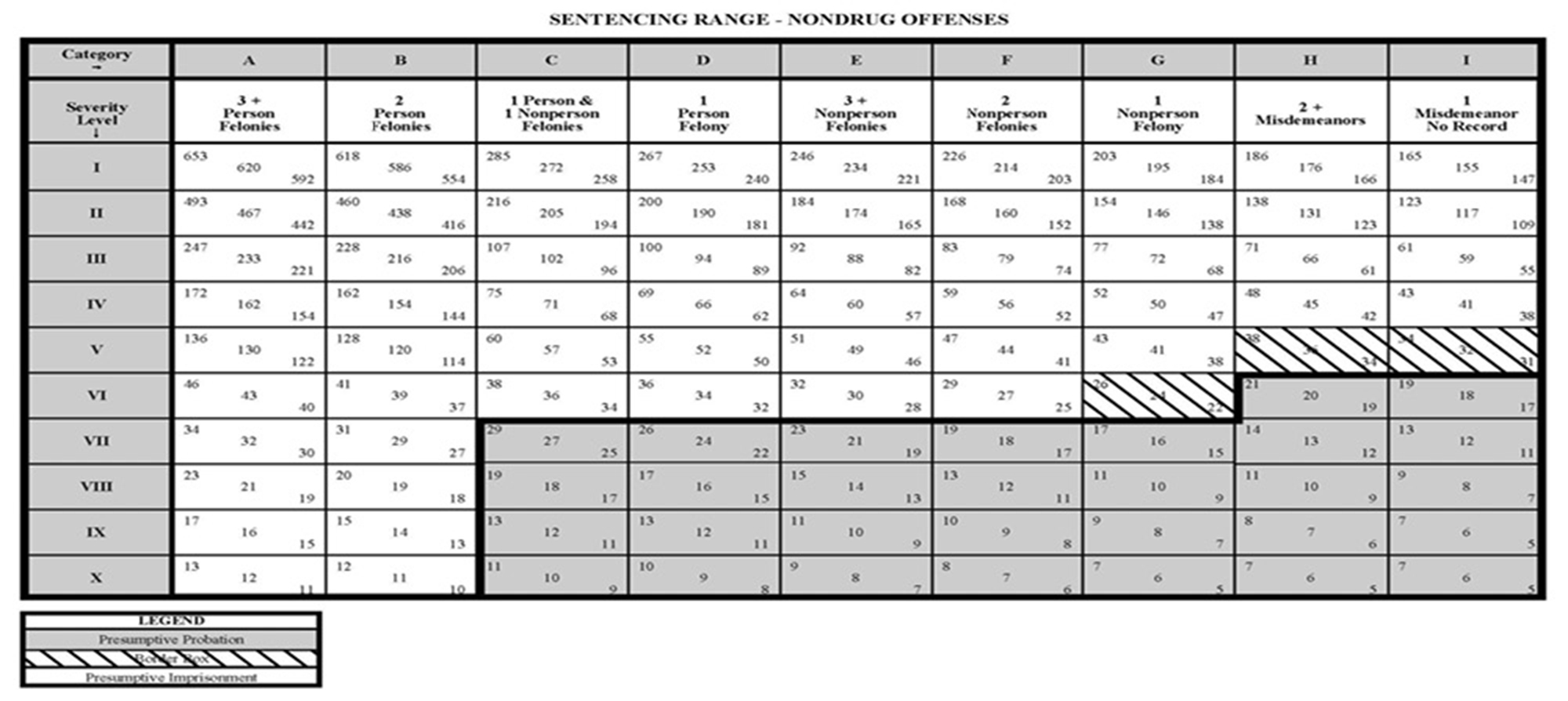
(b) Sentences expressed in the sentencing guidelines grid for nondrug crimes represent months of imprisonment.
(c) The sentencing guidelines grid is a two-dimensional crime severity and criminal history classification tool. The grid’s vertical axis is the crime severity scale which classifies current crimes of conviction. The grid’s horizontal axis is the criminal history scale which classifies criminal histories.
(d) The sentencing guidelines grid for nondrug crimes as provided in this section defines presumptive punishments for felony convictions, subject to the sentencing court’s discretion to enter a departure sentence. The appropriate punishment for a felony conviction should depend on the severity of the crime of conviction when compared to all other crimes and the offender’s criminal history.
(e) (1) The sentencing court has discretion to sentence at any place within the sentencing range. In the usual case it is recommended that the sentencing judge select the center of the range and reserve the upper and lower limits for aggravating and mitigating factors insufficient to warrant a departure.
(2) In presumptive imprisonment cases, the sentencing court shall pronounce the complete sentence which shall include the:
(A) Prison sentence;
(B) maximum potential reduction to such sentence as a result of good time; and
(C) period of postrelease supervision at the sentencing hearing. Failure to pronounce the period of postrelease supervision shall not negate the existence of such period of postrelease supervision.
(3) In presumptive nonprison cases, the sentencing court shall pronounce the:
(A) Prison sentence; and
(B) duration of the nonprison sanction at the sentencing hearing.
(f) Each grid block states the presumptive sentencing range for an offender whose crime of conviction and criminal history place such offender in that grid block. If an offense is classified in a grid block below the dispositional line, the presumptive disposition shall be nonimprisonment. If an offense is classified in a grid block above the dispositional line, the presumptive disposition shall be imprisonment. If an offense is classified in grid blocks 5-H, 5-I or 6-G, the court may impose an optional nonprison sentence as provided in subsection (q).
(g) The sentence for a violation of K.S.A. 21-3415, prior to its repeal, aggravated battery against a law enforcement officer committed prior to July 1, 2006, or a violation of K.S.A. 21-5412(d), and amendments thereto, aggravated assault against a law enforcement officer, which places the defendant’s sentence in grid block 6-H or 6-I shall be presumed imprisonment. The court may impose an optional nonprison sentence as provided in subsection (q).
(h) When a firearm is used to commit any person felony, the offender’s sentence shall be presumed imprisonment. The court may impose an optional nonprison sentence as provided in subsection (q).
(i) (1) The sentence for the violation of the felony provision of K.S.A. 21-5414(c)(1)(C), 21-5823(b)(3) and (b)(4), 21-6412 and 21-6416, and amendments thereto, shall be as provided by the specific mandatory sentencing requirements of that section and shall not be subject to the provisions of this section or K.S.A. 21-6807, and amendments thereto.
(2) If because of the offender’s criminal history classification the offender is subject to presumptive imprisonment or if the judge departs from a presumptive probation sentence and the offender is subject to imprisonment, the provisions of this section and K.S.A. 21-6807, and amendments thereto, shall apply and the offender shall not be subject to the mandatory sentence as provided in K.S.A. 21-5823, and amendments thereto.
(3) Notwithstanding the provisions of any other section, the term of imprisonment imposed for the violation of the felony provision of K.S.A. 21-5414(c)(1)(C), 21-5823(b)(3) and (b)(4), 21-6412 and 21-6416, and amendments thereto, shall not be served in a state facility in the custody of the secretary of corrections. Prior to imposing any sentence pursuant to this subsection, the court may consider assigning the defendant to a house arrest program pursuant to K.S.A. 21-6609, and amendments thereto.
(j) (1) The sentence for any persistent sex offender whose current convicted crime carries a presumptive term of imprisonment shall be double the maximum duration of the presumptive imprisonment term. The sentence for any persistent sex offender whose current conviction carries a presumptive nonprison term shall be presumed imprisonment and shall be double the maximum duration of the presumptive imprisonment term.
(2) Except as otherwise provided in this subsection, as used in this subsection, “persistent sex offender” means a person who:
(A) (i) Has been convicted in this state of a sexually violent crime, as defined in K.S.A. 22-3717, and amendments thereto; and
(ii) at the time of the conviction under clause (i) has at least one conviction for a sexually violent crime, as defined in K.S.A. 22-3717, and amendments thereto, in this state or comparable felony under the laws of another state, the federal government or a foreign government; or
(B) (i) has been convicted of rape, as defined in K.S.A. 21-3502, prior to its repeal, or K.S.A. 21-5503, and amendments thereto; and
(ii) at the time of the conviction under clause (i) has at least one conviction for rape in this state or comparable felony under the laws of another state, the federal government or a foreign government.
(3) Except as provided in subsection (j)(2)(B), the provisions of this subsection shall not apply to any person whose current convicted crime is a severity level 1 or 2 felony.
(k) (1) If it is shown at sentencing that the offender committed any felony violation for the benefit of, at the direction of, or in association with any criminal street gang, with the specific intent to promote, further or assist in any criminal conduct by gang members, the offender’s sentence shall be presumed imprisonment. The court may impose an optional nonprison sentence as provided in subsection (q).
(2) As used in this subsection, “criminal street gang” means any organization, association or group of three or more persons, whether formal or informal, having as one of its primary activities:
(A) The commission of one or more person felonies; or
(B) the commission of felony violations of article 57 of chapter 21 of the Kansas Statutes Annotated, and amendments thereto, K.S.A. 2010 Supp. 21-36a01 through 21-36a17, prior to their transfer, or any felony violation of any provision of the uniform controlled substances act prior to July 1, 2009; and
(C) its members have a common name or common identifying sign or symbol; and
(D) its members, individually or collectively, engage in or have engaged in the commission, attempted commission, conspiracy to commit or solicitation of two or more person felonies or felony violations of article 57 of chapter 21 of the Kansas Statutes Annotated, and amendments thereto, K.S.A. 2010 Supp. 21-36a01 through 21-36a17, prior to their transfer, any felony violation of any provision of the uniform controlled substances act prior to July 1, 2009, or any substantially similar offense from another jurisdiction.
(l) Except as provided in subsection (o), the sentence for a violation of K.S.A. 21-5807(a)(1), and amendments thereto, or any attempt or conspiracy, as defined in K.S.A. 21-5301 and 21-5302, and amendments thereto, to commit such offense, when such person being sentenced has a prior conviction for a violation of K.S.A. 21-3715(a) or (b), prior to its repeal, 21-3716, prior to its repeal, K.S.A. 21-5807(a)(1) or (a)(2) or 21-5807(b), and amendments thereto, or any attempt or conspiracy to commit such offense, shall be presumptive imprisonment.
(m) The sentence for a violation of K.S.A. 22-4903 or K.S.A. 21-5913(a)(2), and amendments thereto, shall be presumptive imprisonment. If an offense under such sections is classified in grid blocks 5-E, 5-F, 5-G, 5-H or 5-I, the court may impose an optional nonprison sentence as provided in subsection (q).
(n) The sentence for a violation of criminal deprivation of property, as defined in K.S.A. 21-5803, and amendments thereto, when such property is a motor vehicle, and when such person being sentenced has any combination of two or more prior convictions of K.S.A. 21-3705(b), prior to its repeal, or of criminal deprivation of property, as defined in K.S.A. 21-5803, and amendments thereto, when such property is a motor vehicle, shall be presumptive imprisonment. Such sentence shall not be considered a departure and shall not be subject to appeal.
(o) (1) The sentence for a felony violation of theft of property as defined in K.S.A. 21-5801, and amendments thereto, or burglary as defined in K.S.A. 21-5807(a), and amendments thereto, when such person being sentenced has no prior convictions for a violation of K.S.A. 21-3701 or 21-3715, prior to their repeal, or theft of property as defined in K.S.A. 21-5801, and amendments thereto, or burglary as defined in K.S.A. 21-5807(a), and amendments thereto; or the sentence for a felony violation of theft of property as defined in K.S.A. 21-5801, and amendments thereto, when such person being sentenced has one or two prior felony convictions for a violation of K.S.A. 21-3701, 21-3715 or 21-3716, prior to their repeal, or theft of property as defined in K.S.A. 21-5801, and amendments thereto, or burglary or aggravated burglary as defined in K.S.A. 21-5807, and amendments thereto; or the sentence for a felony violation of burglary as defined in K.S.A. 21-5807(a), and amendments thereto, when such person being sentenced has one prior felony conviction for a violation of K.S.A. 21-3701, 21-3715 or 21-3716, prior to their repeal, or theft of property as defined in K.S.A. 21-5801, and amendments thereto, or burglary or aggravated burglary as defined in K.S.A. 21-5807, and amendments thereto, shall be the sentence as provided by this section, except that the court may order an optional nonprison sentence for a defendant to participate in a drug treatment program, including, but not limited to, an approved aftercare plan, if the court makes the following findings on the record:
(A) Substance abuse was an underlying factor in the commission of the crime;
(B) substance abuse treatment in the community is likely to be more effective than a prison term in reducing the risk of offender recidivism; and
(C) participation in an intensive substance abuse treatment program will serve community safety interests.
(2) A defendant sentenced to an optional nonprison sentence under this subsection shall be supervised by community correctional services. The provisions of K.S.A. 21-6824(f)(1), and amendments thereto, shall apply to a defendant sentenced under this subsection. The sentence under this subsection shall not be considered a departure and shall not be subject to appeal.
(p) (1) The sentence for a felony violation of theft of property as defined in K.S.A. 21-5801, and amendments thereto, when such person being sentenced has any combination of three or more prior felony convictions for violations of K.S.A. 21-3701, 21-3715 or 21-3716, prior to their repeal, or theft of property as defined in K.S.A. 21-5801, and amendments thereto, or burglary or aggravated burglary as defined in K.S.A. 21-5807, and amendments thereto; or the sentence for a violation of burglary as defined in K.S.A. 21-5807(a), and amendments thereto, when such person being sentenced has any combination of two or more prior convictions for violations of K.S.A. 21-3701, 21-3715 and 21-3716, prior to their repeal, or theft of property as defined in K.S.A. 21-5801, and amendments thereto, or burglary or aggravated burglary as defined in K.S.A. 21-5807, and amendments thereto, shall be presumed imprisonment and the defendant shall be sentenced to prison as provided by this section, except that the court may recommend that an offender be placed in the custody of the secretary of corrections, in a facility designated by the secretary to participate in an intensive substance abuse treatment program, upon making the following findings on the record:
(A) Substance abuse was an underlying factor in the commission of the crime;
(B) substance abuse treatment with a possibility of an early release from imprisonment is likely to be more effective than a prison term in reducing the risk of offender recidivism; and
(C) participation in an intensive substance abuse treatment program with the possibility of an early release from imprisonment will serve community safety interests by promoting offender reformation.
(2) The intensive substance abuse treatment program shall be determined by the secretary of corrections, but shall be for a period of at least four months. Upon the successful completion of such intensive treatment program, the offender shall be returned to the court and the court may modify the sentence by directing that a less severe penalty be imposed in lieu of that originally adjudged within statutory limits. If the offender’s term of imprisonment expires, the offender shall be placed under the applicable period of postrelease supervision. The sentence under this subsection shall not be considered a departure and shall not be subject to appeal.
(q) (1) As used in this section, an “optional nonprison sentence” is a sentence which the court may impose, in lieu of the presumptive sentence, upon making the following findings on the record:
(A) An appropriate treatment program exists which is likely to be more effective than the presumptive prison term in reducing the risk of offender recidivism; and
(B) the recommended treatment program is available and the offender can be admitted to such program within a reasonable period of time; or
(C) the nonprison sanction will serve community safety interests by promoting offender reformation.
(2) Any decision made by the court regarding the imposition of an optional nonprison sentence shall not be considered a departure and shall not be subject to appeal.
(r) The sentence for a violation of K.S.A. 21-5413(c)(2), and amendments thereto, shall be presumptive imprisonment and shall be served consecutively to any other term or terms of imprisonment imposed. Such sentence shall not be considered a departure and shall not be subject to appeal.
(s) The sentence for a violation of K.S.A. 21-5512, and amendments thereto, shall be presumptive imprisonment. Such sentence shall not be considered a departure and shall not be subject to appeal.
(t) (1) If the trier of fact makes a finding beyond a reasonable doubt that an offender wore or used ballistic resistant material in the commission of, or attempt to commit, or flight from any felony, in addition to the sentence imposed pursuant to the Kansas sentencing guidelines act, the offender shall be sentenced to an additional 30 months’ imprisonment.
(2) The sentence imposed pursuant to paragraph (1) shall be presumptive imprisonment and shall be served consecutively to any other term or terms of imprisonment imposed. Such sentence shall not be considered a departure and shall not be subject to appeal.
(3) As used in this subsection, “ballistic resistant material” means any:
(A) Commercially produced material designed with the purpose of providing ballistic and trauma protection, including, but not limited to, bulletproof vests and kevlar vests; and
(B) homemade or fabricated substance or item designed with the purpose of providing ballistic and trauma protection.
(u) The sentence for a violation of K.S.A. 21-6107, and amendments thereto, or any attempt or conspiracy, as defined in K.S.A. 21-5301 and 21-5302, and amendments thereto, to commit such offense, when such person being sentenced has a prior conviction for a violation of K.S.A. 21-4018, prior to its repeal, or K.S.A. 21-6107, and amendments thereto, or any attempt or conspiracy to commit such offense, shall be presumptive imprisonment. Such sentence shall not be considered a departure and shall not be subject to appeal.
(v) The sentence for a third or subsequent violation of K.S.A. 8-1568, and amendments thereto, shall be presumptive imprisonment and shall be served consecutively to any other term or terms of imprisonment imposed. Such sentence shall not be considered a departure and shall not be subject to appeal.
(w) The sentence for aggravated criminal damage to property as defined in K.S.A. 21-5813(b), and amendments thereto, when such person being sentenced has a prior conviction for any nonperson felony shall be presumptive imprisonment. Such sentence shall not be considered a departure and shall not be subject to appeal.
(x) The sentence for a violation of K.S.A. 21-5807(a)(1), and amendments thereto, shall be presumptive imprisonment if the offense under such paragraph is classified in grid blocks 7-C, 7-D or 7-E. Such sentence shall not be considered a departure and shall not be subject to appeal.
(y) (1) Except as provided in paragraph (3), if the trier of fact makes a finding beyond a reasonable doubt that an offender committed a nondrug felony offense, or any attempt or conspiracy, as defined in K.S.A. 21-5301 and 21-5302, and amendments thereto, to commit a nondrug felony offense, against a law enforcement officer, as defined in K.S.A. 21-5111(p)(1) and (3), and amendments thereto, while such officer was engaged in the performance of such officer’s duty, or in whole or in any part because of such officer’s status as a law enforcement officer, the sentence for such offense shall be:
(A) If such offense is classified in severity level 2 through 10, one severity level above the appropriate level for such offense; and
(B) (i) if such offense is classified in severity level 1, except as otherwise provided in clause (ii), imprisonment for life, and such offender shall not be eligible for probation or suspension, modification or reduction of sentence. In addition, such offender shall not be eligible for parole prior to serving 25 years’ imprisonment, and such 25 years’ imprisonment shall not be reduced by the application of good time credits. No other sentence shall be permitted.
(ii) The provisions of clause (i) requiring the court to impose a mandatory minimum term of imprisonment of 25 years shall not apply if the court finds the offender, because of the offender’s criminal history classification, is subject to presumptive imprisonment and the sentencing range exceeds 300 months. In such case, the offender is required to serve a mandatory minimum term equal to the sentence established pursuant to the sentencing range.
(2) The sentence imposed pursuant to paragraph (1) shall not be considered a departure and shall not be subject to appeal.
(3) The provisions of this subsection shall not apply to an offense described in paragraph (1) if the factual aspect concerning a law enforcement officer is a statutory element of such offense.
(z) (1) Notwithstanding K.S.A. 21-5109(b)(2), and amendments thereto, or any other provision of law to the contrary, the sentence for a violation of criminal possession of a weapon by a convicted felon as defined in K.S.A. 21-6304, and amendments thereto, shall be presumptive imprisonment and shall be served consecutively to any other term or terms of imprisonment imposed if the trier of fact makes a finding beyond a reasonable doubt that:
(A) The weapon the offender possessed during such violation was a firearm; and
(B) such firearm was used by the offender during the commission of any violent felony.
(2) The sentence imposed pursuant to paragraph (1) shall not be considered a departure and shall not be subject to appeal. No other sentence shall be permitted.
(3) The provisions of this subsection shall not apply to an offender who is prohibited from possessing a weapon pursuant to K.S.A. 21-6304, and amendments thereto, as a result of a juvenile adjudication.
(4) As used in this subsection, “violent felony” means any of the following:
(A) Capital murder, as defined in K.S.A. 21-5401, and amendments thereto;
(B) murder in the first degree, as defined in K.S.A. 21-5402, and amendments thereto;
(C) murder in the second degree, as defined in K.S.A. 21-5403, and amendments thereto;
(D) voluntary manslaughter, as defined in K.S.A. 21-5404, and amendments thereto;
(E) kidnapping, as defined in K.S.A. 21-5408(a)(1), and amendments thereto, or aggravated kidnapping, as defined in K.S.A. 21-5408(b), and amendments thereto;
(F) aggravated assault, as defined in K.S.A. 21-5412(b)(1), and amendments thereto, and aggravated assault of a law enforcement officer, as defined in K.S.A. 21-5412(d)(1), and amendments thereto;
(G) aggravated battery, as defined in K.S.A. 21-5413(b)(1)(A) or (b)(1)(B), and amendments thereto, and aggravated battery against a law enforcement officer, as defined in K.S.A. 21-5413(d)(1) or (d)(2), and amendments thereto;
(H) mistreatment of a dependent adult or mistreatment of an elder person, as defined in K.S.A. 21-5417(a)(1), and amendments thereto;
(I) rape, as defined in K.S.A. 21-5503, and amendments thereto;
(J) aggravated criminal sodomy, as defined in K.S.A. 21-5504(b), and amendments thereto;
(K) abuse of a child, as defined in K.S.A. 21-5602(a)(1) or (a)(3), and amendments thereto;
(L) any felony offense described in K.S.A. 21-5703 or 21-5705, and amendments thereto;
(M) treason, as defined in K.S.A. 21-5901, and amendments thereto;
(N) criminal discharge of a firearm, as defined in K.S.A. 21-6308(a)(1), and amendments thereto;
(O) fleeing or attempting to elude a police officer, as defined in K.S.A. 8-1568(b), and amendments thereto;
(P) any felony that includes the domestic violence designation pursuant to K.S.A. 22-4616, and amendments thereto; or
(Q) any attempt, conspiracy or criminal solicitation, as defined in K.S.A. 21-5301, 21-5302 and 21-5303, and amendments thereto, of any felony offense defined in this subsection.
(aa) (1) The sentence for a violation of K.S.A. 21-6308(a)(1)(A) or (a)(1)(B), and amendments thereto, if the trier of fact makes a finding beyond a reasonable doubt that the offender discharged a firearm and that the offender knew or reasonably should have known that:
(A) A person was present in the dwelling, building, structure or motor vehicle at which the offender discharged a firearm, shall be presumptive imprisonment and, in addition to the sentence imposed pursuant to the Kansas sentencing guidelines act, the offender shall be sentenced to an additional 60 months of imprisonment; and
(B) a person less than 14 years of age was present in the dwelling, building, structure or motor vehicle at which the offender discharged a firearm, shall be presumptive imprisonment and, in addition to the sentence imposed pursuant to the Kansas sentencing guidelines act, the offender shall be sentenced to an additional 120 months of imprisonment.
(2) The sentence imposed pursuant to paragraph (1) shall be served consecutively to any other term or terms of imprisonment imposed. Such sentence shall not be considered a departure and shall not be subject to appeal.
(bb) (1) If the trier of fact makes a finding beyond a reasonable doubt that an offender committed any act described in K.S.A. 21-5408, 21-5409, 21-5411, 21-5412, 21-5413, 21-5414, 21-5415, 21-5426, 21-5427, 21-5428, 21-5429, 21-5503, 21-5504, 21-5505, 21-5506, 21-5507, 21-5508, 21-5509, 21-5510, 21-5515, 21-5601, 21-5602, 21-5604 or 21-5605, and amendments thereto, or any attempt or conspiracy, as defined in K.S.A. 21-5301 and 21-5302, and amendments thereto, to commit any such act with knowledge that a woman is pregnant and with the intent that such act will compel such woman to obtain an abortion when such woman has expressed her desire to not obtain an abortion, the sentence for such offense shall be:
(A) If such offense is classified in severity level 2 through 10, one severity level above the appropriate level for such offense; and
(B) (i) if such offense is classified in severity level 1, except as otherwise provided in clause (ii), imprisonment for life, and such offender shall not be eligible for probation or suspension, modification or reduction of sentence. In addition, such offender shall not be eligible for parole prior to serving 25 years’ imprisonment, and such 25 years’ imprisonment shall not be reduced by the application of good time credits. No other sentence shall be permitted.
(ii) The provisions of clause (i) requiring the court to impose a mandatory minimum term of imprisonment of 25 years shall not apply if the court finds the offender, because of the offender’s criminal history classification, is subject to presumptive imprisonment and the sentencing range exceeds 300 months. In such case, the offender is required to serve a mandatory minimum term equal to the sentence established pursuant to the sentencing range.
(2) The sentence imposed pursuant to paragraph (1) shall not be considered a departure and shall not be subject to appeal.
(cc) (1) If the trier of fact makes a finding beyond a reasonable doubt that an offender committed any offense or any attempt or conspiracy as defined in K.S.A. 21-5301 and 21-5302, and amendments thereto, to commit any offense with the intent to commit transnational repression as described in section 1(d), and amendments thereto, the sentence for such offense shall be:
(A) If such offense is classified in severity level 2 through 10, one severity level above the appropriate level for such offense; and
(B) (i) if such offense is classified in severity level 1, except as otherwise provided in clause (ii), imprisonment for life, and such offender shall not be eligible for probation or suspension, modification or reduction of sentence. In addition, such offender shall not be eligible for parole prior to serving 25 years’ imprisonment, and such 25 years’ imprisonment shall not be reduced by the application of good time credits. No other sentence shall be permitted.
(ii) The provisions of clause (i) requiring the court to impose a mandatory minimum term of imprisonment of 25 years shall not apply if the court finds the offender, because of the offender’s criminal history classification, is subject to presumptive imprisonment and the sentencing range exceeds 300 months. In such case, the offender is required to serve a mandatory minimum term equal to the sentence established pursuant to the sentencing range.
(2) The sentence imposed pursuant to paragraph (1) shall not be considered a departure and shall not be subject to appeal.
Sec. 5. K.S.A. 22-4807a is hereby amended to read as follows: 22-4807a. (a) The following property is subject to forfeiture pursuant to this act:
(1) Contraband property used or intended to be used in the commission of theft of livestock or an implement of husbandry;
(2) the proceeds gained from the commission of theft of livestock or an implement of husbandry;
(3) personal property acquired with proceeds gained from the commission of theft of livestock or an implement of husbandry;
(4) all conveyances, including aircraft, vehicles, vessels, or horses or dogs which that are used or intended for the use to transport or in any manner to facilitate the transportation for the purpose of the commission of theft of livestock or an implement of husbandry. No conveyance used by any person as a common carrier in the transportation of business as a common carrier is subject to forfeiture under this section unless it appears that the owner or other person in charge of the conveyance is a consenting party or privy to a violation of this act. No conveyance is subject to forfeiture under this section by reason of any act or omission established by the owners thereof to have been committed or omitted without the owners knowledge or consent. A forfeiture of a conveyance encumbered by a bona fide security interest is subject to the interest of the secured party or parties;
(5) all books, records and research products and materials including microfilm, tapes and data which, whether in a physical or electronic format, that are used or intended for the use in the theft of livestock or an implement of husbandry;
(6) everything of value furnished, or intended to be furnished or traded or used as payment or invested for anything of value but shall not include real property. It may be presumed that this the property was acquired with proceeds gained from the commission of theft of livestock or an implement of husbandry and are subject to forfeiture.
(b) Property which that is used in the commission of theft of livestock which or an implement of husbandry that has title of ownership with two parties on the title or a cosigner is subject to forfeiture, if one party on the title uses the property in the commission of theft of livestock or an implement of husbandry or receives titled property as the proceeds of such felony even if the second party claims that such second party did not have knowledge or involvement in such felony.
(c) As used in this act:
(1) “Contraband property” means property of any nature including personal, tangible or intangible but shall does not include real property.
(2) “Implement of husbandry” means the same as defined in K.S.A. 8-126, and amendments thereto.
(3) “Livestock” means cattle, swine, sheep, goats, or horses, mules, domesticated deer and all creatures of the ratite family that are not indigenous to this state, including, but not limited to, ostriches, emus and rheas, and any carcass, skin or part of such animal.
(3)(4) “Theft of livestock” means theft which is classified as a felony violation, pursuant to the same as defined in K.S.A. 21-5801, and amendments thereto, in which the property taken was livestock.
(4) “Domesticated deer” means any member of the family cervidae which was legally obtained and is being sold or raised in a confined area for breeding stock; for any carcass, skin or part of such animal; for exhibition; or for companionship.
Sec. 6. K.S.A. 21-5801, 21-6412 and 22-4807a and K.S.A. 2025 Supp. 21-6804 are hereby repealed.
Sec. 7. This act shall take effect and be in force from and after its publication in the statute book.
Approved April 9, 2026.